
GODS ❤️ LOVE JOHN 3:16
ERA VII — THE DIGITAL REPUBLIC
1991–2026 · AMERICA: 1776 TILL PRESENT™ — A Vision Book of the Republic
ETERNITY VISIONS™ · Following the Bible's lead in presentation — the texts exact, the scenes alive
The web, the smartphone, a wound on a September morning, wars in the desert and the mountains, a pandemic, and an argument conducted at the speed of light — the era we are still living. Its verbatim shelf is the federal record itself: the Court’s words and the people’s statutes, the lawful texts of a digital age. It closes on the Fourth of July, 2026 — the Republic’s 250th birthday, and this book’s reason for existing.
🎬 LIVING PLATE — MEMORIAL AT DUSK, LOWER MANHATTAN · At dusk in Lower Manhattan, water falls into the twin voids of the 9/11 Memorial pools where the towers once stood, as a lone visitor stands in the last light before the rebuilt skyline.
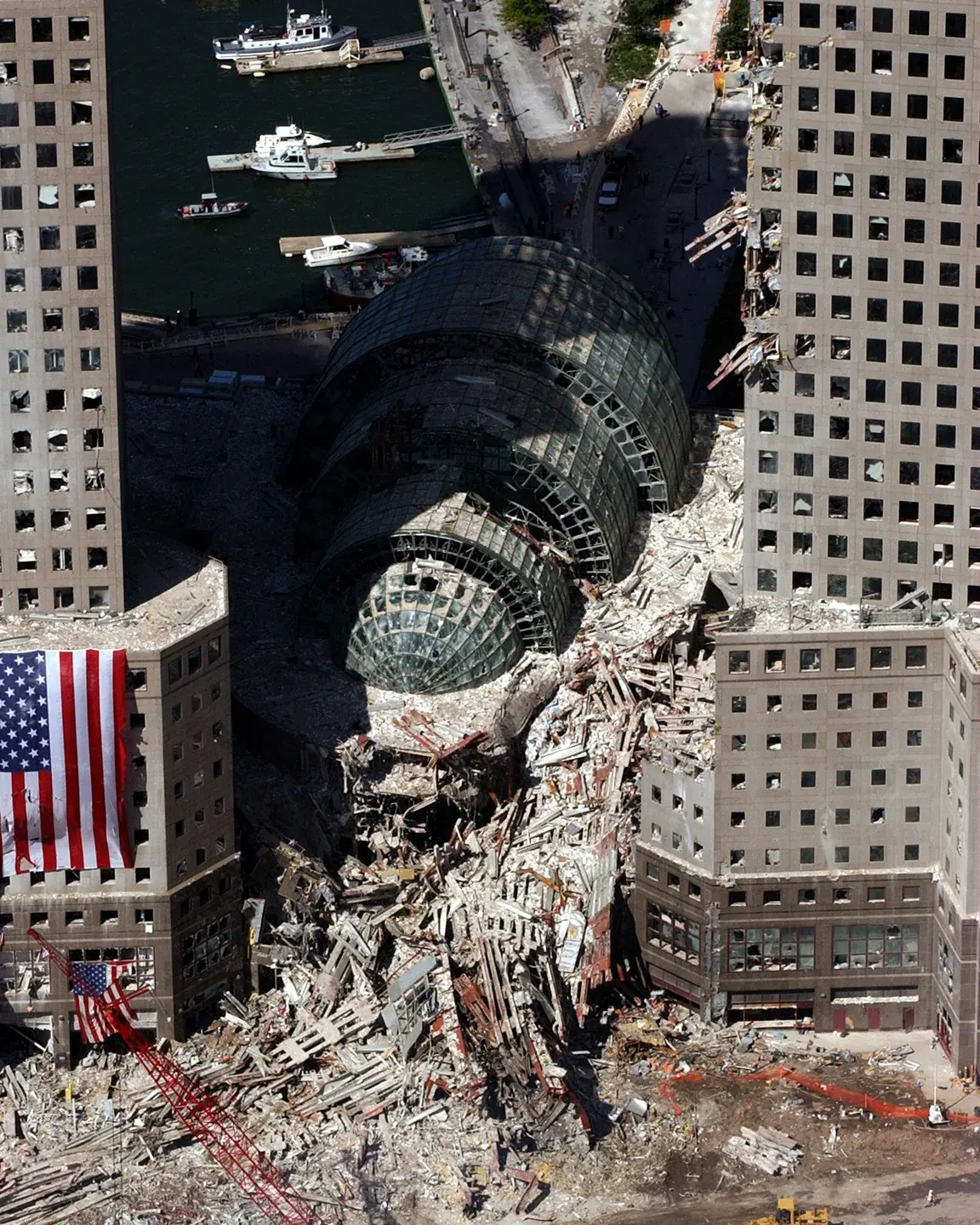
📷 THE PERIOD’S OWN WITNESS — GROUND ZERO, SEPTEMBER 17, 2001 · Aerial view of Ground Zero, New York City, September 17, 2001 — a portion of the site where the World Trade Center collapsed following the September 11 terrorist attack, with surrounding buildings heavily damaged; U.S. Navy photograph.
Explicit federal authorship on the file page: "U.S. Navy photo by Chief Photographer's Mate Eric J. Tilford" (source: navy.mil); file page licensing: "This image is a work of a sailor or employee of the U.S. Navy, taken or made during the course of the person's official duties. As a work of the U.S. federal government, the image is in the public domain"

🖼️ VIDEO CALL — GRANDMOTHER AND GRANDCHILD · In evening kitchen light, a grandmother smiles at a laptop as her grandchild's face glows on the screen an ocean away — the digital republic at kitchen-table scale, with a map and photographs on the wall behind her.
OBERGEFELL et al. v. HODGES, DIRECTOR, OHIO DEPARTMENT OF HEALTH certiorari to the united states court of appeals for the sixth circuit No. 14–556. Argued April 28, 2015—Decided June 26, 2015*
*Together with No. 14–562, Tanco et al. v. Haslam, Governor of Tennessee, et al., No. 14–571, DeBoer et al. v. Snyder, Governor of Michigan, et al., and No. 14–574, Bourke et al. v. Beshear, Governor of Kentucky, also on certiorari to the same court.
Michigan, Kentucky, Ohio, and Tennessee define marriage as a union between one man and one woman. The petitioners, 14 same-sex couples and two men whose same-sex partners are deceased, filed suits in Federal District Courts in their home States, claiming that respondent state officials violate the Fourteenth Amendment by denying them the right to marry or to have marriages lawfully performed in another State given full recognition. Each District Court ruled in the petitioners' favor, but the Sixth Circuit consolidated the cases and reversed.
Held: The Fourteenth Amendment requires a State to license a marriage between two people of the same sex and to recognize a marriage between two people of the same sex when their marriage was lawfully licensed and performed out of State. Pp. 656–681.
(a) Before turning to the governing principles and precedents, it is appropriate to note the history of the subject now before the Court. Pp. 656–663.
(1) The history of marriage as a union between two persons of the opposite sex marks the beginning of these cases. To the respondents, it would demean a timeless institution if marriage were extended to same-sex couples. But the petitioners, far from seeking to devalue marriage, seek it for themselves because of their respect—and need—for its privileges and responsibilities, as illustrated by the petitioners' own experiences. Pp. 656–659.
(2) The history of marriage is one of both continuity and change. Changes, such as the decline of arranged marriages and the abandonment of the law of coverture, have worked deep transformations in the structure of marriage, affecting aspects of marriage once viewed as essential. These new insights have strengthened, not weakened, the institution. Changed understandings of marriage are characteristic of a Nation where new dimensions of freedom become apparent to new generations.
This dynamic can be seen in the Nation's experience with gay and lesbian rights. Well into the 20th century, many States condemned same-sex intimacy as immoral, and homosexuality was treated as an illness. Later in the century, cultural and political developments allowed same-sex couples to lead more open and public lives. Extensive public and private dialogue followed, along with shifts in public attitudes. Questions about the legal treatment of gays and lesbians soon reached the courts, where they could be discussed in the formal discourse of the law. In 2003, this Court overruled its 1986 decision in Bowers v. Hardwick, 478 U. S. 186, which upheld a Georgia law that criminalized certain homosexual acts, concluding laws making same-sex intimacy a crime “demea[n] the lives of homosexual persons.” Lawrence v. Texas, 539 U. S. 558, 575. In 2013, the federal Defense of Marriage Act was also struck down. United States v. Windsor, 570 U. S. 744. Numerous same-sex marriage cases reaching the federal courts and state supreme courts have added to the dialogue. Pp. 659–663.
(b) The Fourteenth Amendment requires a State to license a marriage between two people of the same sex. Pp. 663–680.
(1) The fundamental liberties protected by the Fourteenth Amendment's Due Process Clause extend to certain personal choices central to individual dignity and autonomy, including intimate choices defining personal identity and beliefs. See, e. g., Eisenstadt v. Baird, 405 U. S. 438, 453; Griswold v. Connecticut, 381 U. S. 479, 484–486. Courts must exercise reasoned judgment in identifying interests of the person so fundamental that the State must accord them its respect. History and tradition guide and discipline the inquiry but do not set its outer boundaries. When new insight reveals discord between the Constitution's central protections and a received legal stricture, a claim to liberty must be addressed.
Applying these tenets, the Court has long held the right to marry is protected by the Constitution. For example, Loving v. Virginia, 388 U. S. 1, 12, invalidated bans on interracial unions, and Turner v. Safley, 482 U. S. 78, 95, held that prisoners could not be denied the right to marry. To be sure, these cases presumed a relationship involving opposite-sex partners, as did Baker v. Nelson, 409 U. S. 810, a one-line summary decision issued in 1972, holding that the exclusion of same-sex couples from marriage did not present a substantial federal question. But other, more instructive precedents have expressed broader principles. See, e. g., Lawrence, supra, at 574. In assessing whether the force and rationale of its cases apply to same-sex couples, the Court must respect the basic reasons why the right to marry has been long protected. See, e. g., Eisenstadt, supra, at 453–454. This analysis compels the conclusion that same-sex couples may exercise the right to marry. Pp. 663–665.
(2) Four principles and traditions demonstrate that the reasons marriage is fundamental under the Constitution apply with equal force to same-sex couples. The first premise of this Court's relevant precedents is that the right to personal choice regarding marriage is inherent in the concept of individual autonomy. This abiding connection between marriage and liberty is why Loving invalidated interracial marriage bans under the Due Process Clause. See 388 U. S., at 12. Decisions about marriage are among the most intimate that an individual can make. See Lawrence, supra, at 574. This is true for all persons, whatever their sexual orientation.
A second principle in this Court's jurisprudence is that the right to marry is fundamental because it supports a two-person union unlike any other in its importance to the committed individuals. The intimate association protected by this right was central to Griswold v. Connecticut, which held the Constitution protects the right of married couples to use contraception, 381 U. S., at 485, and was acknowledged in Turner, supra, at 95. Same-sex couples have the same right as opposite-sex couples to enjoy intimate association, a right extending beyond mere freedom from laws making same-sex intimacy a criminal offense. See Lawrence, supra, at 567.
A third basis for protecting the right to marry is that it safeguards children and families and thus draws meaning from related rights of childrearing, procreation, and education. See, e. g., Pierce v. Society of Sisters, 268 U. S. 510. Without the recognition, stability, and predictability marriage offers, children suffer the stigma of knowing their families are somehow lesser. They also suffer the significant material costs of being raised by unmarried parents, relegated to a more difficult and uncertain family life. The marriage laws at issue thus harm and humiliate the children of same-sex couples. See Windsor, supra, at 772. This does not mean that the right to marry is less meaningful for those who do not or cannot have children. Precedent protects the right of a married couple not to procreate, so the right to marry cannot be conditioned on the capacity or commitment to procreate.
Finally, this Court's cases and the Nation's traditions make clear that marriage is a keystone of the Nation's social order. See Maynard v. Hill, 125 U. S. 190, 211. States have contributed to the fundamental character of marriage by placing it at the center of many facets of the legal and social order. There is no difference between same- and opposite-sex couples with respect to this principle, yet same-sex couples are denied the constellation of benefits that the States have linked to marriage and are consigned to an instability many opposite-sex couples would find intolerable. It is demeaning to lock same-sex couples out of a central institution of the Nation's society, for they too may aspire to the transcendent purposes of marriage.
The limitation of marriage to opposite-sex couples may long have seemed natural and just, but its inconsistency with the central meaning of the fundamental right to marry is now manifest. Pp. 665–671.
(3) The right of same-sex couples to marry is also derived from the Fourteenth Amendment's guarantee of equal protection. The Due Process Clause and the Equal Protection Clause are connected in a profound way. Rights implicit in liberty and rights secured by equal protection may rest on different precepts and are not always co-extensive, yet each may be instructive as to the meaning and reach of the other. This dynamic is reflected in Loving, where the Court invoked both the Equal Protection Clause and the Due Process Clause; and in Zablocki v. Redhail, 434 U. S. 374, where the Court invalidated a law barring fathers delinquent on child-support payments from marrying. Indeed, recognizing that new insights and societal understandings can reveal unjustified inequality within fundamental institutions that once passed unnoticed and unchallenged, this Court has invoked equal protection principles to invalidate laws imposing sex-based inequality on marriage, see, e. g., Kirchberg v. Feenstra, 450 U. S. 455, 460–461, and confirmed the relation between liberty and equality, see, e. g., M. L. B. v. S. L. J., 519 U. S. 102, 120–121.
The Court has acknowledged the interlocking nature of these constitutional safeguards in the context of the legal treatment of gays and lesbians. See Lawrence, supra, at 575. This dynamic also applies to same-sex marriage. The challenged laws burden the liberty of same-sex couples, and they abridge central precepts of equality. The marriage laws at issue are in essence unequal: Same-sex couples are denied benefits afforded opposite-sex couples and are barred from exercising a fundamental right. Especially against a long history of disapproval of their relationships, this denial works a grave and continuing harm, serving to disrespect and subordinate gays and lesbians. Pp. 671–675.
(4) The right to marry is a fundamental right inherent in the liberty of the person, and under the Due Process and Equal Protection Clauses of the Fourteenth Amendment couples of the same sex may not be deprived of that right and that liberty. Same-sex couples may exercise the fundamental right to marry. Baker v. Nelson is overruled. The state laws challenged by the petitioners in these cases are held invalid to the extent they exclude same-sex couples from civil marriage on the same terms and conditions as opposite-sex couples. Pp. 675–676.
(5) There may be an initial inclination to await further legislation, litigation, and debate, but referenda, legislative debates, and grassroots campaigns; studies and other writings; and extensive litigation in state and federal courts have led to an enhanced understanding of the issue. While the Constitution contemplates that democracy is the appropriate process for change, individuals who are harmed need not await legislative action before asserting a fundamental right. Bowers, in effect, upheld state action that denied gays and lesbians a fundamental right. Though it was eventually repudiated, men and women suffered pain and humiliation in the interim, and the effects of these injuries no doubt lingered long after Bowers was overruled. A ruling against same-sex couples would have the same effect and would be unjustified under the Fourteenth Amendment. The petitioners' stories show the urgency of the issue they present to the Court, which has a duty to address these claims and answer these questions. The respondents' argument that allowing same-sex couples to wed will harm marriage as an institution rests on a counterintuitive view of opposite-sex couples' decisions about marriage and parenthood. Finally, the First Amendment ensures that religions, those who adhere to religious doctrines, and others have protection as they seek to teach the principles that are so fulfilling and so central to their lives and faiths. Pp. 676–680.
(c) The Fourteenth Amendment requires States to recognize same-sex marriages validly performed out of State. Since same-sex couples may now exercise the fundamental right to marry in all States, there is no lawful basis for a State to refuse to recognize a lawful same-sex marriage performed in another State on the ground of its same-sex character. Pp. 680–681.
772 F. 3d 388, reversed.
OBERGEFELL v. HODGES, 576 U.S. 644 (2015), syllabus — a federal work, public domain.
© 2026 Eternity Gravestones LLC — this edition’s presentation only. All Rights Reserved.
Carried here: Sections 1-5 entire of Public Law 114-196, the United States Semiquincentennial Commission Act of 2016 (130 Stat. 685) — short title, findings and purpose, definitions, establishment of the Commission, and duties — with the Act's preamble. The full enrolled text (Sections 1-10) stands at the source, govinfo (U.S. Government Publishing Office).
Public Law 114-196 114th Congress
An Act
To establish the United States Semiquincentennial Commission, and for other purposes. Be it enacted by the Senate and House of Representatives of the United States of America in Congress assembled,
This Act may be cited as the “United States Semiquincentennial Commission Act of 2016”.
(a) Findings.--Congress finds that July 4, 2026, the 250th anniversary of the founding of the United States, as marked by the Declaration of Independence in 1776, and the historic events preceding that anniversary-- (1) are of major significance in the development of the national heritage of the United States of individual liberty, representative government, and the attainment of equal and inalienable rights; and (2) have had a profound influence throughout the world.
(b) Purpose.--The purpose of this Act is to establish a Commission to provide for the observance and commemoration of the 250th anniversary of the founding of the United States and related events through local, State, national, and international activities planned, encouraged, developed, and coordinated by a national commission representative of appropriate public and private authorities and organizations.
In this Act: (1) Commission.--The term “Commission” means the United States Semiquincentennial Commission established by section 4(a). (2) Private citizen.--The term “private citizen” means an individual who is not an officer or employee of-- (A) the Federal Government; or (B) a State or local government. (3) Secretary.--The term “Secretary” means the Secretary of the Interior.
(a) In General.--There is established a commission, to be known as the “United States Semiquincentennial Commission”, to plan, encourage, develop, and coordinate the commemoration of the history of the United States leading up to the 250th anniversary of the founding of the United States.
(b) Composition.--The Commission shall be composed of the following members: (1) Four members of the Senate, of whom-- (A) two shall be appointed by the majority leader of the Senate; and (B) two shall be appointed by the minority leader of the Senate. (2) Four members of the House of Representatives, of whom-- (A) two shall be appointed by the Speaker of the House of Representatives; and (B) two shall be appointed by the minority leader of the House of Representatives. (3) Sixteen members who are private citizens, of whom-- (A) four shall be appointed by the majority leader of the Senate; (B) four shall be appointed by the minority leader of the Senate; (C) four shall be appointed by the Speaker of the House of Representatives; (D) four shall be appointed by the minority leader of the House of Representatives; and (E) one of whom shall be designated by the President as the Chairperson. (4) The following nonvoting ex officio members: (A) The Secretary. (B) The Secretary of State. (C) The Attorney General. (D) The Secretary of Defense. (E) The Secretary of Education. (F) The Librarian of Congress. (G) The Secretary of the Smithsonian Institution. (H) The Archivist of the United States. (I) The presiding officer of the Federal Council on the Arts and the Humanities.
(c) Term; Vacancies.-- (1) Term.--A member shall be appointed for the life of the Commission. (2) Vacancies.--A vacancy on the Commission-- (A) shall not affect the powers of the Commission; and (B) shall be filled in the same manner as the original appointment was made.
(d) Meetings.--All meetings of the Commission shall be convened at Independence Hall in Philadelphia, Pennsylvania, to honor the historical significance of the building as the site of deliberations and adoption of both the United States Declaration of Independence and Constitution.
(e) Quorum.--A majority of the members of the Commission shall constitute a quorum, but a lesser number of members may hold hearings.
(a) In General.--The Commission shall-- (1) prepare an overall program for commemorating the 250th anniversary of the founding of the United States and the historic events preceding that anniversary; and
(2) plan, encourage, develop, and coordinate observances and activities commemorating the historic events that preceded, and are associated with, the United States Semiquincentennial.
(b) Requirements.-- (1) In general.--In preparing plans and an overall program, the Commission-- (A) shall give due consideration to any related plans and programs developed by State, local, and private groups; and (B) may designate special committees with representatives from groups described in subparagraph (A) to plan, develop, and coordinate specific activities. (2) Emphasis.--The Commission shall-- (A) emphasize the planning of events in locations of historical significance to the United States, especially in those locations that witnessed the assertion of American liberty, such as-- (i) the 13 colonies; and (ii) leading cities, including Boston, Charleston, New York City, and Philadelphia; and (B) give special emphasis to-- (i) the role of persons and locations with significant impact on the history of the United States during the 250-year period beginning on the date of execution of the Declaration of Independence; and (ii) the ideas associated with that history, which have been so important in the development of the United States, in world affairs, and in the quest for freedom of all mankind. (3) Infrastructure.--The Commission shall-- (A) evaluate existing infrastructure; (B) include in the report required under subsection (c) recommendations for what infrastructure should be in place for the successful undertaking of an appropriate celebration in accordance with this Act; and (C) coordinate with State and local bodies to make necessary infrastructure improvements.
(c) Report Submitted to the President.-- (1) In general.--Not later than 2 years after the date of enactment of this Act, the Commission shall submit to the President a comprehensive report that includes the specific recommendations of the Commission for the commemoration of the 250th anniversary and related events. (2) Recommended activities.--The report may include recommended activities such as-- (A) the production, publication, and distribution of books, pamphlets, films, and other educational materials focusing on the history, culture, and political thought of the period of the American Revolution; (B) bibliographical and documentary projects and publications; (C) conferences, convocations, lectures, seminars, and other programs, especially those located in the 13 colonies, including the major cities and buildings of national historical significance of the 13 colonies; (D) the development of libraries, museums, historic sites, and exhibits, including mobile exhibits;
(E) ceremonies and celebrations commemorating specific events, such as-- (i) the signing of the Declaration of Independence; (ii) programs and activities focusing on the national and international significance of the United States Semiquincentennial; and (iii) the implications of the Semiquincentennial for present and future generations; and (F) encouraging Federal agencies to integrate the celebration of the Semiquincentennial into the regular activities and execution of the purpose of the agencies through such activities as the issuance of coins, medals, certificates of recognition, stamps, and the naming of vessels. (3) Requirements.--The report shall include-- (A) the recommendations of the Commission for the allocation of financial and administrative responsibility among the public and private authorities and organizations recommended for participation by the Commission; and (B) proposals for such legislative enactments and administrative actions as the Commission considers necessary to carry out the recommendations.
(d) Report Submitted to Congress.--The President shall submit to Congress a report that contains-- (1) the complete report of the Commission; and (2) such comments and recommendations for legislation and such a description of administrative actions taken by the President as the President considers appropriate.
(e) Point of Contact.--The Commission, acting through the secretariat of the Commission described in section 9(b), shall serve as the point of contact of the Federal Government for all State, local, international, and private sector initiatives regarding the Semiquincentennial of the founding of the United States, with the purpose of coordinating and facilitating all fitting and proper activities honoring the 250th anniversary of the founding of the United States.
PUBLIC LAW 114-196 (2016) — a federal work, public domain. Text: govinfo (130 Stat. 685).
© 2026 Eternity Gravestones LLC — this edition’s presentation only. All Rights Reserved.
🎬 LIVING PLATE — MAIN STREET, JULY 4, 2026 — THE 250TH · On July 4, 2026, fireworks rise over a small-town main street for America's 250th birthday, with a flag on every porch, families in lawn chairs, and a church steeple against the colored dark.