
GODS ❤️ LOVE JOHN 3:16
ERA V — CENTURY TURNS
1900–1945 · AMERICA: 1776 TILL PRESENT™ — A Vision Book of the Republic
ETERNITY VISIONS™ · Following the Bible's lead in presentation — the texts exact, the scenes alive
Flight, a world war, a boom, a crash, a depression, and then the greatest war in human history — this era holds the century’s hammer-blows and its answers side by side: the breadline and the dam in one frame, because that is how the generation that lived it saw their country. The war plates in this era include the period’s own photographs; the camera does not flinch, and neither does this book.
🎬 LIVING PLATE — DECEMBER 17, 1903, KITTY HAWK: THE WRIGHT FLYER JUST LEAVING ITS RAIL INTO A COLD WIND, ONE BROTHER RUNNING ALONGSIDE, THE OTHER AT THE CONTROLS, SAND AND SEA GRASS, GRAY ATLANTIC LIGHT · Kitty Hawk, December 17, 1903 — the Wright Flyer leaves its rail into a cold wind for the first powered flight.
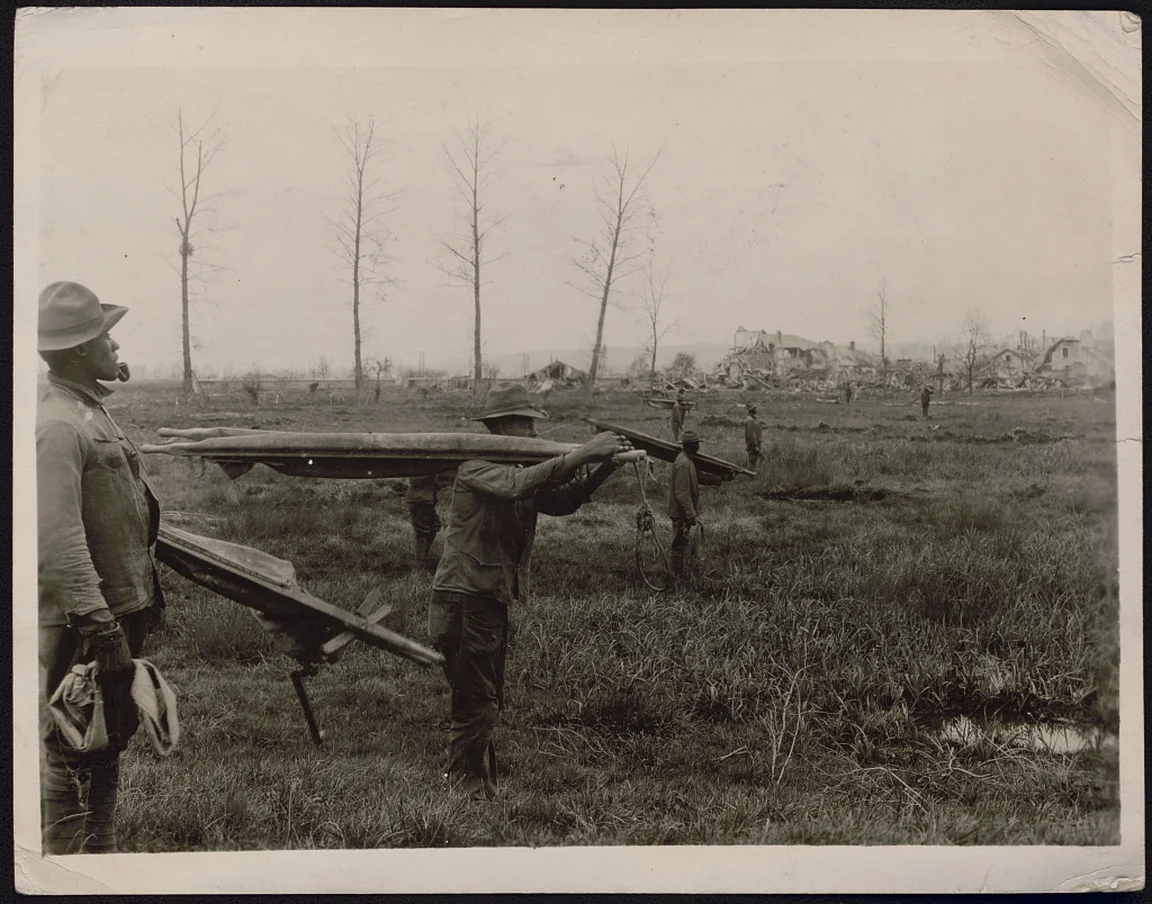
📷 THE PERIOD’S OWN WITNESS — FRANCE, 1918 · Company A, 321st Labor Battalion, spread out in "skirmish line" formation searching for the dead along the south bank of the Vesle in the Chateau-Thierry section, France, 1918 — U.S. Army Signal Corps A.E.F. photograph.
Work of the United States Army Signal Corps, photographer (U.S. federal government work); held by the Library of Congress (LCCN 2017648716); file page permission: "No known restrictions on publication" — public domain
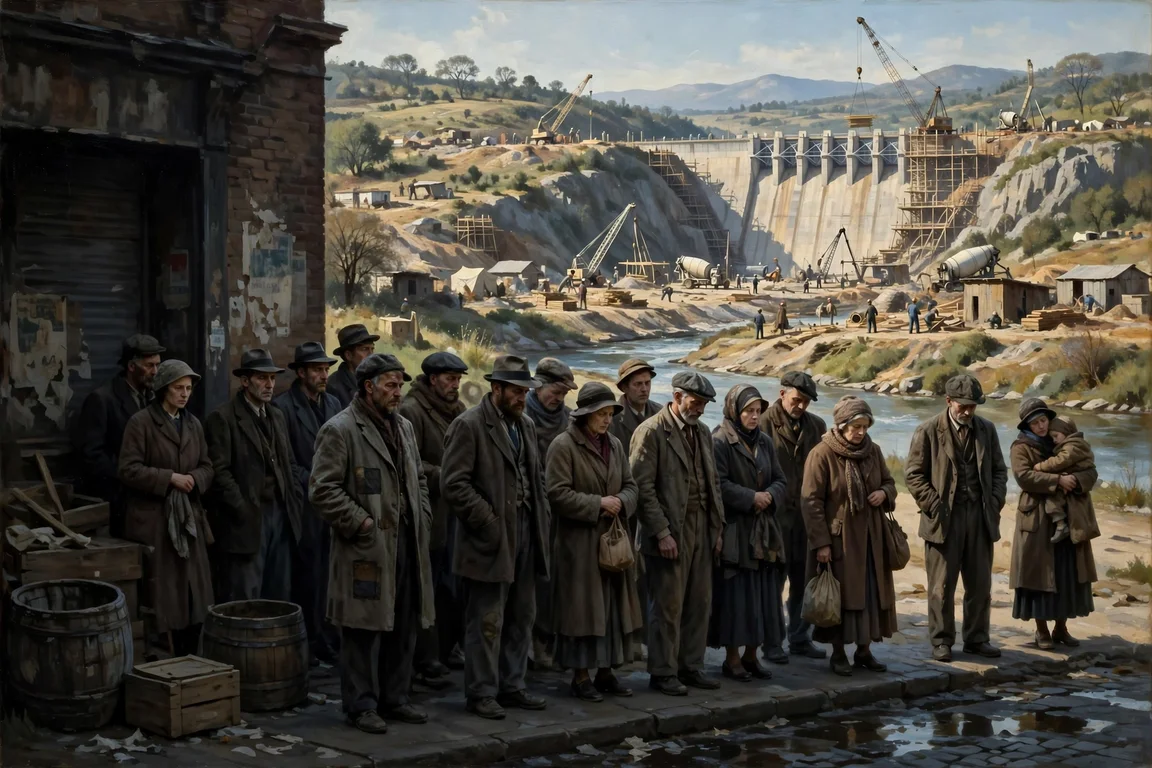
🖼️ 1930S AMERICA IN ONE FRAME: A CITY BREADLINE IN THE FOREGROUND'S SHADOW WHILE, IN THE SUNLIT DISTANCE, WORKERS RAISE A GREAT NEW DEAL DAM — DESPAIR AND ANSWER IN A SINGLE LANDSCAPE · The 1930s in one landscape — a city breadline in shadow, and in sunlit distance workers raising a great New Deal dam.
It will be our wish and purpose that the processes of peace, when they are begun, shall be absolutely open and that they shall involve and permit henceforth no secret understandings of any kind. The day of conquest and aggrandizement is gone by; so is also the day of secret covenants entered into in the interest of particular governments and likely at some unlooked-for moment to upset the peace of the world. It is this happy fact, now clear to the view of every public man whose thoughts do not still linger in an age that is dead and gone, which makes it possible for every nation whose purposes are consistent with justice and the peace of the world to avow nor or at any other time the objects it has in view.
We entered this war because violations of right had occurred which touched us to the quick and made the life of our own people impossible unless they were corrected and the world secure once for all against their recurrence. What we demand in this war, therefore, is nothing peculiar to ourselves. It is that the world be made fit and safe to live in; and particularly that it be made safe for every peace-loving nation which, like our own, wishes to live its own life, determine its own institutions, be assured of justice and fair dealing by the other peoples of the world as against force and selfish aggression. All the peoples of the world are in effect partners in this interest, and for our own part we see very clearly that unless justice be done to others it will not be done to us. The programme of the world's peace, therefore, is our programme; and that programme, the only possible programme, as we see it, is this:
I. Open covenants of peace, openly arrived at, after which there shall be no private international understandings of any kind but diplomacy shall proceed always frankly and in the public view.
II. Absolute freedom of navigation upon the seas, outside territorial waters, alike in peace and in war, except as the seas may be closed in whole or in part by international action for the enforcement of international covenants.
III. The removal, so far as possible, of all economic barriers and the establishment of an equality of trade conditions among all the nations consenting to the peace and associating themselves for its maintenance.
IV. Adequate guarantees given and taken that national armaments will be reduced to the lowest point consistent with domestic safety.
V. A free, open-minded, and absolutely impartial adjustment of all colonial claims, based upon a strict observance of the principle that in determining all such questions of sovereignty the interests of the populations concerned must have equal weight with the equitable claims of the government whose title is to be determined.
VI. The evacuation of all Russian territory and such a settlement of all questions affecting Russia as will secure the best and freest cooperation of the other nations of the world in obtaining for her an unhampered and unembarrassed opportunity for the independent determination of her own political development and national policy and assure her of a sincere welcome into the society of free nations under institutions of her own choosing; and, more than a welcome, assistance also of every kind that she may need and may herself desire. The treatment accorded Russia by her sister nations in the months to come will be the acid test of their good will, of their comprehension of her needs as distinguished from their own interests, and of their intelligent and unselfish sympathy.
VII. Belgium, the whole world will agree, must be evacuated and restored, without any attempt to limit the sovereignty which she enjoys in common with all other free nations. No other single act will serve as this will serve to restore confidence among the nations in the laws which they have themselves set and determined for the government of their relations with one another. Without this healing act the whole structure and validity of international law is forever impaired.
VIII. All French territory should be freed and the invaded portions restored, and the wrong done to France by Prussia in 1871 in the matter of Alsace-Lorraine, which has unsettled the peace of the world for nearly fifty years, should be righted, in order that peace may once more be made secure in the interest of all.
IX. A readjustment of the frontiers of Italy should be effected along clearly recognizable lines of nationality.
X. The peoples of Austria-Hungary, whose place among the nations we wish to see safeguarded and assured, should be accorded the freest opportunity to autonomous development.
XI. Rumania, Serbia, and Montenegro should be evacuated; occupied territories restored; Serbia accorded free and secure access to the sea; and the relations of the several Balkan states to one another determined by friendly counsel along historically established lines of allegiance and nationality; and international guarantees of the political and economic independence and territorial integrity of the several Balkan states should be entered into.
XII. The turkish portion of the present Ottoman Empire should be assured a secure sovereignty, but the other nationalities which are now under Turkish rule should be assured an undoubted security of life and an absolutely unmolested opportunity of autonomous development, and the Dardanelles should be permanently opened as a free passage to the ships and commerce of all nations under international guarantees.
XIII. An independent Polish state should be erected which should include the territories inhabited by indisputably Polish populations, which should be assured a free and secure access to the sea, and whose political and economic independence and territorial integrity should be guaranteed by international covenant.
XIV. A general association of nations must be formed under specific covenants for the purpose of affording mutual guarantees of political independence and territorial integrity to great and small states alike.
In regard to these essential rectifications of wrong and assertions of right we feel ourselves to be intimate partners of all the governments and peoples associated together against the Imperialists. We cannot be separated in interest or divided in purpose. We stand together until the end.
For such arrangements and covenants we are willing to fight and to continue to fight until they are achieved; but only because we wish the right to prevail and desire a just and stable peace such as can be secured only by removing the chief provocations to war, which this programme does remove. We have no jealousy of German greatness, and there is nothing in this programme that impairs it. We grudge her no achievement or distinction of learning or of pacific enterprise such as have made her record very bright and very enviable. We do not wish to injure her or to block in any way her legitimate influence or power. We do not wish to fight her either with arms or with hostile arrangements of trade if she is willing to associate herself with us and the other peace- loving nations of the world in covenants of justice and law and fair dealing. We wish her only to accept a place of equality among the peoples of the world, -- the new world in which we now live, -- instead of a place of mastery.
THE FOURTEEN POINTS (1918) by Woodrow Wilson — public domain. Text via the Avalon Project, Yale Law School.
© 2026 Eternity Gravestones LLC — this edition’s presentation only. All Rights Reserved.
Passed by Congress June 4, 1919. Ratified August 18, 1920.
The right of citizens of the United States to vote shall not be denied or abridged by the United States or by any State on account of sex.
Congress shall have power to enforce this article by appropriate legislation.
THE NINETEENTH AMENDMENT (1920) — public domain. Text: U.S. National Archives.
© 2026 Eternity Gravestones LLC — this edition’s presentation only. All Rights Reserved.
I am certain that my fellow Americans expect that on my induction into the Presidency I will address them with a candor and a decision which the present situation of our Nation impels. This is preeminently the time to speak the truth, the whole truth, frankly and boldly. Nor need we shrink from honestly facing conditions in our country today. This great Nation will endure as it has endured, will revive and will prosper. So, first of all, let me assert my firm belief that the only thing we have to fear is fear itself--nameless, unreasoning, unjustified terror which paralyzes needed efforts to convert retreat into advance. In every dark hour of our national life a leadership of frankness and vigor has met with that understanding and support of the people themselves which is essential to victory. I am convinced that you will again give that support to leadership in these critical days.
In such a spirit on my part and on yours we face our common difficulties. They concern, thank God, only material things. Values have shrunken to fantastic levels; taxes have risen; our ability to pay has fallen; government of all kinds is faced by serious curtailment of income; the means of exchange are frozen in the currents of trade; the withered leaves of industrial enterprise lie on every side; farmers find no markets for their produce; the savings of many years in thousands of families are gone.
More important, a host of unemployed citizens face the grim problem of existence, and an equally great number toil with little return. Only a foolish optimist can deny the dark realities of the moment.
Yet our distress comes from no failure of substance. We are stricken by no plague of locusts. Compared with the perils which our forefathers conquered because they believed and were not afraid, we have still much to be thankful for. Nature still offers her bounty and human efforts have multiplied it. Plenty is at our doorstep, but a generous use of it languishes in the very sight of the supply. Primarily this is because the rulers of the exchange of mankind's goods have failed, through their own stubbornness and their own incompetence, have admitted their failure, and abdicated. Practices of the unscrupulous money changers stand indicted in the court of public opinion, rejected by the hearts and minds of men.
True they have tried, but their efforts have been cast in the pattern of an outworn tradition. Faced by failure of credit they have proposed only the lending of more money. Stripped of the lure of profit by which to induce our people to follow their false leadership, they have resorted to exhortations, pleading tearfully for restored confidence. They know only the rules of a generation of self-seekers. They have no vision, and when there is no vision the people perish.
The money changers have fled from their high seats in the temple of our civilization. We may now restore that temple to the ancient truths. The measure of the restoration lies in the extent to which we apply social values more noble than mere monetary profit.
Happiness lies not in the mere possession of money; it lies in the joy of achievement, in the thrill of creative effort. The joy and moral stimulation of work no longer must be forgotten in the mad chase of evanescent profits. These dark days will be worth all they cost us if they teach us that our true destiny is not to be ministered unto but to minister to ourselves and to our fellow men.
Recognition of the falsity of material wealth as the standard of success goes hand in hand with the abandonment of the false belief that public office and high political position are to be valued only by the standards of pride of place and personal profit; and there must be an end to a conduct in banking and in business which too often has given to a sacred trust the likeness of callous and selfish wrongdoing. Small wonder that confidence languishes, for it thrives only on honesty, on honor, on the sacredness of obligations, on faithful protection, on unselfish performance; without them it cannot live.
Restoration calls, however, not for changes in ethics alone. This Nation asks for action, and action now.
Our greatest primary task is to put people to work. This is no unsolvable problem if we face it wisely and courageously. It can be accomplished in part by direct recruiting by the Government itself, treating the task as we would treat the emergency of a war, but at the same time, through this employment, accomplishing greatly needed projects to stimulate and reorganize the use of our natural resources.
Hand in hand with this we must frankly recognize the overbalance of population in our industrial centers and, by engaging on a national scale in a redistribution, endeavor to provide a better use of the land for those best fitted for the land. The task can be helped by definite efforts to raise the values of agricultural products and with this the power to purchase the output of our cities. It can be helped by preventing realistically the tragedy of the growing loss through foreclosure of our small homes and our farms. It can be helped by insistence that the Federal, State, and local governments act forthwith on the demand that their cost be drastically reduced. It can be helped by the unifying of relief activities which today are often scattered, uneconomical, and unequal. It can be helped by national planning for and supervision of all forms of transportation and of communications and other utilities which have a definitely public character. There are many ways in which it can be helped, but it can never be helped merely by talking about it. We must act and act quickly.
Finally, in our progress toward a resumption of work we require two safeguards against a return of the evils of the old order; there must be a strict supervision of all banking and credits and investments; there must be an end to speculation with other people's money, and there must be provision for an adequate but sound currency.
There are the lines of attack. I shall presently urge upon a new Congress in special session detailed measures for their fulfillment, and I shall seek the immediate assistance of the several States.
Through this program of action we address ourselves to putting our own national house in order and making income balance outgo. Our international trade relations, though vastly important, are in point of time and necessity secondary to the establishment of a sound national economy. I favor as a practical policy the putting of first things first. I shall spare no effort to restore world trade by international economic readjustment, but the emergency at home cannot wait on that accomplishment.
The basic thought that guides these specific means of national recovery is not narrowly nationalistic. It is the insistence, as a first consideration, upon the interdependence of the various elements in all parts of the United States--a recognition of the old and permanently important manifestation of the American spirit of the pioneer. It is the way to recovery. It is the immediate way. It is the strongest assurance that the recovery will endure.
In the field of world policy I would dedicate this Nation to the policy of the good neighbor--the neighbor who resolutely respects himself and, because he does so, respects the rights of others-- the neighbor who respects his obligations and respects the sanctity of his agreements in and with a world of neighbors.
If I read the temper of our people correctly, we now realize as we have never realized before our interdependence on each other; that we can not merely take but we must give as well; that if we are to go forward, we must move as a trained and loyal army willing to sacrifice for the good of a common discipline, because without such discipline no progress is made, no leadership becomes effective. We are, I know, ready and willing to submit our lives and property to such discipline, because it makes possible a leadership which aims at a larger good. This I propose to offer, pledging that the larger purposes will bind upon us all as a sacred obligation with a unity of duty hitherto evoked only in time of armed strife.
With this pledge taken, I assume unhesitatingly the leadership of this great army of our people dedicated to a disciplined attack upon our common problems.
Action in this image and to this end is feasible under the form of government which we have inherited from our ancestors. Our Constitution is so simple and practical that it is possible always to meet extraordinary needs by changes in emphasis and arrangement without loss of essential form. That is why our constitutional system has proved itself the most superbly enduring political mechanism the modern world has produced. It has met every stress of vast expansion of territory, of foreign wars, of bitter internal strife, of world relations.
It is to be hoped that the normal balance of executive and legislative authority may be wholly adequate to meet the unprecedented task before us. But it may be that an unprecedented demand and need for undelayed action may call for temporary departure from that normal balance of public procedure.
I am prepared under my constitutional duty to recommend the measures that a stricken nation in the midst of a stricken world may require. These measures, or such other measures as the Congress may build out of its experience and wisdom, I shall seek, within my constitutional authority, to bring to speedy adoption.
But in the event that the Congress shall fail to take one of these two courses, and in the event that the national emergency is still critical, I shall not evade the clear course of duty that will then confront me. I shall ask the Congress for the one remaining instrument to meet the crisis--broad Executive power to wage a war against the emergency, as great as the power that would be given to me if we were in fact invaded by a foreign foe.
For the trust reposed in me I will return the courage and the devotion that befit the time. I can do no less.
We face the arduous days that lie before us in the warm courage of the national unity; with the clear consciousness of seeking old and precious moral values; with the clean satisfaction that comes from the stem performance of duty by old and young alike. We aim at the assurance of a rounded and permanent national life.
We do not distrust the future of essential democracy. The people of the United States have not failed. In their need they have registered a mandate that they want direct, vigorous action. They have asked for discipline and direction under leadership. They have made me the present instrument of their wishes. In the spirit of the gift I take it.
In this dedication of a Nation we humbly ask the blessing of God. May He protect each and every one of us. May He guide me in the days to come.
FIRST INAUGURAL ADDRESS (1933) by Franklin D. Roosevelt — public domain. Text via the Avalon Project, Yale Law School.
© 2026 Eternity Gravestones LLC — this edition’s presentation only. All Rights Reserved.
🎬 LIVING PLATE — JUNE 6, 1944, FIRST LIGHT: THE SEA OFF NORMANDY FULL OF ALLIED SHIPS TO THE HORIZON, LANDING CRAFT DRIVING TOWARD A SMOKE-HAZED SHORE, BARRAGE BALLOONS ABOVE — THE SCALE OF D-DAY, PAINTED HONESTLY, NO GORE CLOSE-UP · D-Day, June 6, 1944, first light — Allied ships to the horizon off Normandy, landing craft driving toward a smoke-hazed shore beneath barrage balloons.
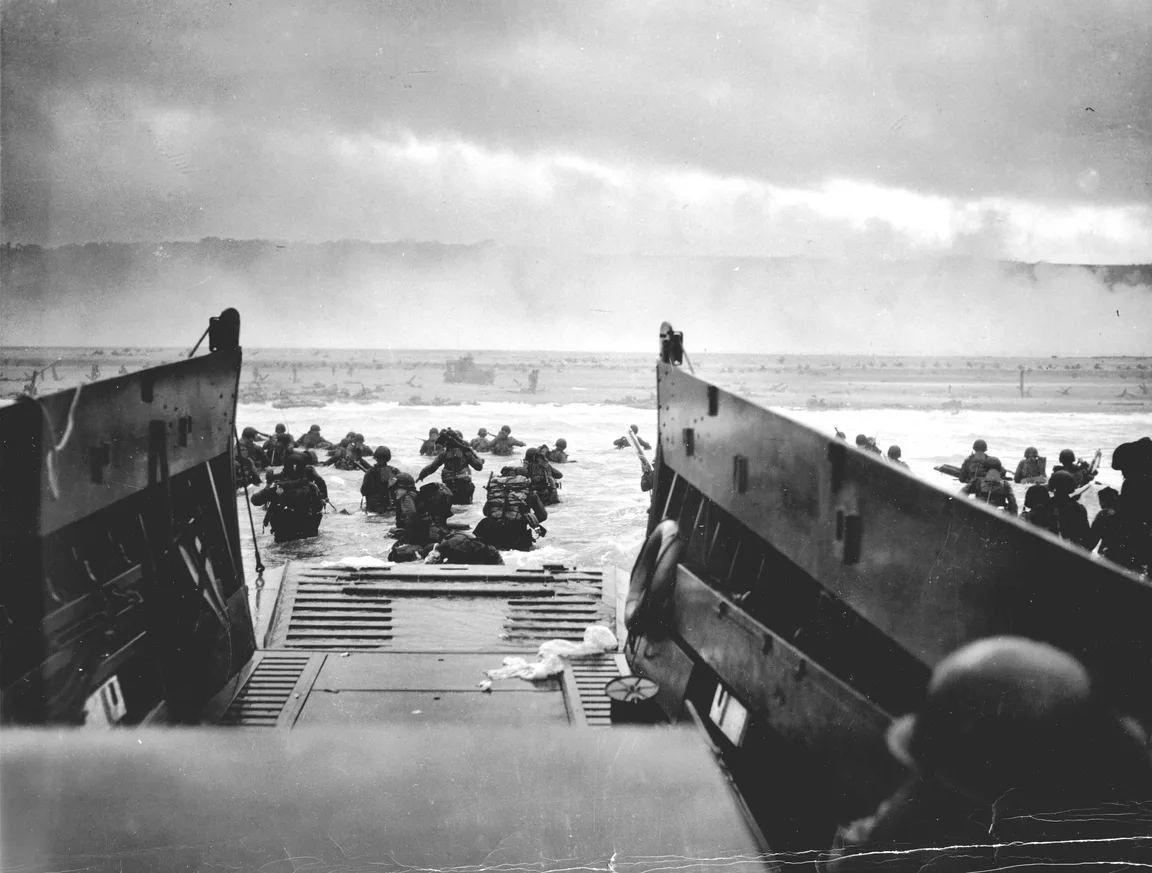
📷 THE PERIOD’S OWN WITNESS — NORMANDY, JUNE 6, 1944 · "Into the Jaws of Death" — troops of the U.S. Army's 1st Infantry Division disembark from a U.S. Coast Guard-manned LCVP from USS Samuel Chase at Omaha Beach on D-Day, June 6, 1944.
Work of U.S. Coast Guard Chief Photographer's Mate (CPHOM) Robert F. Sargent; file page permission: "Public domain; official U.S. Coast Guard photograph" — federal work, public domain
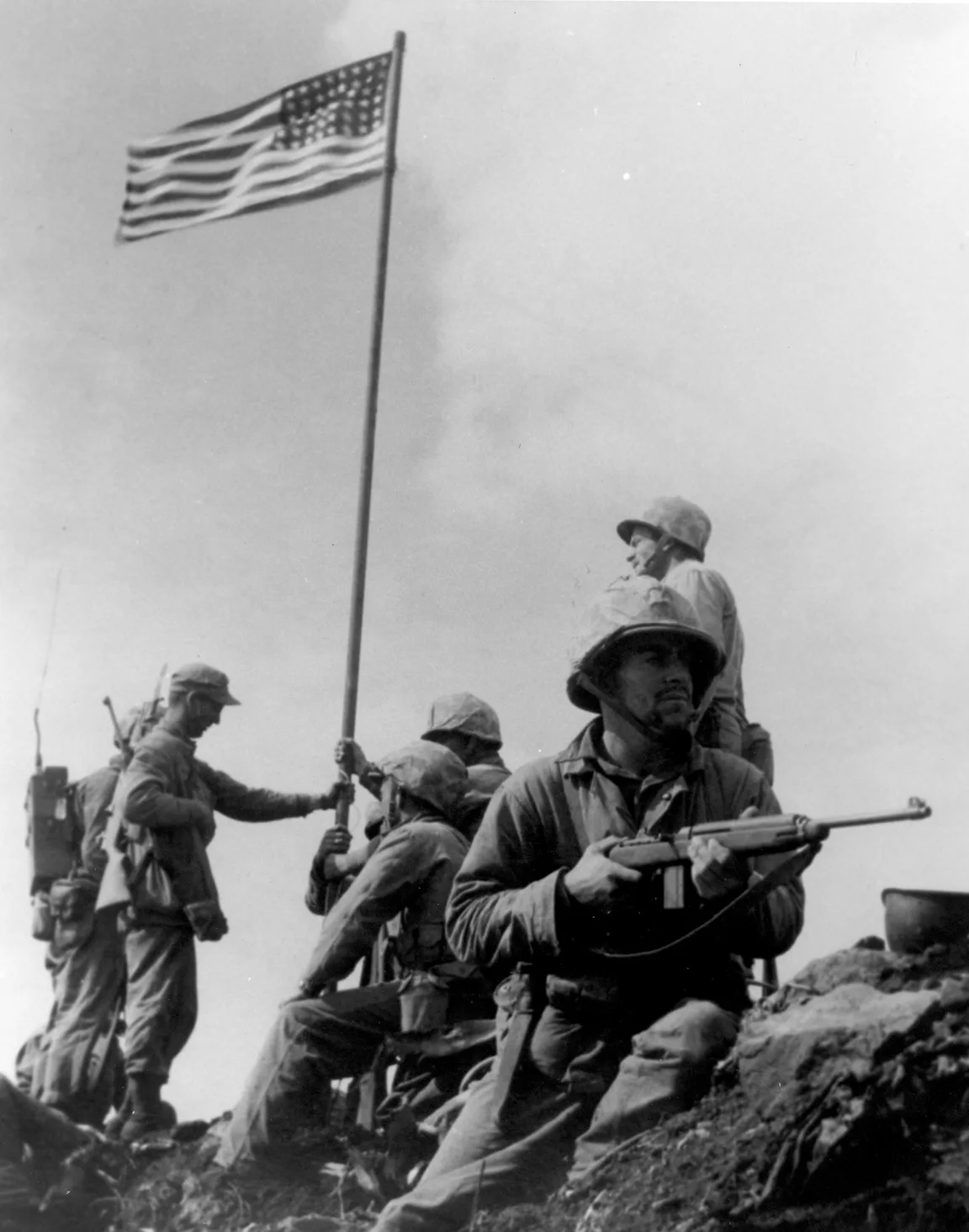
📷 THE PERIOD’S OWN WITNESS — IWO JIMA, FEBRUARY 23, 1945 · The first flag raising on Mount Suribachi, Iwo Jima: the small flag carried ashore by the 2nd Battalion, 28th Marines is planted atop Mount Suribachi on February 23, 1945; photographed by Staff Sergeant Louis R. Lowery, USMC.
Work of a United States Marine (Staff Sergeant Louis R. Lowery, USMC, staff photographer for Leatherneck magazine), taken as part of his official duties; file page licensing: "As a work of the U.S. federal government, it is in the public domain." This is the federal Lowery photograph of the FIRST flag raising — NOT the AP-copyrighted Rosenthal photograph, which was deliberately not fetched.
Mr. President, Mr. Speaker, Members of the Seventy-seventh Congress:
I address you, the Members of the Seventy-seventh Congress, at a moment unprecedented in the history of the Union. I use the word "unprecedented," because at no previous time has American security been as seriously threatened from without as it is today.
Since the permanent formation of our Government under the Constitution, in 1789, most of the periods of crisis in our history have related to our domestic affairs. Fortunately, only one of these--the four-year War Between the States--ever threatened our national unity. Today, thank God, one hundred and thirty million Americans, in forty-eight States, have forgotten points of the compass in our national unity.
It is true that prior to 1914 the United States often had been disturbed by events in other Continents. We had even engaged in two wars with European nations and in a number of undeclared wars in the West Indies, in the Mediterranean and in the Pacific for the maintenance of American rights and for the principles of peaceful commerce. But in no case had a serious threat been raised against our national safety or our continued independence.
What I seek to convey is the historic truth that the United States as a nation has at all times maintained clear, definite opposition, to any attempt to lock us in behind an ancient Chinese wall while the procession of civilization went past. Today, thinking of our children and of their children, we oppose enforced isolation for ourselves or for any other part of the Americas.
That determination of ours, extending over all these years, was proved, for example, during the quarter century of wars following the French Revolution.
While the Napoleonic struggles did threaten interests of the United States because of the French foothold in the West Indies and in Louisiana, and while we engaged in the War of 1812 to vindicate our right to peaceful trade, it is nevertheless clear that neither France nor Great Britain, nor any other nation, was aiming at domination of the whole world.
In like fashion from 1815 to 1914-- ninety-nine years-- no single war in Europe or in Asia constituted a real threat against our future or against the future of any other American nation.
Except in the Maximilian interlude in Mexico, no foreign power sought to establish itself in this Hemisphere; and the strength of the British fleet in the Atlantic has been a friendly strength. It is still a friendly strength.
Even when the World War broke out in 1914, it seemed to contain only small threat of danger to our own American future. But, as time went on, the American people began to visualize what the downfall of democratic nations might mean to our own democracy.
We need not overemphasize imperfections in the Peace of Versailles. We need not harp on failure of the democracies to deal with problems of world reconstruction. We should remember that the Peace of 1919 was far less unjust than the kind of "pacification" which began even before Munich, and which is being carried on under the new order of tyranny that seeks to spread over every continent today. The American people have unalterably set their faces against that tyranny.
Every realist knows that the democratic way of life is at this moment being' directly assailed in every part of the world--assailed either by arms, or by secret spreading of poisonous propaganda by those who seek to destroy unity and promote discord in nations that are still at peace.
During sixteen long months this assault has blotted out the whole pattern of democratic life in an appalling number of independent nations, great and small. The assailants are still on the march, threatening other nations, great and small.
Therefore, as your President, performing my constitutional duty to "give to the Congress information of the state of the Union," I find it, unhappily, necessary to report that the future and the safety of our country and of our democracy are overwhelmingly involved in events far beyond our borders.
Armed defense of democratic existence is now being gallantly waged in four continents. If that defense fails, all the population and all the resources of Europe, Asia, Africa and Australasia will be dominated by the conquerors. Let us remember that the total of those populations and their resources in those four continents greatly exceeds the sum total of the population and the resources of the whole of the Western Hemisphere-many times over.
In times like these it is immature--and incidentally, untrue--for anybody to brag that an unprepared America, single-handed, and with one hand tied behind its back, can hold off the whole world.
No realistic American can expect from a dictator's peace international generosity, or return of true independence, or world disarmament, or freedom of expression, or freedom of religion -or even good business.
Such a peace would bring no security for us or for our neighbors. "Those, who would give up essential liberty to purchase a little temporary safety, deserve neither liberty nor safety."
As a nation, we may take pride in the fact that we are softhearted; but we cannot afford to be soft-headed.
We must always be wary of those who with sounding brass and a tinkling cymbal preach the "ism" of appeasement.
We must especially beware of that small group of selfish men who would clip the wings of the American eagle in order to feather their own nests.
I have recently pointed out how quickly the tempo of modern warfare could bring into our very midst the physical attack which we must eventually expect if the dictator nations win this war.
There is much loose talk of our immunity from immediate and direct invasion from across the seas. Obviously, as long as the British Navy retains its power, no such danger exists. Even if there were no British Navy, it is not probable that any enemy would be stupid enough to attack us by landing troops in the United States from across thousands of miles of ocean, until it had acquired strategic bases from which to operate.
But we learn much from the lessons of the past years in Europe-particularly the lesson of Norway, whose essential seaports were captured by treachery and surprise built up over a series of years.
The first phase of the invasion of this Hemisphere would not be the landing of regular troops. The necessary strategic points would be occupied by secret agents and their dupes- and great numbers of them are already here, and in Latin America.
As long as the aggressor nations maintain the offensive, they-not we--will choose the time and the place and the method of their attack.
That is why the future of all the American Republics is today in serious danger.
That is why this Annual Message to the Congress is unique in our history.
That is why every member of the Executive Branch of the Government and every member of the Congress faces great responsibility and great accountability.
The need of the moment is that our actions and our policy should be devoted primarily-almost exclusively--to meeting this foreign peril. For all our domestic problems are now a part of the great emergency.
Just as our national policy in internal affairs has been based upon a decent respect for the rights and the dignity of all our fellow men within our gates, so our national policy in foreign affairs has been based on a decent respect for the rights and dignity of all nations, large and small. And the justice of morality must and will win in the end.
Our national policy is this:
First, by an impressive expression of the public will and without regard to partisanship, we are committed to all-inclusive national defense.
Second, by an impressive expression of the public will and without regard to partisanship, we are committed to full support of all those resolute peoples, everywhere, who are resisting aggression and are thereby keeping war away from our Hemisphere. By this support, we express our determination that the democratic cause shall prevail; and we strengthen the defense and the security of our own nation.
Third, by an impressive expression of the public will and without regard to partisanship, we are committed to the proposition that principles of morality and considerations for our own security will never permit us to acquiesce in a peace dictated by aggressors and sponsored by appeasers. We know that enduring peace cannot be bought at the cost of other people's freedom.
In the recent national election there was no substantial difference between the two great parties in respect to that national policy. No issue was fought out on this line before the American electorate. Today it is abundantly evident that American citizens everywhere are demanding and supporting speedy and complete action in recognition of obvious danger.
Therefore, the immediate need is a swift and driving increase in our armament production.
Leaders of industry and labor have responded to our summons. Goals of speed have been set. In some cases these goals are being reached ahead of time; in some cases we are on schedule; in other cases there are slight but not serious delays; and in some cases--and I am sorry to say very important cases--we are all concerned by the slowness of the accomplishment of our plans.
The Army and Navy, however, have made substantial progress during the past year. Actual experience is improving and speeding up our methods of production with every passing day. And today's best is not good enough for tomorrow.
I am not satisfied with the progress thus far made. The men in charge of the program represent the best in training, in ability, and in patriotism. They are not satisfied with the progress thus far made. None of us will be satisfied until the job is done.
No matter whether the original goal was set too high or too low, our objective is quicker and better results. To give you two illustrations:
We are behind schedule in turning out finished airplanes; we are working day and night to solve the innumerable problems and to catch up.
We are ahead of schedule in building warships but we are working to get even further ahead of that schedule.
To change a whole nation from a basis of peacetime production of implements of peace to a basis of wartime production of implements of war is no small task. And the greatest difficulty comes at the beginning of the program, when new tools, new plant facilities, new assembly lines, and new ship ways must first be constructed before the actual materiel begins to flow steadily and speedily from them.
The Congress, of course, must rightly keep itself informed at all times of the progress of the program. However, there is certain information, as the Congress itself will readily recognize, which, in the interests of our own security and those of the nations that we are supporting, must of needs be kept in confidence.
New circumstances are constantly begetting new needs for our safety. I shall ask this Congress for greatly increased new appropriations and authorizations to carry on what we have begun.
I also ask this Congress for authority and for funds sufficient to manufacture additional munitions and war supplies of many kinds, to be turned over to those nations which are now in actual war with aggressor nations.
Our most useful and immediate role is to act as an arsenal for them as well as for ourselves. They do not need man power, but they do need billions of dollars worth of the weapons of defense.
The time is near when they will not be able to pay for them all in ready cash. We cannot, and we will not, tell them that they must surrender, merely because of present inability to pay for the weapons which we know they must have.
I do not recommend that we make them a loan of dollars with which to pay for these weapons--a loan to be repaid in dollars.
I recommend that we make it possible for those nations to continue to obtain war materials in the United States, fitting their orders into our own program. Nearly all their materiel would, if the time ever came, be useful for our own defense.
Taking counsel of expert military and naval authorities, considering what is best for our own security, we are free to decide how much should be kept here and how much should be sent abroad to our friends who by their determined and heroic resistance are giving us time in which to make ready our own defense.
For what we send abroad, we shall be repaid within a reasonable time following the close of hostilities, in similar materials, or, at our option, in other goods of many kinds, which they can produce and which we need.
Let us say to the democracies: "We Americans are vitally concerned in your defense of freedom. We are putting forth our energies, our resources and our organizing powers to give you the strength to regain and maintain a free world. We shall send you, in ever-increasing numbers, ships, planes, tanks, guns. This is our purpose and our pledge."
In fulfillment of this purpose we will not be intimidated by the threats of dictators that they will regard as a breach of international law or as an act of war our aid to the democracies which dare to resist their aggression. Such aid is not an act of war, even if a dictator should unilaterally proclaim it so to be.
When the dictators, if the dictators, are ready to make war upon us, they will not wait for an act of war on our part. They did not wait for Norway or Belgium or the Netherlands to commit an act of war.
Their only interest is in a new one-way international law, which lacks mutuality in its observance, and, therefore, becomes an instrument of oppression.
The happiness of future generations of Americans may well depend upon how effective and how immediate we can make our aid felt. No one can tell the exact character of the emergency situations that we may be called upon to meet. The Nation's hands must not be tied when the Nation's life is in danger.
We must all prepare to make the sacrifices that the emergency-almost as serious as war itself--demands. Whatever stands in the way of speed and efficiency in defense preparations must give way to the national need.
A free nation has the right to expect full cooperation from all groups. A free nation has the right to look to the leaders of business, of labor, and of agriculture to take the lead in stimulating effort, not among other groups but within their own groups.
The best way of dealing with the few slackers or trouble makers in our midst is, first, to shame them by patriotic example, and, if that fails, to use the sovereignty of Government to save Government.
As men do not live by bread alone, they do not fight by armaments alone. Those who man our defenses, and those behind them who build our defenses, must have the stamina and the courage which come from unshakable belief in the manner of life which they are defending. The mighty action that we are calling for cannot be based on a disregard of all things worth fighting for.
The Nation takes great satisfaction and much strength from the things which have been done to make its people conscious of their individual stake in the preservation of democratic life in America. Those things have toughened the fibre of our people, have renewed their faith and strengthened their devotion to the institutions we make ready to protect.
Certainly this is no time for any of us to stop thinking about the social and economic problems which are the root cause of the social revolution which is today a supreme factor in the world.
For there is nothing mysterious about the foundations of a healthy and strong democracy. The basic things expected by our people of their political and economic systems are simple. They are:
Equality of opportunity for youth and for others.
Jobs for those who can work.
Security for those who need it.
The ending of special privilege for the few.
The preservation of civil liberties for all.
The enjoyment of the fruits of scientific progress in a wider and constantly rising standard of living.
These are the simple, basic things that must never be lost sight of in the turmoil and unbelievable complexity of our modern world. The inner and abiding strength of our economic and political systems is dependent upon the degree to which they fulfill these expectations.
Many subjects connected with our social economy call for immediate improvement.
As examples:
We should bring more citizens under the coverage of old-age pensions and unemployment insurance.
We should widen the opportunities for adequate medical care.
We should plan a better system by which persons deserving or needing gainful employment may obtain it.
I have called for personal sacrifice. I am assured of the willingness of almost all Americans to respond to that call.
A part of the sacrifice means the payment of more money in taxes. In my Budget Message I shall recommend that a greater portion of this great defense program be paid for from taxation than we are paying today. No person should try, or be allowed, to get rich out of this program; and the principle of tax payments in accordance with ability to pay should be constantly before our eyes to guide our legislation.
If the Congress maintains these principles, the voters, putting patriotism ahead of pocketbooks, will give you their applause.
In the future days, which we seek to make secure, we look forward to a world founded upon four essential human freedoms.
The first is freedom of speech and expression--everywhere in the world.
The second is freedom of every person to worship God in his own way--everywhere in the world.
The third is freedom from want--which, translated into world terms, means economic understandings which will secure to every nation a healthy peacetime life for its inhabitants-everywhere in the world.
The fourth is freedom from fear--which, translated into world terms, means a world-wide reduction of armaments to such a point and in such a thorough fashion that no nation will be in a position to commit an act of physical aggression against any neighbor--anywhere in the world.
That is no vision of a distant millennium. It is a definite basis for a kind of world attainable in our own time and generation. That kind of world is the very antithesis of the so-called new order of tyranny which the dictators seek to create with the crash of a bomb.
To that new order we oppose the greater conception--the moral order. A good society is able to face schemes of world domination and foreign revolutions alike without fear.
Since the beginning of our American history, we have been engaged in change -- in a perpetual peaceful revolution -- a revolution which goes on steadily, quietly adjusting itself to changing conditions--without the concentration camp or the quick-lime in the ditch. The world order which we seek is the cooperation of free countries, working together in a friendly, civilized society.
This nation has placed its destiny in the hands and heads and hearts of its millions of free men and women; and its faith in freedom under the guidance of God. Freedom means the supremacy of human rights everywhere. Our support goes to those who struggle to gain those rights or keep them. Our strength is our unity of purpose. To that high concept there can be no end save victory.
ANNUAL MESSAGE TO CONGRESS (1941) by Franklin D. Roosevelt — public domain. Full text via the FDR Presidential Library, National Archives.
© 2026 Eternity Gravestones LLC — this edition’s presentation only. All Rights Reserved.
O water, voice of my heart, crying in the sand,
All night long crying with a mournful cry,
As I lie and listen, and cannot understand
The voice of my heart in my side or the voice of the sea,
O water, crying for rest, is it I, is it I?
All night long the water is crying to me.
Unresting water, there shall never be rest
Till the last moon droop and the last tide fail,
And the fire of the end begin to burn in the west;
And the heart shall be weary and wonder and cry like the sea,
All life long crying without avail,
As the water all night long is crying to me.
ARTHUR SYMONS.
[Illustration]
Between me and the other world there is ever an unasked question: unasked by some through feelings of delicacy; by others through the difficulty of rightly framing it. All, nevertheless, flutter round it. They approach me in a half-hesitant sort of way, eye me curiously or compassionately, and then, instead of saying directly, How does it feel to be a problem? they say, I know an excellent colored man in my town; or, I fought at Mechanicsville; or, Do not these Southern outrages make your blood boil? At these I smile, or am interested, or reduce the boiling to a simmer, as the occasion may require. To the real question, How does it feel to be a problem? I answer seldom a word.
And yet, being a problem is a strange experience,—peculiar even for one who has never been anything else, save perhaps in babyhood and in Europe. It is in the early days of rollicking boyhood that the revelation first bursts upon one, all in a day, as it were. I remember well when the shadow swept across me. I was a little thing, away up in the hills of New England, where the dark Housatonic winds between Hoosac and Taghkanic to the sea. In a wee wooden schoolhouse, something put it into the boys’ and girls’ heads to buy gorgeous visiting-cards—ten cents a package—and exchange. The exchange was merry, till one girl, a tall newcomer, refused my card,—refused it peremptorily, with a glance. Then it dawned upon me with a certain suddenness that I was different from the others; or like, mayhap, in heart and life and longing, but shut out from their world by a vast veil. I had thereafter no desire to tear down that veil, to creep through; I held all beyond it in common contempt, and lived above it in a region of blue sky and great wandering shadows. That sky was bluest when I could beat my mates at examination-time, or beat them at a foot-race, or even beat their stringy heads. Alas, with the years all this fine contempt began to fade; for the words I longed for, and all their dazzling opportunities, were theirs, not mine. But they should not keep these prizes, I said; some, all, I would wrest from them. Just how I would do it I could never decide: by reading law, by healing the sick, by telling the wonderful tales that swam in my head,—some way. With other black boys the strife was not so fiercely sunny: their youth shrunk into tasteless sycophancy, or into silent hatred of the pale world about them and mocking distrust of everything white; or wasted itself in a bitter cry, Why did God make me an outcast and a stranger in mine own house? The shades of the prison-house closed round about us all: walls strait and stubborn to the whitest, but relentlessly narrow, tall, and unscalable to sons of night who must plod darkly on in resignation, or beat unavailing palms against the stone, or steadily, half hopelessly, watch the streak of blue above.
After the Egyptian and Indian, the Greek and Roman, the Teuton and Mongolian, the Negro is a sort of seventh son, born with a veil, and gifted with second-sight in this American world,—a world which yields him no true self-consciousness, but only lets him see himself through the revelation of the other world. It is a peculiar sensation, this double-consciousness, this sense of always looking at one’s self through the eyes of others, of measuring one’s soul by the tape of a world that looks on in amused contempt and pity. One ever feels his twoness,—an American, a Negro; two souls, two thoughts, two unreconciled strivings; two warring ideals in one dark body, whose dogged strength alone keeps it from being torn asunder.
The history of the American Negro is the history of this strife,—this longing to attain self-conscious manhood, to merge his double self into a better and truer self. In this merging he wishes neither of the older selves to be lost. He would not Africanize America, for America has too much to teach the world and Africa. He would not bleach his Negro soul in a flood of white Americanism, for he knows that Negro blood has a message for the world. He simply wishes to make it possible for a man to be both a Negro and an American, without being cursed and spit upon by his fellows, without having the doors of Opportunity closed roughly in his face.
This, then, is the end of his striving: to be a co-worker in the kingdom of culture, to escape both death and isolation, to husband and use his best powers and his latent genius. These powers of body and mind have in the past been strangely wasted, dispersed, or forgotten. The shadow of a mighty Negro past flits through the tale of Ethiopia the Shadowy and of Egypt the Sphinx. Through history, the powers of single black men flash here and there like falling stars, and die sometimes before the world has rightly gauged their brightness. Here in America, in the few days since Emancipation, the black man’s turning hither and thither in hesitant and doubtful striving has often made his very strength to lose effectiveness, to seem like absence of power, like weakness. And yet it is not weakness,—it is the contradiction of double aims. The double-aimed struggle of the black artisan—on the one hand to escape white contempt for a nation of mere hewers of wood and drawers of water, and on the other hand to plough and nail and dig for a poverty-stricken horde—could only result in making him a poor craftsman, for he had but half a heart in either cause. By the poverty and ignorance of his people, the Negro minister or doctor was tempted toward quackery and demagogy; and by the criticism of the other world, toward ideals that made him ashamed of his lowly tasks. The would-be black savant was confronted by the paradox that the knowledge his people needed was a twice-told tale to his white neighbors, while the knowledge which would teach the white world was Greek to his own flesh and blood. The innate love of harmony and beauty that set the ruder souls of his people a-dancing and a-singing raised but confusion and doubt in the soul of the black artist; for the beauty revealed to him was the soul-beauty of a race which his larger audience despised, and he could not articulate the message of another people. This waste of double aims, this seeking to satisfy two unreconciled ideals, has wrought sad havoc with the courage and faith and deeds of ten thousand thousand people,—has sent them often wooing false gods and invoking false means of salvation, and at times has even seemed about to make them ashamed of themselves.
Away back in the days of bondage they thought to see in one divine event the end of all doubt and disappointment; few men ever worshipped Freedom with half such unquestioning faith as did the American Negro for two centuries. To him, so far as he thought and dreamed, slavery was indeed the sum of all villainies, the cause of all sorrow, the root of all prejudice; Emancipation was the key to a promised land of sweeter beauty than ever stretched before the eyes of wearied Israelites. In song and exhortation swelled one refrain—Liberty; in his tears and curses the God he implored had Freedom in his right hand. At last it came,—suddenly, fearfully, like a dream. With one wild carnival of blood and passion came the message in his own plaintive cadences:—
“Shout, O children!
Shout, you’re free!
For God has bought your liberty!”
Years have passed away since then,—ten, twenty, forty; forty years of national life, forty years of renewal and development, and yet the swarthy spectre sits in its accustomed seat at the Nation’s feast. In vain do we cry to this our vastest social problem:—
“Take any shape but that, and my firm nerves
Shall never tremble!”
The Nation has not yet found peace from its sins; the freedman has not yet found in freedom his promised land. Whatever of good may have come in these years of change, the shadow of a deep disappointment rests upon the Negro people,—a disappointment all the more bitter because the unattained ideal was unbounded save by the simple ignorance of a lowly people.
The first decade was merely a prolongation of the vain search for freedom, the boon that seemed ever barely to elude their grasp,—like a tantalizing will-o’-the-wisp, maddening and misleading the headless host. The holocaust of war, the terrors of the Ku-Klux Klan, the lies of carpet-baggers, the disorganization of industry, and the contradictory advice of friends and foes, left the bewildered serf with no new watchword beyond the old cry for freedom. As the time flew, however, he began to grasp a new idea. The ideal of liberty demanded for its attainment powerful means, and these the Fifteenth Amendment gave him. The ballot, which before he had looked upon as a visible sign of freedom, he now regarded as the chief means of gaining and perfecting the liberty with which war had partially endowed him. And why not? Had not votes made war and emancipated millions? Had not votes enfranchised the freedmen? Was anything impossible to a power that had done all this? A million black men started with renewed zeal to vote themselves into the kingdom. So the decade flew away, the revolution of 1876 came, and left the half-free serf weary, wondering, but still inspired. Slowly but steadily, in the following years, a new vision began gradually to replace the dream of political power,—a powerful movement, the rise of another ideal to guide the unguided, another pillar of fire by night after a clouded day. It was the ideal of “book-learning”; the curiosity, born of compulsory ignorance, to know and test the power of the cabalistic letters of the white man, the longing to know. Here at last seemed to have been discovered the mountain path to Canaan; longer than the highway of Emancipation and law, steep and rugged, but straight, leading to heights high enough to overlook life.
Up the new path the advance guard toiled, slowly, heavily, doggedly; only those who have watched and guided the faltering feet, the misty minds, the dull understandings, of the dark pupils of these schools know how faithfully, how piteously, this people strove to learn. It was weary work. The cold statistician wrote down the inches of progress here and there, noted also where here and there a foot had slipped or some one had fallen. To the tired climbers, the horizon was ever dark, the mists were often cold, the Canaan was always dim and far away. If, however, the vistas disclosed as yet no goal, no resting-place, little but flattery and criticism, the journey at least gave leisure for reflection and self-examination; it changed the child of Emancipation to the youth with dawning self-consciousness, self-realization, self-respect. In those sombre forests of his striving his own soul rose before him, and he saw himself,—darkly as through a veil; and yet he saw in himself some faint revelation of his power, of his mission. He began to have a dim feeling that, to attain his place in the world, he must be himself, and not another. For the first time he sought to analyze the burden he bore upon his back, that dead-weight of social degradation partially masked behind a half-named Negro problem. He felt his poverty; without a cent, without a home, without land, tools, or savings, he had entered into competition with rich, landed, skilled neighbors. To be a poor man is hard, but to be a poor race in a land of dollars is the very bottom of hardships. He felt the weight of his ignorance,—not simply of letters, but of life, of business, of the humanities; the accumulated sloth and shirking and awkwardness of decades and centuries shackled his hands and feet. Nor was his burden all poverty and ignorance. The red stain of bastardy, which two centuries of systematic legal defilement of Negro women had stamped upon his race, meant not only the loss of ancient African chastity, but also the hereditary weight of a mass of corruption from white adulterers, threatening almost the obliteration of the Negro home.
A people thus handicapped ought not to be asked to race with the world, but rather allowed to give all its time and thought to its own social problems. But alas! while sociologists gleefully count his bastards and his prostitutes, the very soul of the toiling, sweating black man is darkened by the shadow of a vast despair. Men call the shadow prejudice, and learnedly explain it as the natural defence of culture against barbarism, learning against ignorance, purity against crime, the “higher” against the “lower” races. To which the Negro cries Amen! and swears that to so much of this strange prejudice as is founded on just homage to civilization, culture, righteousness, and progress, he humbly bows and meekly does obeisance. But before that nameless prejudice that leaps beyond all this he stands helpless, dismayed, and well-nigh speechless; before that personal disrespect and mockery, the ridicule and systematic humiliation, the distortion of fact and wanton license of fancy, the cynical ignoring of the better and the boisterous welcoming of the worse, the all-pervading desire to inculcate disdain for everything black, from Toussaint to the devil,—before this there rises a sickening despair that would disarm and discourage any nation save that black host to whom “discouragement” is an unwritten word.
But the facing of so vast a prejudice could not but bring the inevitable self-questioning, self-disparagement, and lowering of ideals which ever accompany repression and breed in an atmosphere of contempt and hate. Whisperings and portents came home upon the four winds: Lo! we are diseased and dying, cried the dark hosts; we cannot write, our voting is vain; what need of education, since we must always cook and serve? And the Nation echoed and enforced this self-criticism, saying: Be content to be servants, and nothing more; what need of higher culture for half-men? Away with the black man’s ballot, by force or fraud,—and behold the suicide of a race! Nevertheless, out of the evil came something of good,—the more careful adjustment of education to real life, the clearer perception of the Negroes’ social responsibilities, and the sobering realization of the meaning of progress.
So dawned the time of _Sturm und Drang:_ storm and stress to-day rocks our little boat on the mad waters of the world-sea; there is within and without the sound of conflict, the burning of body and rending of soul; inspiration strives with doubt, and faith with vain questionings. The bright ideals of the past,—physical freedom, political power, the training of brains and the training of hands,—all these in turn have waxed and waned, until even the last grows dim and overcast. Are they all wrong,—all false? No, not that, but each alone was over-simple and incomplete,—the dreams of a credulous race-childhood, or the fond imaginings of the other world which does not know and does not want to know our power. To be really true, all these ideals must be melted and welded into one. The training of the schools we need to-day more than ever,—the training of deft hands, quick eyes and ears, and above all the broader, deeper, higher culture of gifted minds and pure hearts. The power of the ballot we need in sheer self-defence,—else what shall save us from a second slavery? Freedom, too, the long-sought, we still seek,—the freedom of life and limb, the freedom to work and think, the freedom to love and aspire. Work, culture, liberty,—all these we need, not singly but together, not successively but together, each growing and aiding each, and all striving toward that vaster ideal that swims before the Negro people, the ideal of human brotherhood, gained through the unifying ideal of Race; the ideal of fostering and developing the traits and talents of the Negro, not in opposition to or contempt for other races, but rather in large conformity to the greater ideals of the American Republic, in order that some day on American soil two world-races may give each to each those characteristics both so sadly lack. We the darker ones come even now not altogether empty-handed: there are to-day no truer exponents of the pure human spirit of the Declaration of Independence than the American Negroes; there is no true American music but the wild sweet melodies of the Negro slave; the American fairy tales and folklore are Indian and African; and, all in all, we black men seem the sole oasis of simple faith and reverence in a dusty desert of dollars and smartness. Will America be poorer if she replace her brutal dyspeptic blundering with light-hearted but determined Negro humility? or her coarse and cruel wit with loving jovial good-humor? or her vulgar music with the soul of the Sorrow Songs?
Merely a concrete test of the underlying principles of the great republic is the Negro Problem, and the spiritual striving of the freedmen’s sons is the travail of souls whose burden is almost beyond the measure of their strength, but who bear it in the name of an historic race, in the name of this the land of their fathers’ fathers, and in the name of human opportunity.
And now what I have briefly sketched in large outline let me on coming pages tell again in many ways, with loving emphasis and deeper detail, that men may listen to the striving in the souls of black folk.
From birth till death enslaved; in word, in deed, unmanned!
******
Hereditary bondsmen! Know ye not
Who would be free themselves must strike the blow?
BYRON.
[Illustration]
Easily the most striking thing in the history of the American Negro since 1876 is the ascendancy of Mr. Booker T. Washington. It began at the time when war memories and ideals were rapidly passing; a day of astonishing commercial development was dawning; a sense of doubt and hesitation overtook the freedmen’s sons,—then it was that his leading began. Mr. Washington came, with a simple definite programme, at the psychological moment when the nation was a little ashamed of having bestowed so much sentiment on Negroes, and was concentrating its energies on Dollars. His programme of industrial education, conciliation of the South, and submission and silence as to civil and political rights, was not wholly original; the Free Negroes from 1830 up to war-time had striven to build industrial schools, and the American Missionary Association had from the first taught various trades; and Price and others had sought a way of honorable alliance with the best of the Southerners. But Mr. Washington first indissolubly linked these things; he put enthusiasm, unlimited energy, and perfect faith into his programme, and changed it from a by-path into a veritable Way of Life. And the tale of the methods by which he did this is a fascinating study of human life.
It startled the nation to hear a Negro advocating such a programme after many decades of bitter complaint; it startled and won the applause of the South, it interested and won the admiration of the North; and after a confused murmur of protest, it silenced if it did not convert the Negroes themselves.
To gain the sympathy and cooperation of the various elements comprising the white South was Mr. Washington’s first task; and this, at the time Tuskegee was founded, seemed, for a black man, well-nigh impossible. And yet ten years later it was done in the word spoken at Atlanta: “In all things purely social we can be as separate as the five fingers, and yet one as the hand in all things essential to mutual progress.” This “Atlanta Compromise” is by all odds the most notable thing in Mr. Washington’s career. The South interpreted it in different ways: the radicals received it as a complete surrender of the demand for civil and political equality; the conservatives, as a generously conceived working basis for mutual understanding. So both approved it, and to-day its author is certainly the most distinguished Southerner since Jefferson Davis, and the one with the largest personal following.
Next to this achievement comes Mr. Washington’s work in gaining place and consideration in the North. Others less shrewd and tactful had formerly essayed to sit on these two stools and had fallen between them; but as Mr. Washington knew the heart of the South from birth and training, so by singular insight he intuitively grasped the spirit of the age which was dominating the North. And so thoroughly did he learn the speech and thought of triumphant commercialism, and the ideals of material prosperity, that the picture of a lone black boy poring over a French grammar amid the weeds and dirt of a neglected home soon seemed to him the acme of absurdities. One wonders what Socrates and St. Francis of Assisi would say to this.
And yet this very singleness of vision and thorough oneness with his age is a mark of the successful man. It is as though Nature must needs make men narrow in order to give them force. So Mr. Washington’s cult has gained unquestioning followers, his work has wonderfully prospered, his friends are legion, and his enemies are confounded. To-day he stands as the one recognized spokesman of his ten million fellows, and one of the most notable figures in a nation of seventy millions. One hesitates, therefore, to criticise a life which, beginning with so little, has done so much. And yet the time is come when one may speak in all sincerity and utter courtesy of the mistakes and shortcomings of Mr. Washington’s career, as well as of his triumphs, without being thought captious or envious, and without forgetting that it is easier to do ill than well in the world.
The criticism that has hitherto met Mr. Washington has not always been of this broad character. In the South especially has he had to walk warily to avoid the harshest judgments,—and naturally so, for he is dealing with the one subject of deepest sensitiveness to that section. Twice—once when at the Chicago celebration of the Spanish-American War he alluded to the color-prejudice that is “eating away the vitals of the South,” and once when he dined with President Roosevelt—has the resulting Southern criticism been violent enough to threaten seriously his popularity. In the North the feeling has several times forced itself into words, that Mr. Washington’s counsels of submission overlooked certain elements of true manhood, and that his educational programme was unnecessarily narrow. Usually, however, such criticism has not found open expression, although, too, the spiritual sons of the Abolitionists have not been prepared to acknowledge that the schools founded before Tuskegee, by men of broad ideals and self-sacrificing spirit, were wholly failures or worthy of ridicule. While, then, criticism has not failed to follow Mr. Washington, yet the prevailing public opinion of the land has been but too willing to deliver the solution of a wearisome problem into his hands, and say, “If that is all you and your race ask, take it.”
Among his own people, however, Mr. Washington has encountered the strongest and most lasting opposition, amounting at times to bitterness, and even today continuing strong and insistent even though largely silenced in outward expression by the public opinion of the nation. Some of this opposition is, of course, mere envy; the disappointment of displaced demagogues and the spite of narrow minds. But aside from this, there is among educated and thoughtful colored men in all parts of the land a feeling of deep regret, sorrow, and apprehension at the wide currency and ascendancy which some of Mr. Washington’s theories have gained. These same men admire his sincerity of purpose, and are willing to forgive much to honest endeavor which is doing something worth the doing. They cooperate with Mr. Washington as far as they conscientiously can; and, indeed, it is no ordinary tribute to this man’s tact and power that, steering as he must between so many diverse interests and opinions, he so largely retains the respect of all.
But the hushing of the criticism of honest opponents is a dangerous thing. It leads some of the best of the critics to unfortunate silence and paralysis of effort, and others to burst into speech so passionately and intemperately as to lose listeners. Honest and earnest criticism from those whose interests are most nearly touched,—criticism of writers by readers,—this is the soul of democracy and the safeguard of modern society. If the best of the American Negroes receive by outer pressure a leader whom they had not recognized before, manifestly there is here a certain palpable gain. Yet there is also irreparable loss,—a loss of that peculiarly valuable education which a group receives when by search and criticism it finds and commissions its own leaders. The way in which this is done is at once the most elementary and the nicest problem of social growth. History is but the record of such group-leadership; and yet how infinitely changeful is its type and character! And of all types and kinds, what can be more instructive than the leadership of a group within a group?—that curious double movement where real progress may be negative and actual advance be relative retrogression. All this is the social student’s inspiration and despair.
Now in the past the American Negro has had instructive experience in the choosing of group leaders, founding thus a peculiar dynasty which in the light of present conditions is worth while studying. When sticks and stones and beasts form the sole environment of a people, their attitude is largely one of determined opposition to and conquest of natural forces. But when to earth and brute is added an environment of men and ideas, then the attitude of the imprisoned group may take three main forms,—a feeling of revolt and revenge; an attempt to adjust all thought and action to the will of the greater group; or, finally, a determined effort at self-realization and self-development despite environing opinion. The influence of all of these attitudes at various times can be traced in the history of the American Negro, and in the evolution of his successive leaders.
Before 1750, while the fire of African freedom still burned in the veins of the slaves, there was in all leadership or attempted leadership but the one motive of revolt and revenge,—typified in the terrible Maroons, the Danish blacks, and Cato of Stono, and veiling all the Americas in fear of insurrection. The liberalizing tendencies of the latter half of the eighteenth century brought, along with kindlier relations between black and white, thoughts of ultimate adjustment and assimilation. Such aspiration was especially voiced in the earnest songs of Phyllis, in the martyrdom of Attucks, the fighting of Salem and Poor, the intellectual accomplishments of Banneker and Derham, and the political demands of the Cuffes.
Stern financial and social stress after the war cooled much of the previous humanitarian ardor. The disappointment and impatience of the Negroes at the persistence of slavery and serfdom voiced itself in two movements. The slaves in the South, aroused undoubtedly by vague rumors of the Haytian revolt, made three fierce attempts at insurrection,—in 1800 under Gabriel in Virginia, in 1822 under Vesey in Carolina, and in 1831 again in Virginia under the terrible Nat Turner. In the Free States, on the other hand, a new and curious attempt at self-development was made. In Philadelphia and New York color-prescription led to a withdrawal of Negro communicants from white churches and the formation of a peculiar socio-religious institution among the Negroes known as the African Church,—an organization still living and controlling in its various branches over a million of men.
Walker’s wild appeal against the trend of the times showed how the world was changing after the coming of the cotton-gin. By 1830 slavery seemed hopelessly fastened on the South, and the slaves thoroughly cowed into submission. The free Negroes of the North, inspired by the mulatto immigrants from the West Indies, began to change the basis of their demands; they recognized the slavery of slaves, but insisted that they themselves were freemen, and sought assimilation and amalgamation with the nation on the same terms with other men. Thus, Forten and Purvis of Philadelphia, Shad of Wilmington, Du Bois of New Haven, Barbadoes of Boston, and others, strove singly and together as men, they said, not as slaves; as “people of color,” not as “Negroes.” The trend of the times, however, refused them recognition save in individual and exceptional cases, considered them as one with all the despised blacks, and they soon found themselves striving to keep even the rights they formerly had of voting and working and moving as freemen. Schemes of migration and colonization arose among them; but these they refused to entertain, and they eventually turned to the Abolition movement as a final refuge.
Here, led by Remond, Nell, Wells-Brown, and Douglass, a new period of self-assertion and self-development dawned. To be sure, ultimate freedom and assimilation was the ideal before the leaders, but the assertion of the manhood rights of the Negro by himself was the main reliance, and John Brown’s raid was the extreme of its logic. After the war and emancipation, the great form of Frederick Douglass, the greatest of American Negro leaders, still led the host. Self-assertion, especially in political lines, was the main programme, and behind Douglass came Elliot, Bruce, and Langston, and the Reconstruction politicians, and, less conspicuous but of greater social significance, Alexander Crummell and Bishop Daniel Payne.
Then came the Revolution of 1876, the suppression of the Negro votes, the changing and shifting of ideals, and the seeking of new lights in the great night. Douglass, in his old age, still bravely stood for the ideals of his early manhood,—ultimate assimilation _through_ self-assertion, and on no other terms. For a time Price arose as a new leader, destined, it seemed, not to give up, but to re-state the old ideals in a form less repugnant to the white South. But he passed away in his prime. Then came the new leader. Nearly all the former ones had become leaders by the silent suffrage of their fellows, had sought to lead their own people alone, and were usually, save Douglass, little known outside their race. But Booker T. Washington arose as essentially the leader not of one race but of two,—a compromiser between the South, the North, and the Negro. Naturally the Negroes resented, at first bitterly, signs of compromise which surrendered their civil and political rights, even though this was to be exchanged for larger chances of economic development. The rich and dominating North, however, was not only weary of the race problem, but was investing largely in Southern enterprises, and welcomed any method of peaceful cooperation. Thus, by national opinion, the Negroes began to recognize Mr. Washington’s leadership; and the voice of criticism was hushed.
Mr. Washington represents in Negro thought the old attitude of adjustment and submission; but adjustment at such a peculiar time as to make his programme unique. This is an age of unusual economic development, and Mr. Washington’s programme naturally takes an economic cast, becoming a gospel of Work and Money to such an extent as apparently almost completely to overshadow the higher aims of life. Moreover, this is an age when the more advanced races are coming in closer contact with the less developed races, and the race-feeling is therefore intensified; and Mr. Washington’s programme practically accepts the alleged inferiority of the Negro races. Again, in our own land, the reaction from the sentiment of war time has given impetus to race-prejudice against Negroes, and Mr. Washington withdraws many of the high demands of Negroes as men and American citizens. In other periods of intensified prejudice all the Negro’s tendency to self-assertion has been called forth; at this period a policy of submission is advocated. In the history of nearly all other races and peoples the doctrine preached at such crises has been that manly self-respect is worth more than lands and houses, and that a people who voluntarily surrender such respect, or cease striving for it, are not worth civilizing.
In answer to this, it has been claimed that the Negro can survive only through submission. Mr. Washington distinctly asks that black people give up, at least for the present, three things,—
First, political power,
Second, insistence on civil rights,
Third, higher education of Negro youth,—and concentrate all their energies on industrial education, and accumulation of wealth, and the conciliation of the South. This policy has been courageously and insistently advocated for over fifteen years, and has been triumphant for perhaps ten years. As a result of this tender of the palm-branch, what has been the return? In these years there have occurred:
1. The disfranchisement of the Negro.
2. The legal creation of a distinct status of civil inferiority for the Negro.
3. The steady withdrawal of aid from institutions for the higher training of the Negro.
These movements are not, to be sure, direct results of Mr. Washington’s teachings; but his propaganda has, without a shadow of doubt, helped their speedier accomplishment. The question then comes: Is it possible, and probable, that nine millions of men can make effective progress in economic lines if they are deprived of political rights, made a servile caste, and allowed only the most meagre chance for developing their exceptional men? If history and reason give any distinct answer to these questions, it is an emphatic _No_. And Mr. Washington thus faces the triple paradox of his career:
1. He is striving nobly to make Negro artisans business men and property-owners; but it is utterly impossible, under modern competitive methods, for workingmen and property-owners to defend their rights and exist without the right of suffrage.
2. He insists on thrift and self-respect, but at the same time counsels a silent submission to civic inferiority such as is bound to sap the manhood of any race in the long run.
3. He advocates common-school and industrial training, and depreciates institutions of higher learning; but neither the Negro common-schools, nor Tuskegee itself, could remain open a day were it not for teachers trained in Negro colleges, or trained by their graduates.
This triple paradox in Mr. Washington’s position is the object of criticism by two classes of colored Americans. One class is spiritually descended from Toussaint the Savior, through Gabriel, Vesey, and Turner, and they represent the attitude of revolt and revenge; they hate the white South blindly and distrust the white race generally, and so far as they agree on definite action, think that the Negro’s only hope lies in emigration beyond the borders of the United States. And yet, by the irony of fate, nothing has more effectually made this programme seem hopeless than the recent course of the United States toward weaker and darker peoples in the West Indies, Hawaii, and the Philippines,—for where in the world may we go and be safe from lying and brute force?
The other class of Negroes who cannot agree with Mr. Washington has hitherto said little aloud. They deprecate the sight of scattered counsels, of internal disagreement; and especially they dislike making their just criticism of a useful and earnest man an excuse for a general discharge of venom from small-minded opponents. Nevertheless, the questions involved are so fundamental and serious that it is difficult to see how men like the Grimkes, Kelly Miller, J. W. E. Bowen, and other representatives of this group, can much longer be silent. Such men feel in conscience bound to ask of this nation three things:
1. The right to vote.
2. Civic equality.
3. The education of youth according to ability. They acknowledge Mr. Washington’s invaluable service in counselling patience and courtesy in such demands; they do not ask that ignorant black men vote when ignorant whites are debarred, or that any reasonable restrictions in the suffrage should not be applied; they know that the low social level of the mass of the race is responsible for much discrimination against it, but they also know, and the nation knows, that relentless color-prejudice is more often a cause than a result of the Negro’s degradation; they seek the abatement of this relic of barbarism, and not its systematic encouragement and pampering by all agencies of social power from the Associated Press to the Church of Christ. They advocate, with Mr. Washington, a broad system of Negro common schools supplemented by thorough industrial training; but they are surprised that a man of Mr. Washington’s insight cannot see that no such educational system ever has rested or can rest on any other basis than that of the well-equipped college and university, and they insist that there is a demand for a few such institutions throughout the South to train the best of the Negro youth as teachers, professional men, and leaders.
This group of men honor Mr. Washington for his attitude of conciliation toward the white South; they accept the “Atlanta Compromise” in its broadest interpretation; they recognize, with him, many signs of promise, many men of high purpose and fair judgment, in this section; they know that no easy task has been laid upon a region already tottering under heavy burdens. But, nevertheless, they insist that the way to truth and right lies in straightforward honesty, not in indiscriminate flattery; in praising those of the South who do well and criticising uncompromisingly those who do ill; in taking advantage of the opportunities at hand and urging their fellows to do the same, but at the same time in remembering that only a firm adherence to their higher ideals and aspirations will ever keep those ideals within the realm of possibility. They do not expect that the free right to vote, to enjoy civic rights, and to be educated, will come in a moment; they do not expect to see the bias and prejudices of years disappear at the blast of a trumpet; but they are absolutely certain that the way for a people to gain their reasonable rights is not by voluntarily throwing them away and insisting that they do not want them; that the way for a people to gain respect is not by continually belittling and ridiculing themselves; that, on the contrary, Negroes must insist continually, in season and out of season, that voting is necessary to modern manhood, that color discrimination is barbarism, and that black boys need education as well as white boys.
In failing thus to state plainly and unequivocally the legitimate demands of their people, even at the cost of opposing an honored leader, the thinking classes of American Negroes would shirk a heavy responsibility,—a responsibility to themselves, a responsibility to the struggling masses, a responsibility to the darker races of men whose future depends so largely on this American experiment, but especially a responsibility to this nation,—this common Fatherland. It is wrong to encourage a man or a people in evil-doing; it is wrong to aid and abet a national crime simply because it is unpopular not to do so. The growing spirit of kindliness and reconciliation between the North and South after the frightful difference of a generation ago ought to be a source of deep congratulation to all, and especially to those whose mistreatment caused the war; but if that reconciliation is to be marked by the industrial slavery and civic death of those same black men, with permanent legislation into a position of inferiority, then those black men, if they are really men, are called upon by every consideration of patriotism and loyalty to oppose such a course by all civilized methods, even though such opposition involves disagreement with Mr. Booker T. Washington. We have no right to sit silently by while the inevitable seeds are sown for a harvest of disaster to our children, black and white.
First, it is the duty of black men to judge the South discriminatingly. The present generation of Southerners are not responsible for the past, and they should not be blindly hated or blamed for it. Furthermore, to no class is the indiscriminate endorsement of the recent course of the South toward Negroes more nauseating than to the best thought of the South. The South is not “solid”; it is a land in the ferment of social change, wherein forces of all kinds are fighting for supremacy; and to praise the ill the South is today perpetrating is just as wrong as to condemn the good. Discriminating and broad-minded criticism is what the South needs,—needs it for the sake of her own white sons and daughters, and for the insurance of robust, healthy mental and moral development.
Today even the attitude of the Southern whites toward the blacks is not, as so many assume, in all cases the same; the ignorant Southerner hates the Negro, the workingmen fear his competition, the money-makers wish to use him as a laborer, some of the educated see a menace in his upward development, while others—usually the sons of the masters—wish to help him to rise. National opinion has enabled this last class to maintain the Negro common schools, and to protect the Negro partially in property, life, and limb. Through the pressure of the money-makers, the Negro is in danger of being reduced to semi-slavery, especially in the country districts; the workingmen, and those of the educated who fear the Negro, have united to disfranchise him, and some have urged his deportation; while the passions of the ignorant are easily aroused to lynch and abuse any black man. To praise this intricate whirl of thought and prejudice is nonsense; to inveigh indiscriminately against “the South” is unjust; but to use the same breath in praising Governor Aycock, exposing Senator Morgan, arguing with Mr. Thomas Nelson Page, and denouncing Senator Ben Tillman, is not only sane, but the imperative duty of thinking black men.
It would be unjust to Mr. Washington not to acknowledge that in several instances he has opposed movements in the South which were unjust to the Negro; he sent memorials to the Louisiana and Alabama constitutional conventions, he has spoken against lynching, and in other ways has openly or silently set his influence against sinister schemes and unfortunate happenings. Notwithstanding this, it is equally true to assert that on the whole the distinct impression left by Mr. Washington’s propaganda is, first, that the South is justified in its present attitude toward the Negro because of the Negro’s degradation; secondly, that the prime cause of the Negro’s failure to rise more quickly is his wrong education in the past; and, thirdly, that his future rise depends primarily on his own efforts. Each of these propositions is a dangerous half-truth. The supplementary truths must never be lost sight of: first, slavery and race-prejudice are potent if not sufficient causes of the Negro’s position; second, industrial and common-school training were necessarily slow in planting because they had to await the black teachers trained by higher institutions,—it being extremely doubtful if any essentially different development was possible, and certainly a Tuskegee was unthinkable before 1880; and, third, while it is a great truth to say that the Negro must strive and strive mightily to help himself, it is equally true that unless his striving be not simply seconded, but rather aroused and encouraged, by the initiative of the richer and wiser environing group, he cannot hope for great success.
In his failure to realize and impress this last point, Mr. Washington is especially to be criticised. His doctrine has tended to make the whites, North and South, shift the burden of the Negro problem to the Negro’s shoulders and stand aside as critical and rather pessimistic spectators; when in fact the burden belongs to the nation, and the hands of none of us are clean if we bend not our energies to righting these great wrongs.
The South ought to be led, by candid and honest criticism, to assert her better self and do her full duty to the race she has cruelly wronged and is still wronging. The North—her co-partner in guilt—cannot salve her conscience by plastering it with gold. We cannot settle this problem by diplomacy and suaveness, by “policy” alone. If worse come to worst, can the moral fibre of this country survive the slow throttling and murder of nine millions of men?
The black men of America have a duty to perform, a duty stern and delicate,—a forward movement to oppose a part of the work of their greatest leader. So far as Mr. Washington preaches Thrift, Patience, and Industrial Training for the masses, we must hold up his hands and strive with him, rejoicing in his honors and glorying in the strength of this Joshua called of God and of man to lead the headless host. But so far as Mr. Washington apologizes for injustice, North or South, does not rightly value the privilege and duty of voting, belittles the emasculating effects of caste distinctions, and opposes the higher training and ambition of our brighter minds,—so far as he, the South, or the Nation, does this,—we must unceasingly and firmly oppose them. By every civilized and peaceful method we must strive for the rights which the world accords to men, clinging unwaveringly to those great words which the sons of the Fathers would fain forget: “We hold these truths to be self-evident: That all men are created equal; that they are endowed by their Creator with certain unalienable rights; that among these are life, liberty, and the pursuit of happiness.”
Life treads on life, and heart on heart;
We press too close in church and mart
To keep a dream or grave apart.
MRS. BROWNING.
[Illustration]
The world-old phenomenon of the contact of diverse races of men is to have new exemplification during the new century. Indeed, the characteristic of our age is the contact of European civilization with the world’s undeveloped peoples. Whatever we may say of the results of such contact in the past, it certainly forms a chapter in human action not pleasant to look back upon. War, murder, slavery, extermination, and debauchery,—this has again and again been the result of carrying civilization and the blessed gospel to the isles of the sea and the heathen without the law. Nor does it altogether satisfy the conscience of the modern world to be told complacently that all this has been right and proper, the fated triumph of strength over weakness, of righteousness over evil, of superiors over inferiors. It would certainly be soothing if one could readily believe all this; and yet there are too many ugly facts for everything to be thus easily explained away. We feel and know that there are many delicate differences in race psychology, numberless changes that our crude social measurements are not yet able to follow minutely, which explain much of history and social development. At the same time, too, we know that these considerations have never adequately explained or excused the triumph of brute force and cunning over weakness and innocence.
It is, then, the strife of all honorable men of the twentieth century to see that in the future competition of races the survival of the fittest shall mean the triumph of the good, the beautiful, and the true; that we may be able to preserve for future civilization all that is really fine and noble and strong, and not continue to put a premium on greed and impudence and cruelty. To bring this hope to fruition, we are compelled daily to turn more and more to a conscientious study of the phenomena of race-contact,—to a study frank and fair, and not falsified and colored by our wishes or our fears. And we have in the South as fine a field for such a study as the world affords,—a field, to be sure, which the average American scientist deems somewhat beneath his dignity, and which the average man who is not a scientist knows all about, but nevertheless a line of study which by reason of the enormous race complications with which God seems about to punish this nation must increasingly claim our sober attention, study, and thought, we must ask, what are the actual relations of whites and blacks in the South? and we must be answered, not by apology or fault-finding, but by a plain, unvarnished tale.
In the civilized life of to-day the contact of men and their relations to each other fall in a few main lines of action and communication: there is, first, the physical proximity of home and dwelling-places, the way in which neighborhoods group themselves, and the contiguity of neighborhoods. Secondly, and in our age chiefest, there are the economic relations,—the methods by which individuals cooperate for earning a living, for the mutual satisfaction of wants, for the production of wealth. Next, there are the political relations, the cooperation in social control, in group government, in laying and paying the burden of taxation. In the fourth place there are the less tangible but highly important forms of intellectual contact and commerce, the interchange of ideas through conversation and conference, through periodicals and libraries; and, above all, the gradual formation for each community of that curious _tertium quid_ which we call public opinion. Closely allied with this come the various forms of social contact in everyday life, in travel, in theatres, in house gatherings, in marrying and giving in marriage. Finally, there are the varying forms of religious enterprise, of moral teaching and benevolent endeavor. These are the principal ways in which men living in the same communities are brought into contact with each other. It is my present task, therefore, to indicate, from my point of view, how the black race in the South meet and mingle with the whites in these matters of everyday life.
First, as to physical dwelling. It is usually possible to draw in nearly every Southern community a physical color-line on the map, on the one side of which whites dwell and on the other Negroes. The winding and intricacy of the geographical color-line varies, of course, in different communities. I know some towns where a straight line drawn through the middle of the main street separates nine-tenths of the whites from nine-tenths of the blacks. In other towns the older settlement of whites has been encircled by a broad band of blacks; in still other cases little settlements or nuclei of blacks have sprung up amid surrounding whites. Usually in cities each street has its distinctive color, and only now and then do the colors meet in close proximity. Even in the country something of this segregation is manifest in the smaller areas, and of course in the larger phenomena of the Black Belt.
All this segregation by color is largely independent of that natural clustering by social grades common to all communities. A Negro slum may be in dangerous proximity to a white residence quarter, while it is quite common to find a white slum planted in the heart of a respectable Negro district. One thing, however, seldom occurs: the best of the whites and the best of the Negroes almost never live in anything like close proximity. It thus happens that in nearly every Southern town and city, both whites and blacks see commonly the worst of each other. This is a vast change from the situation in the past, when, through the close contact of master and house-servant in the patriarchal big house, one found the best of both races in close contact and sympathy, while at the same time the squalor and dull round of toil among the field-hands was removed from the sight and hearing of the family. One can easily see how a person who saw slavery thus from his father’s parlors, and sees freedom on the streets of a great city, fails to grasp or comprehend the whole of the new picture. On the other hand, the settled belief of the mass of the Negroes that the Southern white people do not have the black man’s best interests at heart has been intensified in later years by this continual daily contact of the better class of blacks with the worst representatives of the white race.
Coming now to the economic relations of the races, we are on ground made familiar by study, much discussion, and no little philanthropic effort. And yet with all this there are many essential elements in the cooperation of Negroes and whites for work and wealth that are too readily overlooked or not thoroughly understood. The average American can easily conceive of a rich land awaiting development and filled with black laborers. To him the Southern problem is simply that of making efficient workingmen out of this material, by giving them the requisite technical skill and the help of invested capital. The problem, however, is by no means as simple as this, from the obvious fact that these workingmen have been trained for centuries as slaves. They exhibit, therefore, all the advantages and defects of such training; they are willing and good-natured, but not self-reliant, provident, or careful. If now the economic development of the South is to be pushed to the verge of exploitation, as seems probable, then we have a mass of workingmen thrown into relentless competition with the workingmen of the world, but handicapped by a training the very opposite to that of the modern self-reliant democratic laborer. What the black laborer needs is careful personal guidance, group leadership of men with hearts in their bosoms, to train them to foresight, carefulness, and honesty. Nor does it require any fine-spun theories of racial differences to prove the necessity of such group training after the brains of the race have been knocked out by two hundred and fifty years of assiduous education in submission, carelessness, and stealing. After Emancipation, it was the plain duty of some one to assume this group leadership and training of the Negro laborer. I will not stop here to inquire whose duty it was—whether that of the white ex-master who had profited by unpaid toil, or the Northern philanthropist whose persistence brought on the crisis, or the National Government whose edict freed the bondmen; I will not stop to ask whose duty it was, but I insist it was the duty of some one to see that these workingmen were not left alone and unguided, without capital, without land, without skill, without economic organization, without even the bald protection of law, order, and decency,—left in a great land, not to settle down to slow and careful internal development, but destined to be thrown almost immediately into relentless and sharp competition with the best of modern workingmen under an economic system where every participant is fighting for himself, and too often utterly regardless of the rights or welfare of his neighbor.
For we must never forget that the economic system of the South to-day which has succeeded the old regime is not the same system as that of the old industrial North, of England, or of France, with their trade-unions, their restrictive laws, their written and unwritten commercial customs, and their long experience. It is, rather, a copy of that England of the early nineteenth century, before the factory acts,—the England that wrung pity from thinkers and fired the wrath of Carlyle. The rod of empire that passed from the hands of Southern gentlemen in 1865, partly by force, partly by their own petulance, has never returned to them. Rather it has passed to those men who have come to take charge of the industrial exploitation of the New South,—the sons of poor whites fired with a new thirst for wealth and power, thrifty and avaricious Yankees, and unscrupulous immigrants. Into the hands of these men the Southern laborers, white and black, have fallen; and this to their sorrow. For the laborers as such, there is in these new captains of industry neither love nor hate, neither sympathy nor romance; it is a cold question of dollars and dividends. Under such a system all labor is bound to suffer. Even the white laborers are not yet intelligent, thrifty, and well trained enough to maintain themselves against the powerful inroads of organized capital. The results among them, even, are long hours of toil, low wages, child labor, and lack of protection against usury and cheating. But among the black laborers all this is aggravated, first, by a race prejudice which varies from a doubt and distrust among the best element of whites to a frenzied hatred among the worst; and, secondly, it is aggravated, as I have said before, by the wretched economic heritage of the freedmen from slavery. With this training it is difficult for the freedman to learn to grasp the opportunities already opened to him, and the new opportunities are seldom given him, but go by favor to the whites.
Left by the best elements of the South with little protection or oversight, he has been made in law and custom the victim of the worst and most unscrupulous men in each community. The crop-lien system which is depopulating the fields of the South is not simply the result of shiftlessness on the part of Negroes, but is also the result of cunningly devised laws as to mortgages, liens, and misdemeanors, which can be made by conscienceless men to entrap and snare the unwary until escape is impossible, further toil a farce, and protest a crime. I have seen, in the Black Belt of Georgia, an ignorant, honest Negro buy and pay for a farm in installments three separate times, and then in the face of law and decency the enterprising American who sold it to him pocketed the money and deed and left the black man landless, to labor on his own land at thirty cents a day. I have seen a black farmer fall in debt to a white storekeeper, and that storekeeper go to his farm and strip it of every single marketable article,—mules, ploughs, stored crops, tools, furniture, bedding, clocks, looking-glass,—and all this without a sheriff or officer, in the face of the law for homestead exemptions, and without rendering to a single responsible person any account or reckoning. And such proceedings can happen, and will happen, in any community where a class of ignorant toilers are placed by custom and race-prejudice beyond the pale of sympathy and race-brotherhood. So long as the best elements of a community do not feel in duty bound to protect and train and care for the weaker members of their group, they leave them to be preyed upon by these swindlers and rascals.
This unfortunate economic situation does not mean the hindrance of all advance in the black South, or the absence of a class of black landlords and mechanics who, in spite of disadvantages, are accumulating property and making good citizens. But it does mean that this class is not nearly so large as a fairer economic system might easily make it, that those who survive in the competition are handicapped so as to accomplish much less than they deserve to, and that, above all, the _personnel_ of the successful class is left to chance and accident, and not to any intelligent culling or reasonable methods of selection. As a remedy for this, there is but one possible procedure. We must accept some of the race prejudice in the South as a fact,—deplorable in its intensity, unfortunate in results, and dangerous for the future, but nevertheless a hard fact which only time can efface. We cannot hope, then, in this generation, or for several generations, that the mass of the whites can be brought to assume that close sympathetic and self-sacrificing leadership of the blacks which their present situation so eloquently demands. Such leadership, such social teaching and example, must come from the blacks themselves. For some time men doubted as to whether the Negro could develop such leaders; but to-day no one seriously disputes the capability of individual Negroes to assimilate the culture and common sense of modern civilization, and to pass it on, to some extent at least, to their fellows. If this is true, then here is the path out of the economic situation, and here is the imperative demand for trained Negro leaders of character and intelligence,—men of skill, men of light and leading, college-bred men, black captains of industry, and missionaries of culture; men who thoroughly comprehend and know modern civilization, and can take hold of Negro communities and raise and train them by force of precept and example, deep sympathy, and the inspiration of common blood and ideals. But if such men are to be effective they must have some power,—they must be backed by the best public opinion of these communities, and able to wield for their objects and aims such weapons as the experience of the world has taught are indispensable to human progress.
Of such weapons the greatest, perhaps, in the modern world is the power of the ballot; and this brings me to a consideration of the third form of contact between whites and blacks in the South,—political activity.
In the attitude of the American mind toward Negro suffrage can be traced with unusual accuracy the prevalent conceptions of government. In the fifties we were near enough the echoes of the French Revolution to believe pretty thoroughly in universal suffrage. We argued, as we thought then rather logically, that no social class was so good, so true, and so disinterested as to be trusted wholly with the political destiny of its neighbors; that in every state the best arbiters of their own welfare are the persons directly affected; consequently that it is only by arming every hand with a ballot,—with the right to have a voice in the policy of the state,—that the greatest good to the greatest number could be attained. To be sure, there were objections to these arguments, but we thought we had answered them tersely and convincingly; if some one complained of the ignorance of voters, we answered, “Educate them.” If another complained of their venality, we replied, “Disfranchise them or put them in jail.” And, finally, to the men who feared demagogues and the natural perversity of some human beings we insisted that time and bitter experience would teach the most hardheaded. It was at this time that the question of Negro suffrage in the South was raised. Here was a defenceless people suddenly made free. How were they to be protected from those who did not believe in their freedom and were determined to thwart it? Not by force, said the North; not by government guardianship, said the South; then by the ballot, the sole and legitimate defence of a free people, said the Common Sense of the Nation. No one thought, at the time, that the ex-slaves could use the ballot intelligently or very effectively; but they did think that the possession of so great power by a great class in the nation would compel their fellows to educate this class to its intelligent use.
Meantime, new thoughts came to the nation: the inevitable period of moral retrogression and political trickery that ever follows in the wake of war overtook us. So flagrant became the political scandals that reputable men began to leave politics alone, and politics consequently became disreputable. Men began to pride themselves on having nothing to do with their own government, and to agree tacitly with those who regarded public office as a private perquisite. In this state of mind it became easy to wink at the suppression of the Negro vote in the South, and to advise self-respecting Negroes to leave politics entirely alone. The decent and reputable citizens of the North who neglected their own civic duties grew hilarious over the exaggerated importance with which the Negro regarded the franchise. Thus it easily happened that more and more the better class of Negroes followed the advice from abroad and the pressure from home, and took no further interest in politics, leaving to the careless and the venal of their race the exercise of their rights as voters. The black vote that still remained was not trained and educated, but further debauched by open and unblushing bribery, or force and fraud; until the Negro voter was thoroughly inoculated with the idea that politics was a method of private gain by disreputable means.
And finally, now, to-day, when we are awakening to the fact that the perpetuity of republican institutions on this continent depends on the purification of the ballot, the civic training of voters, and the raising of voting to the plane of a solemn duty which a patriotic citizen neglects to his peril and to the peril of his children’s children,—in this day, when we are striving for a renaissance of civic virtue, what are we going to say to the black voter of the South? Are we going to tell him still that politics is a disreputable and useless form of human activity? Are we going to induce the best class of Negroes to take less and less interest in government, and to give up their right to take such an interest, without a protest? I am not saying a word against all legitimate efforts to purge the ballot of ignorance, pauperism, and crime. But few have pretended that the present movement for disfranchisement in the South is for such a purpose; it has been plainly and frankly declared in nearly every case that the object of the disfranchising laws is the elimination of the black man from politics.
Now, is this a minor matter which has no influence on the main question of the industrial and intellectual development of the Negro? Can we establish a mass of black laborers and artisans and landholders in the South who, by law and public opinion, have absolutely no voice in shaping the laws under which they live and work? Can the modern organization of industry, assuming as it does free democratic government and the power and ability of the laboring classes to compel respect for their welfare,—can this system be carried out in the South when half its laboring force is voiceless in the public councils and powerless in its own defence? To-day the black man of the South has almost nothing to say as to how much he shall be taxed, or how those taxes shall be expended; as to who shall execute the laws, and how they shall do it; as to who shall make the laws, and how they shall be made. It is pitiable that frantic efforts must be made at critical times to get law-makers in some States even to listen to the respectful presentation of the black man’s side of a current controversy. Daily the Negro is coming more and more to look upon law and justice, not as protecting safeguards, but as sources of humiliation and oppression. The laws are made by men who have little interest in him; they are executed by men who have absolutely no motive for treating the black people with courtesy or consideration; and, finally, the accused law-breaker is tried, not by his peers, but too often by men who would rather punish ten innocent Negroes than let one guilty one escape.
I should be the last one to deny the patent weaknesses and shortcomings of the Negro people; I should be the last to withhold sympathy from the white South in its efforts to solve its intricate social problems. I freely acknowledged that it is possible, and sometimes best, that a partially undeveloped people should be ruled by the best of their stronger and better neighbors for their own good, until such time as they can start and fight the world’s battles alone. I have already pointed out how sorely in need of such economic and spiritual guidance the emancipated Negro was, and I am quite willing to admit that if the representatives of the best white Southern public opinion were the ruling and guiding powers in the South to-day the conditions indicated would be fairly well fulfilled. But the point I have insisted upon and now emphasize again, is that the best opinion of the South to-day is not the ruling opinion. That to leave the Negro helpless and without a ballot to-day is to leave him not to the guidance of the best, but rather to the exploitation and debauchment of the worst; that this is no truer of the South than of the North,—of the North than of Europe: in any land, in any country under modern free competition, to lay any class of weak and despised people, be they white, black, or blue, at the political mercy of their stronger, richer, and more resourceful fellows, is a temptation which human nature seldom has withstood and seldom will withstand.
Moreover, the political status of the Negro in the South is closely connected with the question of Negro crime. There can be no doubt that crime among Negroes has sensibly increased in the last thirty years, and that there has appeared in the slums of great cities a distinct criminal class among the blacks. In explaining this unfortunate development, we must note two things: (1) that the inevitable result of Emancipation was to increase crime and criminals, and (2) that the police system of the South was primarily designed to control slaves. As to the first point, we must not forget that under a strict slave system there can scarcely be such a thing as crime. But when these variously constituted human particles are suddenly thrown broadcast on the sea of life, some swim, some sink, and some hang suspended, to be forced up or down by the chance currents of a busy hurrying world. So great an economic and social revolution as swept the South in ’63 meant a weeding out among the Negroes of the incompetents and vicious, the beginning of a differentiation of social grades. Now a rising group of people are not lifted bodily from the ground like an inert solid mass, but rather stretch upward like a living plant with its roots still clinging in the mould. The appearance, therefore, of the Negro criminal was a phenomenon to be awaited; and while it causes anxiety, it should not occasion surprise.
Here again the hope for the future depended peculiarly on careful and delicate dealing with these criminals. Their offences at first were those of laziness, carelessness, and impulse, rather than of malignity or ungoverned viciousness. Such misdemeanors needed discriminating treatment, firm but reformatory, with no hint of injustice, and full proof of guilt. For such dealing with criminals, white or black, the South had no machinery, no adequate jails or reformatories; its police system was arranged to deal with blacks alone, and tacitly assumed that every white man was _ipso facto_ a member of that police. Thus grew up a double system of justice, which erred on the white side by undue leniency and the practical immunity of red-handed criminals, and erred on the black side by undue severity, injustice, and lack of discrimination. For, as I have said, the police system of the South was originally designed to keep track of all Negroes, not simply of criminals; and when the Negroes were freed and the whole South was convinced of the impossibility of free Negro labor, the first and almost universal device was to use the courts as a means of reenslaving the blacks. It was not then a question of crime, but rather one of color, that settled a man’s conviction on almost any charge. Thus Negroes came to look upon courts as instruments of injustice and oppression, and upon those convicted in them as martyrs and victims.
When, now, the real Negro criminal appeared, and instead of petty stealing and vagrancy we began to have highway robbery, burglary, murder, and rape, there was a curious effect on both sides the color-line: the Negroes refused to believe the evidence of white witnesses or the fairness of white juries, so that the greatest deterrent to crime, the public opinion of one’s own social caste, was lost, and the criminal was looked upon as crucified rather than hanged. On the other hand, the whites, used to being careless as to the guilt or innocence of accused Negroes, were swept in moments of passion beyond law, reason, and decency. Such a situation is bound to increase crime, and has increased it. To natural viciousness and vagrancy are being daily added motives of revolt and revenge which stir up all the latent savagery of both races and make peaceful attention to economic development often impossible.
But the chief problem in any community cursed with crime is not the punishment of the criminals, but the preventing of the young from being trained to crime. And here again the peculiar conditions of the South have prevented proper precautions. I have seen twelve-year-old boys working in chains on the public streets of Atlanta, directly in front of the schools, in company with old and hardened criminals; and this indiscriminate mingling of men and women and children makes the chain-gangs perfect schools of crime and debauchery. The struggle for reformatories, which has gone on in Virginia, Georgia, and other States, is the one encouraging sign of the awakening of some communities to the suicidal results of this policy.
It is the public schools, however, which can be made, outside the homes, the greatest means of training decent self-respecting citizens. We have been so hotly engaged recently in discussing trade-schools and the higher education that the pitiable plight of the public-school system in the South has almost dropped from view. Of every five dollars spent for public education in the State of Georgia, the white schools get four dollars and the Negro one dollar; and even then the white public-school system, save in the cities, is bad and cries for reform. If this is true of the whites, what of the blacks? I am becoming more and more convinced, as I look upon the system of common-school training in the South, that the national government must soon step in and aid popular education in some way. To-day it has been only by the most strenuous efforts on the part of the thinking men of the South that the Negro’s share of the school fund has not been cut down to a pittance in some half-dozen States; and that movement not only is not dead, but in many communities is gaining strength. What in the name of reason does this nation expect of a people, poorly trained and hard pressed in severe economic competition, without political rights, and with ludicrously inadequate common-school facilities? What can it expect but crime and listlessness, offset here and there by the dogged struggles of the fortunate and more determined who are themselves buoyed by the hope that in due time the country will come to its senses?
I have thus far sought to make clear the physical, economic, and political relations of the Negroes and whites in the South, as I have conceived them, including, for the reasons set forth, crime and education. But after all that has been said on these more tangible matters of human contact, there still remains a part essential to a proper description of the South which it is difficult to describe or fix in terms easily understood by strangers. It is, in fine, the atmosphere of the land, the thought and feeling, the thousand and one little actions which go to make up life. In any community or nation it is these little things which are most elusive to the grasp and yet most essential to any clear conception of the group life taken as a whole. What is thus true of all communities is peculiarly true of the South, where, outside of written history and outside of printed law, there has been going on for a generation as deep a storm and stress of human souls, as intense a ferment of feeling, as intricate a writhing of spirit, as ever a people experienced. Within and without the sombre veil of color vast social forces have been at work,—efforts for human betterment, movements toward disintegration and despair, tragedies and comedies in social and economic life, and a swaying and lifting and sinking of human hearts which have made this land a land of mingled sorrow and joy, of change and excitement and unrest.
The centre of this spiritual turmoil has ever been the millions of black freedmen and their sons, whose destiny is so fatefully bound up with that of the nation. And yet the casual observer visiting the South sees at first little of this. He notes the growing frequency of dark faces as he rides along,—but otherwise the days slip lazily on, the sun shines, and this little world seems as happy and contented as other worlds he has visited. Indeed, on the question of questions—the Negro problem—he hears so little that there almost seems to be a conspiracy of silence; the morning papers seldom mention it, and then usually in a far-fetched academic way, and indeed almost every one seems to forget and ignore the darker half of the land, until the astonished visitor is inclined to ask if after all there IS any problem here. But if he lingers long enough there comes the awakening: perhaps in a sudden whirl of passion which leaves him gasping at its bitter intensity; more likely in a gradually dawning sense of things he had not at first noticed. Slowly but surely his eyes begin to catch the shadows of the color-line: here he meets crowds of Negroes and whites; then he is suddenly aware that he cannot discover a single dark face; or again at the close of a day’s wandering he may find himself in some strange assembly, where all faces are tinged brown or black, and where he has the vague, uncomfortable feeling of the stranger. He realizes at last that silently, resistlessly, the world about flows by him in two great streams: they ripple on in the same sunshine, they approach and mingle their waters in seeming carelessness,—then they divide and flow wide apart. It is done quietly; no mistakes are made, or if one occurs, the swift arm of the law and of public opinion swings down for a moment, as when the other day a black man and a white woman were arrested for talking together on Whitehall Street in Atlanta.
Now if one notices carefully one will see that between these two worlds, despite much physical contact and daily intermingling, there is almost no community of intellectual life or point of transference where the thoughts and feelings of one race can come into direct contact and sympathy with the thoughts and feelings of the other. Before and directly after the war, when all the best of the Negroes were domestic servants in the best of the white families, there were bonds of intimacy, affection, and sometimes blood relationship, between the races. They lived in the same home, shared in the family life, often attended the same church, and talked and conversed with each other. But the increasing civilization of the Negro since then has naturally meant the development of higher classes: there are increasing numbers of ministers, teachers, physicians, merchants, mechanics, and independent farmers, who by nature and training are the aristocracy and leaders of the blacks. Between them, however, and the best element of the whites, there is little or no intellectual commerce. They go to separate churches, they live in separate sections, they are strictly separated in all public gatherings, they travel separately, and they are beginning to read different papers and books. To most libraries, lectures, concerts, and museums, Negroes are either not admitted at all, or on terms peculiarly galling to the pride of the very classes who might otherwise be attracted. The daily paper chronicles the doings of the black world from afar with no great regard for accuracy; and so on, throughout the category of means for intellectual communication,—schools, conferences, efforts for social betterment, and the like,—it is usually true that the very representatives of the two races, who for mutual benefit and the welfare of the land ought to be in complete understanding and sympathy, are so far strangers that one side thinks all whites are narrow and prejudiced, and the other thinks educated Negroes dangerous and insolent. Moreover, in a land where the tyranny of public opinion and the intolerance of criticism is for obvious historical reasons so strong as in the South, such a situation is extremely difficult to correct. The white man, as well as the Negro, is bound and barred by the color-line, and many a scheme of friendliness and philanthropy, of broad-minded sympathy and generous fellowship between the two has dropped still-born because some busybody has forced the color-question to the front and brought the tremendous force of unwritten law against the innovators.
It is hardly necessary for me to add very much in regard to the social contact between the races. Nothing has come to replace that finer sympathy and love between some masters and house servants which the radical and more uncompromising drawing of the color-line in recent years has caused almost completely to disappear. In a world where it means so much to take a man by the hand and sit beside him, to look frankly into his eyes and feel his heart beating with red blood; in a world where a social cigar or a cup of tea together means more than legislative halls and magazine articles and speeches,—one can imagine the consequences of the almost utter absence of such social amenities between estranged races, whose separation extends even to parks and streetcars.
Here there can be none of that social going down to the people,—the opening of heart and hand of the best to the worst, in generous acknowledgment of a common humanity and a common destiny. On the other hand, in matters of simple almsgiving, where there can be no question of social contact, and in the succor of the aged and sick, the South, as if stirred by a feeling of its unfortunate limitations, is generous to a fault. The black beggar is never turned away without a good deal more than a crust, and a call for help for the unfortunate meets quick response. I remember, one cold winter, in Atlanta, when I refrained from contributing to a public relief fund lest Negroes should be discriminated against, I afterward inquired of a friend: “Were any black people receiving aid?” “Why,” said he, “they were _all_ black.”
And yet this does not touch the kernel of the problem. Human advancement is not a mere question of almsgiving, but rather of sympathy and cooperation among classes who would scorn charity. And here is a land where, in the higher walks of life, in all the higher striving for the good and noble and true, the color-line comes to separate natural friends and coworkers; while at the bottom of the social group, in the saloon, the gambling-hell, and the brothel, that same line wavers and disappears.
I have sought to paint an average picture of real relations between the sons of master and man in the South. I have not glossed over matters for policy’s sake, for I fear we have already gone too far in that sort of thing. On the other hand, I have sincerely sought to let no unfair exaggerations creep in. I do not doubt that in some Southern communities conditions are better than those I have indicated; while I am no less certain that in other communities they are far worse.
Nor does the paradox and danger of this situation fail to interest and perplex the best conscience of the South. Deeply religious and intensely democratic as are the mass of the whites, they feel acutely the false position in which the Negro problems place them. Such an essentially honest-hearted and generous people cannot cite the caste-levelling precepts of Christianity, or believe in equality of opportunity for all men, without coming to feel more and more with each generation that the present drawing of the color-line is a flat contradiction to their beliefs and professions. But just as often as they come to this point, the present social condition of the Negro stands as a menace and a portent before even the most open-minded: if there were nothing to charge against the Negro but his blackness or other physical peculiarities, they argue, the problem would be comparatively simple; but what can we say to his ignorance, shiftlessness, poverty, and crime? can a self-respecting group hold anything but the least possible fellowship with such persons and survive? and shall we let a mawkish sentiment sweep away the culture of our fathers or the hope of our children? The argument so put is of great strength, but it is not a whit stronger than the argument of thinking Negroes: granted, they reply, that the condition of our masses is bad; there is certainly on the one hand adequate historical cause for this, and unmistakable evidence that no small number have, in spite of tremendous disadvantages, risen to the level of American civilization. And when, by proscription and prejudice, these same Negroes are classed with and treated like the lowest of their people, simply because they are Negroes, such a policy not only discourages thrift and intelligence among black men, but puts a direct premium on the very things you complain of,—inefficiency and crime. Draw lines of crime, of incompetency, of vice, as tightly and uncompromisingly as you will, for these things must be proscribed; but a color-line not only does not accomplish this purpose, but thwarts it.
In the face of two such arguments, the future of the South depends on the ability of the representatives of these opposing views to see and appreciate and sympathize with each other’s position,—for the Negro to realize more deeply than he does at present the need of uplifting the masses of his people, for the white people to realize more vividly than they have yet done the deadening and disastrous effect of a color-prejudice that classes Phillis Wheatley and Sam Hose in the same despised class.
It is not enough for the Negroes to declare that color-prejudice is the sole cause of their social condition, nor for the white South to reply that their social condition is the main cause of prejudice. They both act as reciprocal cause and effect, and a change in neither alone will bring the desired effect. Both must change, or neither can improve to any great extent. The Negro cannot stand the present reactionary tendencies and unreasoning drawing of the color-line indefinitely without discouragement and retrogression. And the condition of the Negro is ever the excuse for further discrimination. Only by a union of intelligence and sympathy across the color-line in this critical period of the Republic shall justice and right triumph,
“That mind and soul according well,
May make one music as before,
But vaster.”
THE SOULS OF BLACK FOLK (1903) by W. E. B. Du Bois — public domain. Text via Project Gutenberg eBook #408 (selections as noted).
© 2026 Eternity Gravestones LLC — this edition’s presentation only. All Rights Reserved.