
GODS ❤️ LOVE JOHN 3:16
ERA III — THE CIVIL WAR
1861–1865 · AMERICA: 1776 TILL PRESENT™ — A Vision Book of the Republic
ETERNITY VISIONS™ · Following the Bible's lead in presentation — the texts exact, the scenes alive
Four years that cost more American lives than any war before or since. The Union is preserved and slavery is destroyed — and the price is written in fields like the one in this era’s first plate, photographed by the men who stood in it. Nothing in this chapter is softened; nothing is gloated over. The fallen of both armies were Americans, and their question stands at the head of the author’s own statement: was it worth it — and do we live like it was?
🎬 LIVING PLATE — DAWN AFTER THE BATTLE OF GETTYSBURG, JULY 1863: MIST OVER A TORN FIELD, SPLIT-RAIL FENCES BROKEN, A LONE UNION COLOR-BEARER STANDING WITH A FURLED FLAG AMONG THE WRECKAGE OF BATTLE, FIRST LIGHT · Dawn after Gettysburg — mist over a torn field, a lone color-bearer with a furled flag among the wreckage, July 1863.
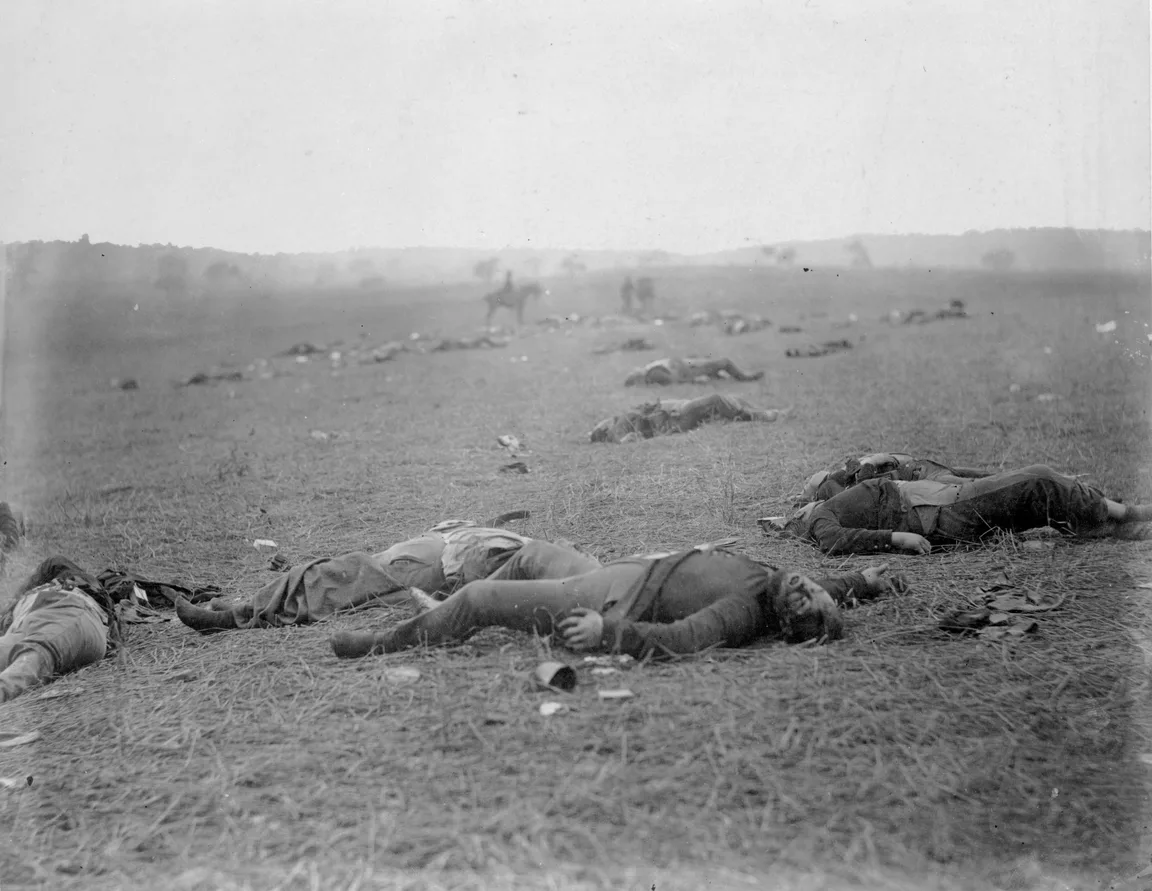
📷 THE PERIOD’S OWN WITNESS — GETTYSBURG, JULY 1863 · "A Harvest of Death" — dead Federal soldiers on the Gettysburg battlefield, July 1863; negative by Timothy H. O'Sullivan, positive by Alexander Gardner.
19th-century photograph held by the Library of Congress, Prints & Photographs Division (digital ID ppmsc.00168, reproduction number LC-B8184-7964-A); Library of Congress: "No known restrictions on publication"; public domain — copyright expired (photographer Timothy H. O'Sullivan, 1840–1882)
🎬 LIVING PLATE — NIGHT OF JANUARY 1, 1863: INSIDE A SMALL WOODEN CHURCH, A BLACK CONGREGATION BY LANTERN LIGHT HEARING THE EMANCIPATION PROCLAMATION READ ALOUD, FACES LIFTED, WINTER NIGHT OUTSIDE THE WINDOWS · Watch Night, January 1, 1863 — a congregation by lantern light hears the Emancipation Proclamation read aloud.
A Proclamation.
Whereas, on the twenty-second day of September, in the year of our Lord one thousand eight hundred and sixty-two, a proclamation was issued by the President of the United States, containing, among other things, the following, to wit:
"That on the first day of January, in the year of our Lord one thousand eight hundred and sixty-three, all persons held as slaves within any State or designated part of a State, the people whereof shall then be in rebellion against the United States, shall be then, thenceforward, and forever free; and the Executive Government of the United States, including the military and naval authority thereof, will recognize and maintain the freedom of such persons, and will do no act or acts to repress such persons, or any of them, in any efforts they may make for their actual freedom.
"That the Executive will, on the first day of January aforesaid, by proclamation, designate the States and parts of States, if any, in which the people thereof, respectively, shall then be in rebellion against the United States; and the fact that any State, or the people thereof, shall on that day be, in good faith, represented in the Congress of the United States by members chosen thereto at elections wherein a majority of the qualified voters of such State shall have participated, shall, in the absence of strong countervailing testimony, be deemed conclusive evidence that such State, and the people thereof, are not then in rebellion against the United States."
Now, therefore I, Abraham Lincoln, President of the United States, by virtue of the power in me vested as Commander-in-Chief, of the Army and Navy of the United States in time of actual armed rebellion against the authority and government of the United States, and as a fit and necessary war measure for suppressing said rebellion, do, on this first day of January, in the year of our Lord one thousand eight hundred and sixty-three, and in accordance with my purpose so to do publicly proclaimed for the full period of one hundred days, from the day first above mentioned, order and designate as the States and parts of States wherein the people thereof respectively, are this day in rebellion against the United States, the following, to wit:
Arkansas, Texas, Louisiana, (except the Parishes of St. Bernard, Plaquemines, Jefferson, St. John, St. Charles, St. James Ascension, Assumption, Terrebonne, Lafourche, St. Mary, St. Martin, and Orleans, including the City of New Orleans) Mississippi, Alabama, Florida, Georgia, South Carolina, North Carolina, and Virginia, (except the forty-eight counties designated as West Virginia, and also the counties of Berkley, Accomac, Northampton, Elizabeth City, York, Princess Ann, and Norfolk, including the cities of Norfolk and Portsmouth[)], and which excepted parts, are for the present, left precisely as if this proclamation were not issued.
And by virtue of the power, and for the purpose aforesaid, I do order and declare that all persons held as slaves within said designated States, and parts of States, are, and henceforward shall be free; and that the Executive government of the United States, including the military and naval authorities thereof, will recognize and maintain the freedom of said persons.
And I hereby enjoin upon the people so declared to be free to abstain from all violence, unless in necessary self-defence; and I recommend to them that, in all cases when allowed, they labor faithfully for reasonable wages.
And I further declare and make known, that such persons of suitable condition, will be received into the armed service of the United States to garrison forts, positions, stations, and other places, and to man vessels of all sorts in said service.
And upon this act, sincerely believed to be an act of justice, warranted by the Constitution, upon military necessity, I invoke the considerate judgment of mankind, and the gracious favor of Almighty God.
In witness whereof, I have hereunto set my hand and caused the seal of the United States to be affixed.
Done at the City of Washington, this first day of January, in the year of our Lord one thousand eight hundred and sixty three, and of the Independence of the United States of America the eighty-seventh.
By the President: ABRAHAM LINCOLN
WILLIAM H. SEWARD, Secretary of State.
THE EMANCIPATION PROCLAMATION (1863) — public domain. Transcription: U.S. National Archives.
© 2026 Eternity Gravestones LLC — this edition’s presentation only. All Rights Reserved.
Four score and seven years ago our fathers brought forth on this continent a new nation, conceived in Liberty, and dedicated to the proposition that all men are created equal.
Now we are engaged in a great civil war, testing whether that nation, or any nation, so conceived and so dedicated, can long endure. We are met on a great battle-field of that war. We have come to dedicate a portion of that field, as a final resting place for those who here gave their lives that that nation might live. It is altogether fitting and proper that we should do this.
But, in a larger sense, we can not dedicate—we can not consecrate—we can not hallow—this ground. The brave men, living and dead, who struggled here, have consecrated it, far above our poor power to add or detract. The world will little note, nor long remember what we say here, but it can never forget what they did here. It is for us the living, rather, to be dedicated here to the unfinished work which they who fought here have thus far so nobly advanced. It is rather for us to be here dedicated to the great task remaining before us—that from these honored dead we take increased devotion to that cause for which they gave the last full measure of devotion—that we here highly resolve that these dead shall not have died in vain—that this nation, under God, shall have a new birth of freedom—and that government of the people, by the people, for the people, shall not perish from the earth.
THE GETTYSBURG ADDRESS (1863) by Abraham Lincoln — public domain. Bliss copy.
© 2026 Eternity Gravestones LLC — this edition’s presentation only. All Rights Reserved.
Fellow countrymen: at this second appearing to take the oath of the presidential office there is less occasion for an extended address than there was at the first. Then a statement somewhat in detail of a course to be pursued seemed fitting and proper. Now, at the expiration of four years during which public declarations have been constantly called forth on every point and phase of the great contest which still absorbs the attention and engrosses the energies of the nation little that is new could be presented. The progress of our arms, upon which all else chiefly depends is as well known to the public as to myself and it is I trust reasonably satisfactory and encouraging to all. With high hope for the future no prediction in regard to it is ventured.
On the occasion corresponding to this four years ago all thoughts were anxiously directed to an impending civil war. All dreaded it ~ all sought to avert it. While the inaugural address was being delivered from this place devoted altogether to saving the Union without war insurgent agents were in the city seeking to destroy it without war ~ seeking to dissolve the Union and divide effects by negotiation. Both parties deprecated war but one of them would make war rather than let the nation survive, and the other would accept war rather than let it perish. And the war came.
One eighth of the whole population were colored slaves not distributed generally over the union but localized in the southern part of it. These slaves constituted a peculiar and powerful interest. All knew that this interest was somehow the cause of the war. To strengthen perpetuate and extend this interest was the object for which the insurgents would rend the Union even by war while the government claimed no right to do more than to restrict the territorial enlargement of it. Neither party expected for the war the magnitude or the duration which it has already attained. Neither anticipated that the cause of the conflict might cease with or even before the conflict itself should cease. Each looked for an easier triumph and a result less fundamental and astounding.
Both read the same Bible and pray to the same God and each invokes His aid against the other. It may seem strange that any men should dare to ask a just God's assistance in wringing their bread from the sweat of other men's faces but let us judge not that we be not judged. The prayers of both could not be answered ~ that of neither has been answered fully. The Almighty has His own purposes.
‘Woe unto the world because of offences! for it must needs be that offences come; but woe to that man by whom the offence cometh!’ If we shall suppose that American Slavery is one of those offences which, in the providence of God, must needs come, but which, having continued through His appointed time, He now wills to remove, and that He gives to both North and South, this terrible war, as the woe due to those by whom the offence came, shall we discern therein any departure from those divine attributes which the believers in a Living God always ascribe to Him?
Fondly do we hope ~ fervently do we pray ~ that this mighty scourge of war may speedily pass away. Yet, if God wills that it continue until all the wealth piled by the bondsman's two hundred and fifty years of unrequited toil shall be sunk and until every drop of blood drawn with the lash shall be paid by another drawn with the sword as was said three thousand years ago so still it must be said 'the judgments of the Lord are true and righteous altogether.
With malice toward none with charity for all with firmness in the right as God gives us to see the right let us strive on to finish the work we are in to bind up the nation's wounds, to care for him who shall have borne the battle and for his widow and his orphan ~ to do all which may achieve and cherish a just and lasting peace among ourselves and with all nations.
SECOND INAUGURAL ADDRESS (1865) by Abraham Lincoln — public domain. Text via the National Park Service.
© 2026 Eternity Gravestones LLC — this edition’s presentation only. All Rights Reserved.
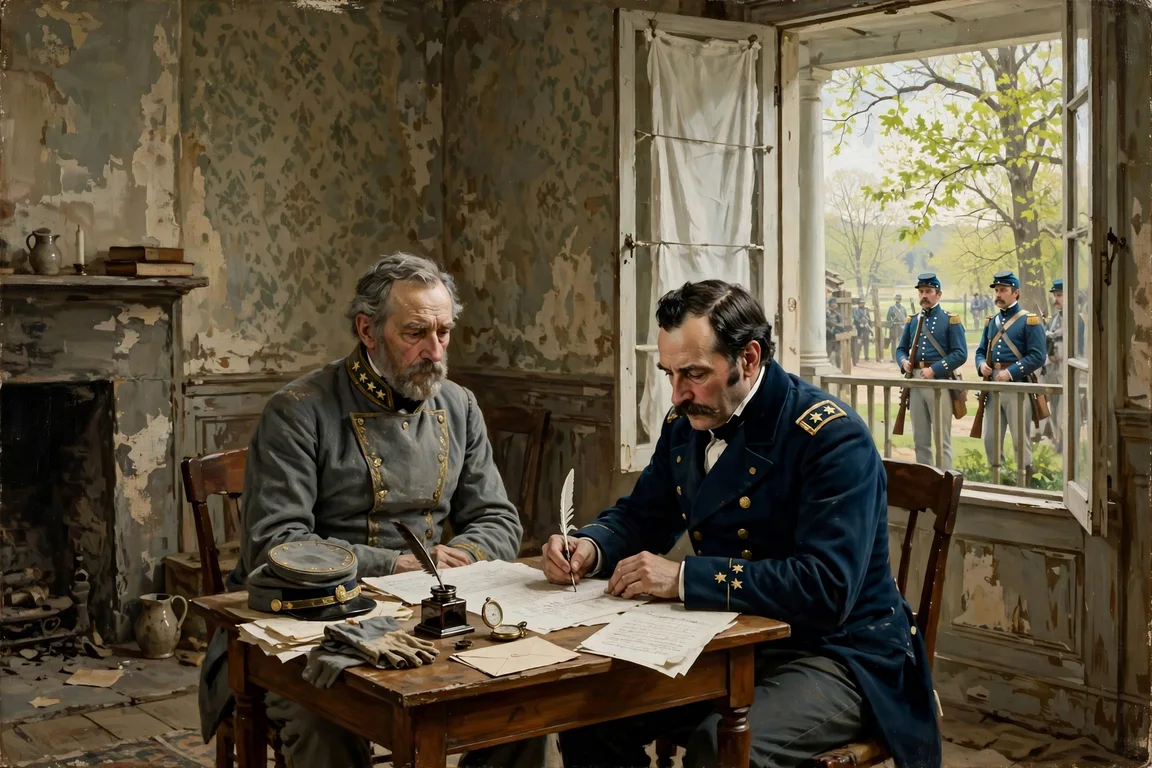
🖼️ APRIL 9, 1865: A QUIET VIRGINIA PARLOR, TWO GENERALS AT A SMALL TABLE SIGNING SURRENDER TERMS, SPRING GREEN VISIBLE THROUGH THE WINDOW, SOLDIERS WAITING SILENTLY OUTSIDE · Appomattox, April 9, 1865 — surrender terms signed in a quiet Virginia parlor, spring green through the window.
I was born in Tuckahoe, near Hillsborough, and about twelve miles from Easton, in Talbot county, Maryland. I have no accurate knowledge of my age, never having seen any authentic record containing it. By far the larger part of the slaves know as little of their ages as horses know of theirs, and it is the wish of most masters within my knowledge to keep their slaves thus ignorant. I do not remember to have ever met a slave who could tell of his birthday. They seldom come nearer to it than planting-time, harvest-time, cherry-time, spring-time, or fall-time. A want of information concerning my own was a source of unhappiness to me even during childhood. The white children could tell their ages. I could not tell why I ought to be deprived of the same privilege. I was not allowed to make any inquiries of my master concerning it. He deemed all such inquiries on the part of a slave improper and impertinent, and evidence of a restless spirit. The nearest estimate I can give makes me now between twenty-seven and twenty-eight years of age. I come to this, from hearing my master say, some time during 1835, I was about seventeen years old.
My mother was named Harriet Bailey. She was the daughter of Isaac and Betsey Bailey, both colored, and quite dark. My mother was of a darker complexion than either my grandmother or grandfather.
My father was a white man. He was admitted to be such by all I ever heard speak of my parentage. The opinion was also whispered that my master was my father; but of the correctness of this opinion, I know nothing; the means of knowing was withheld from me. My mother and I were separated when I was but an infant—before I knew her as my mother. It is a common custom, in the part of Maryland from which I ran away, to part children from their mothers at a very early age. Frequently, before the child has reached its twelfth month, its mother is taken from it, and hired out on some farm a considerable distance off, and the child is placed under the care of an old woman, too old for field labor. For what this separation is done, I do not know, unless it be to hinder the development of the child’s affection toward its mother, and to blunt and destroy the natural affection of the mother for the child. This is the inevitable result.
I never saw my mother, to know her as such, more than four or five times in my life; and each of these times was very short in duration, and at night. She was hired by a Mr. Stewart, who lived about twelve miles from my home. She made her journeys to see me in the night, travelling the whole distance on foot, after the performance of her day’s work. She was a field hand, and a whipping is the penalty of not being in the field at sunrise, unless a slave has special permission from his or her master to the contrary—a permission which they seldom get, and one that gives to him that gives it the proud name of being a kind master. I do not recollect of ever seeing my mother by the light of day. She was with me in the night. She would lie down with me, and get me to sleep, but long before I waked she was gone. Very little communication ever took place between us. Death soon ended what little we could have while she lived, and with it her hardships and suffering. She died when I was about seven years old, on one of my master’s farms, near Lee’s Mill. I was not allowed to be present during her illness, at her death, or burial. She was gone long before I knew any thing about it. Never having enjoyed, to any considerable extent, her soothing presence, her tender and watchful care, I received the tidings of her death with much the same emotions I should have probably felt at the death of a stranger.
Called thus suddenly away, she left me without the slightest intimation of who my father was. The whisper that my master was my father, may or may not be true; and, true or false, it is of but little consequence to my purpose whilst the fact remains, in all its glaring odiousness, that slaveholders have ordained, and by law established, that the children of slave women shall in all cases follow the condition of their mothers; and this is done too obviously to administer to their own lusts, and make a gratification of their wicked desires profitable as well as pleasurable; for by this cunning arrangement, the slaveholder, in cases not a few, sustains to his slaves the double relation of master and father.
I know of such cases; and it is worthy of remark that such slaves invariably suffer greater hardships, and have more to contend with, than others. They are, in the first place, a constant offence to their mistress. She is ever disposed to find fault with them; they can seldom do any thing to please her; she is never better pleased than when she sees them under the lash, especially when she suspects her husband of showing to his mulatto children favors which he withholds from his black slaves. The master is frequently compelled to sell this class of his slaves, out of deference to the feelings of his white wife; and, cruel as the deed may strike any one to be, for a man to sell his own children to human flesh-mongers, it is often the dictate of humanity for him to do so; for, unless he does this, he must not only whip them himself, but must stand by and see one white son tie up his brother, of but few shades darker complexion than himself, and ply the gory lash to his naked back; and if he lisp one word of disapproval, it is set down to his parental partiality, and only makes a bad matter worse, both for himself and the slave whom he would protect and defend.
Every year brings with it multitudes of this class of slaves. It was doubtless in consequence of a knowledge of this fact, that one great statesman of the south predicted the downfall of slavery by the inevitable laws of population. Whether this prophecy is ever fulfilled or not, it is nevertheless plain that a very different-looking class of people are springing up at the south, and are now held in slavery, from those originally brought to this country from Africa; and if their increase do no other good, it will do away the force of the argument, that God cursed Ham, and therefore American slavery is right. If the lineal descendants of Ham are alone to be scripturally enslaved, it is certain that slavery at the south must soon become unscriptural; for thousands are ushered into the world, annually, who, like myself, owe their existence to white fathers, and those fathers most frequently their own masters.
I have had two masters. My first master’s name was Anthony. I do not remember his first name. He was generally called Captain Anthony—a title which, I presume, he acquired by sailing a craft on the Chesapeake Bay. He was not considered a rich slaveholder. He owned two or three farms, and about thirty slaves. His farms and slaves were under the care of an overseer. The overseer’s name was Plummer. Mr. Plummer was a miserable drunkard, a profane swearer, and a savage monster. He always went armed with a cowskin and a heavy cudgel. I have known him to cut and slash the women’s heads so horribly, that even master would be enraged at his cruelty, and would threaten to whip him if he did not mind himself. Master, however, was not a humane slaveholder. It required extraordinary barbarity on the part of an overseer to affect him. He was a cruel man, hardened by a long life of slaveholding. He would at times seem to take great pleasure in whipping a slave. I have often been awakened at the dawn of day by the most heart-rending shrieks of an own aunt of mine, whom he used to tie up to a joist, and whip upon her naked back till she was literally covered with blood. No words, no tears, no prayers, from his gory victim, seemed to move his iron heart from its bloody purpose. The louder she screamed, the harder he whipped; and where the blood ran fastest, there he whipped longest. He would whip her to make her scream, and whip her to make her hush; and not until overcome by fatigue, would he cease to swing the blood-clotted cowskin. I remember the first time I ever witnessed this horrible exhibition. I was quite a child, but I well remember it. I never shall forget it whilst I remember any thing. It was the first of a long series of such outrages, of which I was doomed to be a witness and a participant. It struck me with awful force. It was the blood-stained gate, the entrance to the hell of slavery, through which I was about to pass. It was a most terrible spectacle. I wish I could commit to paper the feelings with which I beheld it.
This occurrence took place very soon after I went to live with my old master, and under the following circumstances. Aunt Hester went out one night,—where or for what I do not know,—and happened to be absent when my master desired her presence. He had ordered her not to go out evenings, and warned her that she must never let him catch her in company with a young man, who was paying attention to her belonging to Colonel Lloyd. The young man’s name was Ned Roberts, generally called Lloyd’s Ned. Why master was so careful of her, may be safely left to conjecture. She was a woman of noble form, and of graceful proportions, having very few equals, and fewer superiors, in personal appearance, among the colored or white women of our neighborhood.
Aunt Hester had not only disobeyed his orders in going out, but had been found in company with Lloyd’s Ned; which circumstance, I found, from what he said while whipping her, was the chief offence. Had he been a man of pure morals himself, he might have been thought interested in protecting the innocence of my aunt; but those who knew him will not suspect him of any such virtue. Before he commenced whipping Aunt Hester, he took her into the kitchen, and stripped her from neck to waist, leaving her neck, shoulders, and back, entirely naked. He then told her to cross her hands, calling her at the same time a d——d b—-h. After crossing her hands, he tied them with a strong rope, and led her to a stool under a large hook in the joist, put in for the purpose. He made her get upon the stool, and tied her hands to the hook. She now stood fair for his infernal purpose. Her arms were stretched up at their full length, so that she stood upon the ends of her toes. He then said to her, “Now, you d——d b—-h, I’ll learn you how to disobey my orders!” and after rolling up his sleeves, he commenced to lay on the heavy cowskin, and soon the warm, red blood (amid heart-rending shrieks from her, and horrid oaths from him) came dripping to the floor. I was so terrified and horror-stricken at the sight, that I hid myself in a closet, and dared not venture out till long after the bloody transaction was over. I expected it would be my turn next. It was all new to me. I had never seen any thing like it before. I had always lived with my grandmother on the outskirts of the plantation, where she was put to raise the children of the younger women. I had therefore been, until now, out of the way of the bloody scenes that often occurred on the plantation.
My master’s family consisted of two sons, Andrew and Richard; one daughter, Lucretia, and her husband, Captain Thomas Auld. They lived in one house, upon the home plantation of Colonel Edward Lloyd. My master was Colonel Lloyd’s clerk and superintendent. He was what might be called the overseer of the overseers. I spent two years of childhood on this plantation in my old master’s family. It was here that I witnessed the bloody transaction recorded in the first chapter; and as I received my first impressions of slavery on this plantation, I will give some description of it, and of slavery as it there existed. The plantation is about twelve miles north of Easton, in Talbot county, and is situated on the border of Miles River. The principal products raised upon it were tobacco, corn, and wheat. These were raised in great abundance; so that, with the products of this and the other farms belonging to him, he was able to keep in almost constant employment a large sloop, in carrying them to market at Baltimore. This sloop was named Sally Lloyd, in honor of one of the colonel’s daughters. My master’s son-in-law, Captain Auld, was master of the vessel; she was otherwise manned by the colonel’s own slaves. Their names were Peter, Isaac, Rich, and Jake. These were esteemed very highly by the other slaves, and looked upon as the privileged ones of the plantation; for it was no small affair, in the eyes of the slaves, to be allowed to see Baltimore.
Colonel Lloyd kept from three to four hundred slaves on his home plantation, and owned a large number more on the neighboring farms belonging to him. The names of the farms nearest to the home plantation were Wye Town and New Design. “Wye Town” was under the overseership of a man named Noah Willis. New Design was under the overseership of a Mr. Townsend. The overseers of these, and all the rest of the farms, numbering over twenty, received advice and direction from the managers of the home plantation. This was the great business place. It was the seat of government for the whole twenty farms. All disputes among the overseers were settled here. If a slave was convicted of any high misdemeanor, became unmanageable, or evinced a determination to run away, he was brought immediately here, severely whipped, put on board the sloop, carried to Baltimore, and sold to Austin Woolfolk, or some other slave-trader, as a warning to the slaves remaining.
Here, too, the slaves of all the other farms received their monthly allowance of food, and their yearly clothing. The men and women slaves received, as their monthly allowance of food, eight pounds of pork, or its equivalent in fish, and one bushel of corn meal. Their yearly clothing consisted of two coarse linen shirts, one pair of linen trousers, like the shirts, one jacket, one pair of trousers for winter, made of coarse negro cloth, one pair of stockings, and one pair of shoes; the whole of which could not have cost more than seven dollars. The allowance of the slave children was given to their mothers, or the old women having the care of them. The children unable to work in the field had neither shoes, stockings, jackets, nor trousers, given to them; their clothing consisted of two coarse linen shirts per year. When these failed them, they went naked until the next allowance-day. Children from seven to ten years old, of both sexes, almost naked, might be seen at all seasons of the year.
There were no beds given the slaves, unless one coarse blanket be considered such, and none but the men and women had these. This, however, is not considered a very great privation. They find less difficulty from the want of beds, than from the want of time to sleep; for when their day’s work in the field is done, the most of them having their washing, mending, and cooking to do, and having few or none of the ordinary facilities for doing either of these, very many of their sleeping hours are consumed in preparing for the field the coming day; and when this is done, old and young, male and female, married and single, drop down side by side, on one common bed,—the cold, damp floor,—each covering himself or herself with their miserable blankets; and here they sleep till they are summoned to the field by the driver’s horn. At the sound of this, all must rise, and be off to the field. There must be no halting; every one must be at his or her post; and woe betides them who hear not this morning summons to the field; for if they are not awakened by the sense of hearing, they are by the sense of feeling: no age nor sex finds any favor. Mr. Severe, the overseer, used to stand by the door of the quarter, armed with a large hickory stick and heavy cowskin, ready to whip any one who was so unfortunate as not to hear, or, from any other cause, was prevented from being ready to start for the field at the sound of the horn.
Mr. Severe was rightly named: he was a cruel man. I have seen him whip a woman, causing the blood to run half an hour at the time; and this, too, in the midst of her crying children, pleading for their mother’s release. He seemed to take pleasure in manifesting his fiendish barbarity. Added to his cruelty, he was a profane swearer. It was enough to chill the blood and stiffen the hair of an ordinary man to hear him talk. Scarce a sentence escaped him but that was commenced or concluded by some horrid oath. The field was the place to witness his cruelty and profanity. His presence made it both the field of blood and of blasphemy. From the rising till the going down of the sun, he was cursing, raving, cutting, and slashing among the slaves of the field, in the most frightful manner. His career was short. He died very soon after I went to Colonel Lloyd’s; and he died as he lived, uttering, with his dying groans, bitter curses and horrid oaths. His death was regarded by the slaves as the result of a merciful providence.
Mr. Severe’s place was filled by a Mr. Hopkins. He was a very different man. He was less cruel, less profane, and made less noise, than Mr. Severe. His course was characterized by no extraordinary demonstrations of cruelty. He whipped, but seemed to take no pleasure in it. He was called by the slaves a good overseer.
The home plantation of Colonel Lloyd wore the appearance of a country village. All the mechanical operations for all the farms were performed here. The shoemaking and mending, the blacksmithing, cartwrighting, coopering, weaving, and grain-grinding, were all performed by the slaves on the home plantation. The whole place wore a business-like aspect very unlike the neighboring farms. The number of houses, too, conspired to give it advantage over the neighboring farms. It was called by the slaves the Great House Farm. Few privileges were esteemed higher, by the slaves of the out-farms, than that of being selected to do errands at the Great House Farm. It was associated in their minds with greatness. A representative could not be prouder of his election to a seat in the American Congress, than a slave on one of the out-farms would be of his election to do errands at the Great House Farm. They regarded it as evidence of great confidence reposed in them by their overseers; and it was on this account, as well as a constant desire to be out of the field from under the driver’s lash, that they esteemed it a high privilege, one worth careful living for. He was called the smartest and most trusty fellow, who had this honor conferred upon him the most frequently. The competitors for this office sought as diligently to please their overseers, as the office-seekers in the political parties seek to please and deceive the people. The same traits of character might be seen in Colonel Lloyd’s slaves, as are seen in the slaves of the political parties.
The slaves selected to go to the Great House Farm, for the monthly allowance for themselves and their fellow-slaves, were peculiarly enthusiastic. While on their way, they would make the dense old woods, for miles around, reverberate with their wild songs, revealing at once the highest joy and the deepest sadness. They would compose and sing as they went along, consulting neither time nor tune. The thought that came up, came out—if not in the word, in the sound;—and as frequently in the one as in the other. They would sometimes sing the most pathetic sentiment in the most rapturous tone, and the most rapturous sentiment in the most pathetic tone. Into all of their songs they would manage to weave something of the Great House Farm. Especially would they do this, when leaving home. They would then sing most exultingly the following words:—
“I am going away to the Great House Farm! O, yea! O, yea! O!”
This they would sing, as a chorus, to words which to many would seem unmeaning jargon, but which, nevertheless, were full of meaning to themselves. I have sometimes thought that the mere hearing of those songs would do more to impress some minds with the horrible character of slavery, than the reading of whole volumes of philosophy on the subject could do.
I did not, when a slave, understand the deep meaning of those rude and apparently incoherent songs. I was myself within the circle; so that I neither saw nor heard as those without might see and hear. They told a tale of woe which was then altogether beyond my feeble comprehension; they were tones loud, long, and deep; they breathed the prayer and complaint of souls boiling over with the bitterest anguish. Every tone was a testimony against slavery, and a prayer to God for deliverance from chains. The hearing of those wild notes always depressed my spirit, and filled me with ineffable sadness. I have frequently found myself in tears while hearing them. The mere recurrence to those songs, even now, afflicts me; and while I am writing these lines, an expression of feeling has already found its way down my cheek. To those songs I trace my first glimmering conception of the dehumanizing character of slavery. I can never get rid of that conception. Those songs still follow me, to deepen my hatred of slavery, and quicken my sympathies for my brethren in bonds. If any one wishes to be impressed with the soul-killing effects of slavery, let him go to Colonel Lloyd’s plantation, and, on allowance-day, place himself in the deep pine woods, and there let him, in silence, analyze the sounds that shall pass through the chambers of his soul,—and if he is not thus impressed, it will only be because “there is no flesh in his obdurate heart.”
I have often been utterly astonished, since I came to the north, to find persons who could speak of the singing, among slaves, as evidence of their contentment and happiness. It is impossible to conceive of a greater mistake. Slaves sing most when they are most unhappy. The songs of the slave represent the sorrows of his heart; and he is relieved by them, only as an aching heart is relieved by its tears. At least, such is my experience. I have often sung to drown my sorrow, but seldom to express my happiness. Crying for joy, and singing for joy, were alike uncommon to me while in the jaws of slavery. The singing of a man cast away upon a desolate island might be as appropriately considered as evidence of contentment and happiness, as the singing of a slave; the songs of the one and of the other are prompted by the same emotion.
My new mistress proved to be all she appeared when I first met her at the door,—a woman of the kindest heart and finest feelings. She had never had a slave under her control previously to myself, and prior to her marriage she had been dependent upon her own industry for a living. She was by trade a weaver; and by constant application to her business, she had been in a good degree preserved from the blighting and dehumanizing effects of slavery. I was utterly astonished at her goodness. I scarcely knew how to behave towards her. She was entirely unlike any other white woman I had ever seen. I could not approach her as I was accustomed to approach other white ladies. My early instruction was all out of place. The crouching servility, usually so acceptable a quality in a slave, did not answer when manifested toward her. Her favor was not gained by it; she seemed to be disturbed by it. She did not deem it impudent or unmannerly for a slave to look her in the face. The meanest slave was put fully at ease in her presence, and none left without feeling better for having seen her. Her face was made of heavenly smiles, and her voice of tranquil music.
But, alas! this kind heart had but a short time to remain such. The fatal poison of irresponsible power was already in her hands, and soon commenced its infernal work. That cheerful eye, under the influence of slavery, soon became red with rage; that voice, made all of sweet accord, changed to one of harsh and horrid discord; and that angelic face gave place to that of a demon.
Very soon after I went to live with Mr. and Mrs. Auld, she very kindly commenced to teach me the A, B, C. After I had learned this, she assisted me in learning to spell words of three or four letters. Just at this point of my progress, Mr. Auld found out what was going on, and at once forbade Mrs. Auld to instruct me further, telling her, among other things, that it was unlawful, as well as unsafe, to teach a slave to read. To use his own words, further, he said, “If you give a nigger an inch, he will take an ell. A nigger should know nothing but to obey his master—to do as he is told to do. Learning would spoil the best nigger in the world. Now,” said he, “if you teach that nigger (speaking of myself) how to read, there would be no keeping him. It would forever unfit him to be a slave. He would at once become unmanageable, and of no value to his master. As to himself, it could do him no good, but a great deal of harm. It would make him discontented and unhappy.” These words sank deep into my heart, stirred up sentiments within that lay slumbering, and called into existence an entirely new train of thought. It was a new and special revelation, explaining dark and mysterious things, with which my youthful understanding had struggled, but struggled in vain. I now understood what had been to me a most perplexing difficulty—to wit, the white man’s power to enslave the black man. It was a grand achievement, and I prized it highly. From that moment, I understood the pathway from slavery to freedom. It was just what I wanted, and I got it at a time when I the least expected it. Whilst I was saddened by the thought of losing the aid of my kind mistress, I was gladdened by the invaluable instruction which, by the merest accident, I had gained from my master. Though conscious of the difficulty of learning without a teacher, I set out with high hope, and a fixed purpose, at whatever cost of trouble, to learn how to read. The very decided manner with which he spoke, and strove to impress his wife with the evil consequences of giving me instruction, served to convince me that he was deeply sensible of the truths he was uttering. It gave me the best assurance that I might rely with the utmost confidence on the results which, he said, would flow from teaching me to read. What he most dreaded, that I most desired. What he most loved, that I most hated. That which to him was a great evil, to be carefully shunned, was to me a great good, to be diligently sought; and the argument which he so warmly urged, against my learning to read, only served to inspire me with a desire and determination to learn. In learning to read, I owe almost as much to the bitter opposition of my master, as to the kindly aid of my mistress. I acknowledge the benefit of both.
I had resided but a short time in Baltimore before I observed a marked difference, in the treatment of slaves, from that which I had witnessed in the country. A city slave is almost a freeman, compared with a slave on the plantation. He is much better fed and clothed, and enjoys privileges altogether unknown to the slave on the plantation. There is a vestige of decency, a sense of shame, that does much to curb and check those outbreaks of atrocious cruelty so commonly enacted upon the plantation. He is a desperate slaveholder, who will shock the humanity of his non-slaveholding neighbors with the cries of his lacerated slave. Few are willing to incur the odium attaching to the reputation of being a cruel master; and above all things, they would not be known as not giving a slave enough to eat. Every city slaveholder is anxious to have it known of him, that he feeds his slaves well; and it is due to them to say, that most of them do give their slaves enough to eat. There are, however, some painful exceptions to this rule. Directly opposite to us, on Philpot Street, lived Mr. Thomas Hamilton. He owned two slaves. Their names were Henrietta and Mary. Henrietta was about twenty-two years of age, Mary was about fourteen; and of all the mangled and emaciated creatures I ever looked upon, these two were the most so. His heart must be harder than stone, that could look upon these unmoved. The head, neck, and shoulders of Mary were literally cut to pieces. I have frequently felt her head, and found it nearly covered with festering sores, caused by the lash of her cruel mistress. I do not know that her master ever whipped her, but I have been an eye-witness to the cruelty of Mrs. Hamilton. I used to be in Mr. Hamilton’s house nearly every day. Mrs. Hamilton used to sit in a large chair in the middle of the room, with a heavy cowskin always by her side, and scarce an hour passed during the day but was marked by the blood of one of these slaves. The girls seldom passed her without her saying, “Move faster, you black gip!” at the same time giving them a blow with the cowskin over the head or shoulders, often drawing the blood. She would then say, “Take that, you black gip!” continuing, “If you don’t move faster, I’ll move you!” Added to the cruel lashings to which these slaves were subjected, they were kept nearly half-starved. They seldom knew what it was to eat a full meal. I have seen Mary contending with the pigs for the offal thrown into the street. So much was Mary kicked and cut to pieces, that she was oftener called “pecked” than by her name.
I lived in Master Hugh’s family about seven years. During this time, I succeeded in learning to read and write. In accomplishing this, I was compelled to resort to various stratagems. I had no regular teacher. My mistress, who had kindly commenced to instruct me, had, in compliance with the advice and direction of her husband, not only ceased to instruct, but had set her face against my being instructed by any one else. It is due, however, to my mistress to say of her, that she did not adopt this course of treatment immediately. She at first lacked the depravity indispensable to shutting me up in mental darkness. It was at least necessary for her to have some training in the exercise of irresponsible power, to make her equal to the task of treating me as though I were a brute.
My mistress was, as I have said, a kind and tender-hearted woman; and in the simplicity of her soul she commenced, when I first went to live with her, to treat me as she supposed one human being ought to treat another. In entering upon the duties of a slaveholder, she did not seem to perceive that I sustained to her the relation of a mere chattel, and that for her to treat me as a human being was not only wrong, but dangerously so. Slavery proved as injurious to her as it did to me. When I went there, she was a pious, warm, and tender-hearted woman. There was no sorrow or suffering for which she had not a tear. She had bread for the hungry, clothes for the naked, and comfort for every mourner that came within her reach. Slavery soon proved its ability to divest her of these heavenly qualities. Under its influence, the tender heart became stone, and the lamblike disposition gave way to one of tiger-like fierceness. The first step in her downward course was in her ceasing to instruct me. She now commenced to practise her husband’s precepts. She finally became even more violent in her opposition than her husband himself. She was not satisfied with simply doing as well as he had commanded; she seemed anxious to do better. Nothing seemed to make her more angry than to see me with a newspaper. She seemed to think that here lay the danger. I have had her rush at me with a face made all up of fury, and snatch from me a newspaper, in a manner that fully revealed her apprehension. She was an apt woman; and a little experience soon demonstrated, to her satisfaction, that education and slavery were incompatible with each other.
From this time I was most narrowly watched. If I was in a separate room any considerable length of time, I was sure to be suspected of having a book, and was at once called to give an account of myself. All this, however, was too late. The first step had been taken. Mistress, in teaching me the alphabet, had given me the inch, and no precaution could prevent me from taking the ell.
The plan which I adopted, and the one by which I was most successful, was that of making friends of all the little white boys whom I met in the street. As many of these as I could, I converted into teachers. With their kindly aid, obtained at different times and in different places, I finally succeeded in learning to read. When I was sent of errands, I always took my book with me, and by going one part of my errand quickly, I found time to get a lesson before my return. I used also to carry bread with me, enough of which was always in the house, and to which I was always welcome; for I was much better off in this regard than many of the poor white children in our neighborhood. This bread I used to bestow upon the hungry little urchins, who, in return, would give me that more valuable bread of knowledge. I am strongly tempted to give the names of two or three of those little boys, as a testimonial of the gratitude and affection I bear them; but prudence forbids;—not that it would injure me, but it might embarrass them; for it is almost an unpardonable offence to teach slaves to read in this Christian country. It is enough to say of the dear little fellows, that they lived on Philpot Street, very near Durgin and Bailey’s ship-yard. I used to talk this matter of slavery over with them. I would sometimes say to them, I wished I could be as free as they would be when they got to be men. “You will be free as soon as you are twenty-one, but I am a slave for life! Have not I as good a right to be free as you have?” These words used to trouble them; they would express for me the liveliest sympathy, and console me with the hope that something would occur by which I might be free.
I was now about twelve years old, and the thought of being a slave for life began to bear heavily upon my heart. Just about this time, I got hold of a book entitled “The Columbian Orator.” Every opportunity I got, I used to read this book. Among much of other interesting matter, I found in it a dialogue between a master and his slave. The slave was represented as having run away from his master three times. The dialogue represented the conversation which took place between them, when the slave was retaken the third time. In this dialogue, the whole argument in behalf of slavery was brought forward by the master, all of which was disposed of by the slave. The slave was made to say some very smart as well as impressive things in reply to his master—things which had the desired though unexpected effect; for the conversation resulted in the voluntary emancipation of the slave on the part of the master.
In the same book, I met with one of Sheridan’s mighty speeches on and in behalf of Catholic emancipation. These were choice documents to me. I read them over and over again with unabated interest. They gave tongue to interesting thoughts of my own soul, which had frequently flashed through my mind, and died away for want of utterance. The moral which I gained from the dialogue was the power of truth over the conscience of even a slaveholder. What I got from Sheridan was a bold denunciation of slavery, and a powerful vindication of human rights. The reading of these documents enabled me to utter my thoughts, and to meet the arguments brought forward to sustain slavery; but while they relieved me of one difficulty, they brought on another even more painful than the one of which I was relieved. The more I read, the more I was led to abhor and detest my enslavers. I could regard them in no other light than a band of successful robbers, who had left their homes, and gone to Africa, and stolen us from our homes, and in a strange land reduced us to slavery. I loathed them as being the meanest as well as the most wicked of men. As I read and contemplated the subject, behold! that very discontentment which Master Hugh had predicted would follow my learning to read had already come, to torment and sting my soul to unutterable anguish. As I writhed under it, I would at times feel that learning to read had been a curse rather than a blessing. It had given me a view of my wretched condition, without the remedy. It opened my eyes to the horrible pit, but to no ladder upon which to get out. In moments of agony, I envied my fellow-slaves for their stupidity. I have often wished myself a beast. I preferred the condition of the meanest reptile to my own. Any thing, no matter what, to get rid of thinking! It was this everlasting thinking of my condition that tormented me. There was no getting rid of it. It was pressed upon me by every object within sight or hearing, animate or inanimate. The silver trump of freedom had roused my soul to eternal wakefulness. Freedom now appeared, to disappear no more forever. It was heard in every sound, and seen in every thing. It was ever present to torment me with a sense of my wretched condition. I saw nothing without seeing it, I heard nothing without hearing it, and felt nothing without feeling it. It looked from every star, it smiled in every calm, breathed in every wind, and moved in every storm.
I often found myself regretting my own existence, and wishing myself dead; and but for the hope of being free, I have no doubt but that I should have killed myself, or done something for which I should have been killed. While in this state of mind, I was eager to hear any one speak of slavery. I was a ready listener. Every little while, I could hear something about the abolitionists. It was some time before I found what the word meant. It was always used in such connections as to make it an interesting word to me. If a slave ran away and succeeded in getting clear, or if a slave killed his master, set fire to a barn, or did any thing very wrong in the mind of a slaveholder, it was spoken of as the fruit of abolition. Hearing the word in this connection very often, I set about learning what it meant. The dictionary afforded me little or no help. I found it was “the act of abolishing;” but then I did not know what was to be abolished. Here I was perplexed. I did not dare to ask any one about its meaning, for I was satisfied that it was something they wanted me to know very little about. After a patient waiting, I got one of our city papers, containing an account of the number of petitions from the north, praying for the abolition of slavery in the District of Columbia, and of the slave trade between the States. From this time I understood the words abolition and abolitionist, and always drew near when that word was spoken, expecting to hear something of importance to myself and fellow-slaves. The light broke in upon me by degrees. I went one day down on the wharf of Mr. Waters; and seeing two Irishmen unloading a scow of stone, I went, unasked, and helped them. When we had finished, one of them came to me and asked me if I were a slave. I told him I was. He asked, “Are ye a slave for life?” I told him that I was. The good Irishman seemed to be deeply affected by the statement. He said to the other that it was a pity so fine a little fellow as myself should be a slave for life. He said it was a shame to hold me. They both advised me to run away to the north; that I should find friends there, and that I should be free. I pretended not to be interested in what they said, and treated them as if I did not understand them; for I feared they might be treacherous. White men have been known to encourage slaves to escape, and then, to get the reward, catch them and return them to their masters. I was afraid that these seemingly good men might use me so; but I nevertheless remembered their advice, and from that time I resolved to run away. I looked forward to a time at which it would be safe for me to escape. I was too young to think of doing so immediately; besides, I wished to learn how to write, as I might have occasion to write my own pass. I consoled myself with the hope that I should one day find a good chance. Meanwhile, I would learn to write.
The idea as to how I might learn to write was suggested to me by being in Durgin and Bailey’s ship-yard, and frequently seeing the ship carpenters, after hewing, and getting a piece of timber ready for use, write on the timber the name of that part of the ship for which it was intended. When a piece of timber was intended for the larboard side, it would be marked thus—“L.” When a piece was for the starboard side, it would be marked thus—“S.” A piece for the larboard side forward, would be marked thus—“L. F.” When a piece was for starboard side forward, it would be marked thus—“S. F.” For larboard aft, it would be marked thus—“L. A.” For starboard aft, it would be marked thus—“S. A.” I soon learned the names of these letters, and for what they were intended when placed upon a piece of timber in the ship-yard. I immediately commenced copying them, and in a short time was able to make the four letters named. After that, when I met with any boy who I knew could write, I would tell him I could write as well as he. The next word would be, “I don’t believe you. Let me see you try it.” I would then make the letters which I had been so fortunate as to learn, and ask him to beat that. In this way I got a good many lessons in writing, which it is quite possible I should never have gotten in any other way. During this time, my copy-book was the board fence, brick wall, and pavement; my pen and ink was a lump of chalk. With these, I learned mainly how to write. I then commenced and continued copying the Italics in Webster’s Spelling Book, until I could make them all without looking on the book. By this time, my little Master Thomas had gone to school, and learned how to write, and had written over a number of copy-books. These had been brought home, and shown to some of our near neighbors, and then laid aside. My mistress used to go to class meeting at the Wilk Street meetinghouse every Monday afternoon, and leave me to take care of the house. When left thus, I used to spend the time in writing in the spaces left in Master Thomas’s copy-book, copying what he had written. I continued to do this until I could write a hand very similar to that of Master Thomas. Thus, after a long, tedious effort for years, I finally succeeded in learning how to write.
I now come to that part of my life during which I planned, and finally succeeded in making, my escape from slavery. But before narrating any of the peculiar circumstances, I deem it proper to make known my intention not to state all the facts connected with the transaction. My reasons for pursuing this course may be understood from the following: First, were I to give a minute statement of all the facts, it is not only possible, but quite probable, that others would thereby be involved in the most embarrassing difficulties. Secondly, such a statement would most undoubtedly induce greater vigilance on the part of slaveholders than has existed heretofore among them; which would, of course, be the means of guarding a door whereby some dear brother bondman might escape his galling chains. I deeply regret the necessity that impels me to suppress any thing of importance connected with my experience in slavery. It would afford me great pleasure indeed, as well as materially add to the interest of my narrative, were I at liberty to gratify a curiosity, which I know exists in the minds of many, by an accurate statement of all the facts pertaining to my most fortunate escape. But I must deprive myself of this pleasure, and the curious of the gratification which such a statement would afford. I would allow myself to suffer under the greatest imputations which evil-minded men might suggest, rather than exculpate myself, and thereby run the hazard of closing the slightest avenue by which a brother slave might clear himself of the chains and fetters of slavery.
I have never approved of the very public manner in which some of our western friends have conducted what they call the underground railroad, but which I think, by their open declarations, has been made most emphatically the upperground railroad. I honor those good men and women for their noble daring, and applaud them for willingly subjecting themselves to bloody persecution, by openly avowing their participation in the escape of slaves. I, however, can see very little good resulting from such a course, either to themselves or the slaves escaping; while, upon the other hand, I see and feel assured that those open declarations are a positive evil to the slaves remaining, who are seeking to escape. They do nothing towards enlightening the slave, whilst they do much towards enlightening the master. They stimulate him to greater watchfulness, and enhance his power to capture his slave. We owe something to the slave south of the line as well as to those north of it; and in aiding the latter on their way to freedom, we should be careful to do nothing which would be likely to hinder the former from escaping from slavery. I would keep the merciless slaveholder profoundly ignorant of the means of flight adopted by the slave. I would leave him to imagine himself surrounded by myriads of invisible tormentors, ever ready to snatch from his infernal grasp his trembling prey. Let him be left to feel his way in the dark; let darkness commensurate with his crime hover over him; and let him feel that at every step he takes, in pursuit of the flying bondman, he is running the frightful risk of having his hot brains dashed out by an invisible agency. Let us render the tyrant no aid; let us not hold the light by which he can trace the footprints of our flying brother. But enough of this. I will now proceed to the statement of those facts, connected with my escape, for which I am alone responsible, and for which no one can be made to suffer but myself.
In the early part of the year 1838, I became quite restless. I could see no reason why I should, at the end of each week, pour the reward of my toil into the purse of my master. When I carried to him my weekly wages, he would, after counting the money, look me in the face with a robber-like fierceness, and ask, “Is this all?” He was satisfied with nothing less than the last cent. He would, however, when I made him six dollars, sometimes give me six cents, to encourage me. It had the opposite effect. I regarded it as a sort of admission of my right to the whole. The fact that he gave me any part of my wages was proof, to my mind, that he believed me entitled to the whole of them. I always felt worse for having received any thing; for I feared that the giving me a few cents would ease his conscience, and make him feel himself to be a pretty honorable sort of robber. My discontent grew upon me. I was ever on the look-out for means of escape; and, finding no direct means, I determined to try to hire my time, with a view of getting money with which to make my escape. In the spring of 1838, when Master Thomas came to Baltimore to purchase his spring goods, I got an opportunity, and applied to him to allow me to hire my time. He unhesitatingly refused my request, and told me this was another stratagem by which to escape. He told me I could go nowhere but that he could get me; and that, in the event of my running away, he should spare no pains in his efforts to catch me. He exhorted me to content myself, and be obedient. He told me, if I would be happy, I must lay out no plans for the future. He said, if I behaved myself properly, he would take care of me. Indeed, he advised me to complete thoughtlessness of the future, and taught me to depend solely upon him for happiness. He seemed to see fully the pressing necessity of setting aside my intellectual nature, in order to contentment in slavery. But in spite of him, and even in spite of myself, I continued to think, and to think about the injustice of my enslavement, and the means of escape.
About two months after this, I applied to Master Hugh for the privilege of hiring my time. He was not acquainted with the fact that I had applied to Master Thomas, and had been refused. He too, at first, seemed disposed to refuse; but, after some reflection, he granted me the privilege, and proposed the following terms: I was to be allowed all my time, make all contracts with those for whom I worked, and find my own employment; and, in return for this liberty, I was to pay him three dollars at the end of each week; find myself in calking tools, and in board and clothing. My board was two dollars and a half per week. This, with the wear and tear of clothing and calking tools, made my regular expenses about six dollars per week. This amount I was compelled to make up, or relinquish the privilege of hiring my time. Rain or shine, work or no work, at the end of each week the money must be forthcoming, or I must give up my privilege. This arrangement, it will be perceived, was decidedly in my master’s favor. It relieved him of all need of looking after me. His money was sure. He received all the benefits of slaveholding without its evils; while I endured all the evils of a slave, and suffered all the care and anxiety of a freeman. I found it a hard bargain. But, hard as it was, I thought it better than the old mode of getting along. It was a step towards freedom to be allowed to bear the responsibilities of a freeman, and I was determined to hold on upon it. I bent myself to the work of making money. I was ready to work at night as well as day, and by the most untiring perseverance and industry, I made enough to meet my expenses, and lay up a little money every week. I went on thus from May till August. Master Hugh then refused to allow me to hire my time longer. The ground for his refusal was a failure on my part, one Saturday night, to pay him for my week’s time. This failure was occasioned by my attending a camp meeting about ten miles from Baltimore. During the week, I had entered into an engagement with a number of young friends to start from Baltimore to the camp ground early Saturday evening; and being detained by my employer, I was unable to get down to Master Hugh’s without disappointing the company. I knew that Master Hugh was in no special need of the money that night. I therefore decided to go to camp meeting, and upon my return pay him the three dollars. I staid at the camp meeting one day longer than I intended when I left. But as soon as I returned, I called upon him to pay him what he considered his due. I found him very angry; he could scarce restrain his wrath. He said he had a great mind to give me a severe whipping. He wished to know how I dared go out of the city without asking his permission. I told him I hired my time and while I paid him the price which he asked for it, I did not know that I was bound to ask him when and where I should go. This reply troubled him; and, after reflecting a few moments, he turned to me, and said I should hire my time no longer; that the next thing he should know of, I would be running away. Upon the same plea, he told me to bring my tools and clothing home forthwith. I did so; but instead of seeking work, as I had been accustomed to do previously to hiring my time, I spent the whole week without the performance of a single stroke of work. I did this in retaliation. Saturday night, he called upon me as usual for my week’s wages. I told him I had no wages; I had done no work that week. Here we were upon the point of coming to blows. He raved, and swore his determination to get hold of me. I did not allow myself a single word; but was resolved, if he laid the weight of his hand upon me, it should be blow for blow. He did not strike me, but told me that he would find me in constant employment in future. I thought the matter over during the next day, Sunday, and finally resolved upon the third day of September, as the day upon which I would make a second attempt to secure my freedom. I now had three weeks during which to prepare for my journey. Early on Monday morning, before Master Hugh had time to make any engagement for me, I went out and got employment of Mr. Butler, at his ship-yard near the drawbridge, upon what is called the City Block, thus making it unnecessary for him to seek employment for me. At the end of the week, I brought him between eight and nine dollars. He seemed very well pleased, and asked why I did not do the same the week before. He little knew what my plans were. My object in working steadily was to remove any suspicion he might entertain of my intent to run away; and in this I succeeded admirably. I suppose he thought I was never better satisfied with my condition than at the very time during which I was planning my escape. The second week passed, and again I carried him my full wages; and so well pleased was he, that he gave me twenty-five cents, (quite a large sum for a slaveholder to give a slave,) and bade me to make a good use of it. I told him I would.
Things went on without very smoothly indeed, but within there was trouble. It is impossible for me to describe my feelings as the time of my contemplated start drew near. I had a number of warmhearted friends in Baltimore,—friends that I loved almost as I did my life,—and the thought of being separated from them forever was painful beyond expression. It is my opinion that thousands would escape from slavery, who now remain, but for the strong cords of affection that bind them to their friends. The thought of leaving my friends was decidedly the most painful thought with which I had to contend. The love of them was my tender point, and shook my decision more than all things else. Besides the pain of separation, the dread and apprehension of a failure exceeded what I had experienced at my first attempt. The appalling defeat I then sustained returned to torment me. I felt assured that, if I failed in this attempt, my case would be a hopeless one—it would seal my fate as a slave forever. I could not hope to get off with any thing less than the severest punishment, and being placed beyond the means of escape. It required no very vivid imagination to depict the most frightful scenes through which I should have to pass, in case I failed. The wretchedness of slavery, and the blessedness of freedom, were perpetually before me. It was life and death with me. But I remained firm, and, according to my resolution, on the third day of September, 1838, I left my chains, and succeeded in reaching New York without the slightest interruption of any kind. How I did so,—what means I adopted,—what direction I travelled, and by what mode of conveyance,—I must leave unexplained, for the reasons before mentioned.
I have been frequently asked how I felt when I found myself in a free State. I have never been able to answer the question with any satisfaction to myself. It was a moment of the highest excitement I ever experienced. I suppose I felt as one may imagine the unarmed mariner to feel when he is rescued by a friendly man-of-war from the pursuit of a pirate. In writing to a dear friend, immediately after my arrival at New York, I said I felt like one who had escaped a den of hungry lions. This state of mind, however, very soon subsided; and I was again seized with a feeling of great insecurity and loneliness. I was yet liable to be taken back, and subjected to all the tortures of slavery. This in itself was enough to damp the ardor of my enthusiasm. But the loneliness overcame me. There I was in the midst of thousands, and yet a perfect stranger; without home and without friends, in the midst of thousands of my own brethren—children of a common Father, and yet I dared not to unfold to any one of them my sad condition. I was afraid to speak to any one for fear of speaking to the wrong one, and thereby falling into the hands of money-loving kidnappers, whose business it was to lie in wait for the panting fugitive, as the ferocious beasts of the forest lie in wait for their prey. The motto which I adopted when I started from slavery was this—“Trust no man!” I saw in every white man an enemy, and in almost every colored man cause for distrust. It was a most painful situation; and, to understand it, one must needs experience it, or imagine himself in similar circumstances. Let him be a fugitive slave in a strange land—a land given up to be the hunting-ground for slaveholders—whose inhabitants are legalized kidnappers—where he is every moment subjected to the terrible liability of being seized upon by his fellowmen, as the hideous crocodile seizes upon his prey!—I say, let him place himself in my situation—without home or friends—without money or credit—wanting shelter, and no one to give it—wanting bread, and no money to buy it,—and at the same time let him feel that he is pursued by merciless men-hunters, and in total darkness as to what to do, where to go, or where to stay,—perfectly helpless both as to the means of defence and means of escape,—in the midst of plenty, yet suffering the terrible gnawings of hunger,—in the midst of houses, yet having no home,—among fellow-men, yet feeling as if in the midst of wild beasts, whose greediness to swallow up the trembling and half-famished fugitive is only equalled by that with which the monsters of the deep swallow up the helpless fish upon which they subsist,—I say, let him be placed in this most trying situation,—the situation in which I was placed,—then, and not till then, will he fully appreciate the hardships of, and know how to sympathize with, the toil-worn and whip-scarred fugitive slave.
Thank Heaven, I remained but a short time in this distressed situation. I was relieved from it by the humane hand of Mr. David Ruggles, whose vigilance, kindness, and perseverance, I shall never forget. I am glad of an opportunity to express, as far as words can, the love and gratitude I bear him. Mr. Ruggles is now afflicted with blindness, and is himself in need of the same kind offices which he was once so forward in the performance of toward others. I had been in New York but a few days, when Mr. Ruggles sought me out, and very kindly took me to his boarding-house at the corner of Church and Lespenard Streets. Mr. Ruggles was then very deeply engaged in the memorable Darg case, as well as attending to a number of other fugitive slaves, devising ways and means for their successful escape; and, though watched and hemmed in on almost every side, he seemed to be more than a match for his enemies.
Very soon after I went to Mr. Ruggles, he wished to know of me where I wanted to go; as he deemed it unsafe for me to remain in New York. I told him I was a calker, and should like to go where I could get work. I thought of going to Canada; but he decided against it, and in favor of my going to New Bedford, thinking I should be able to get work there at my trade. At this time, Anna,[2] my intended wife, came on; for I wrote to her immediately after my arrival at New York, (notwithstanding my homeless, houseless, and helpless condition,) informing her of my successful flight, and wishing her to come on forthwith. In a few days after her arrival, Mr. Ruggles called in the Rev. J. W. C. Pennington, who, in the presence of Mr. Ruggles, Mrs. Michaels, and two or three others, performed the marriage ceremony, and gave us a certificate, of which the following is an exact copy:—
“This may certify, that I joined together in holy matrimony Frederick Johnson[3] and Anna Murray, as man and wife, in the presence of Mr. David Ruggles and Mrs. Michaels.
“JAMES W. C. PENNINGTON “New York, Sept. 15, 1838”
[2] She was free.
[3] I had changed my name from Frederick Bailey to that of Johnson.
Upon receiving this certificate, and a five-dollar bill from Mr. Ruggles, I shouldered one part of our baggage, and Anna took up the other, and we set out forthwith to take passage on board of the steamboat John W. Richmond for Newport, on our way to New Bedford. Mr. Ruggles gave me a letter to a Mr. Shaw in Newport, and told me, in case my money did not serve me to New Bedford, to stop in Newport and obtain further assistance; but upon our arrival at Newport, we were so anxious to get to a place of safety, that, notwithstanding we lacked the necessary money to pay our fare, we decided to take seats in the stage, and promise to pay when we got to New Bedford. We were encouraged to do this by two excellent gentlemen, residents of New Bedford, whose names I afterward ascertained to be Joseph Ricketson and William C. Taber. They seemed at once to understand our circumstances, and gave us such assurance of their friendliness as put us fully at ease in their presence.
It was good indeed to meet with such friends, at such a time. Upon reaching New Bedford, we were directed to the house of Mr. Nathan Johnson, by whom we were kindly received, and hospitably provided for. Both Mr. and Mrs. Johnson took a deep and lively interest in our welfare. They proved themselves quite worthy of the name of abolitionists. When the stage-driver found us unable to pay our fare, he held on upon our baggage as security for the debt. I had but to mention the fact to Mr. Johnson, and he forthwith advanced the money.
We now began to feel a degree of safety, and to prepare ourselves for the duties and responsibilities of a life of freedom. On the morning after our arrival at New Bedford, while at the breakfast-table, the question arose as to what name I should be called by. The name given me by my mother was, “Frederick Augustus Washington Bailey.” I, however, had dispensed with the two middle names long before I left Maryland so that I was generally known by the name of “Frederick Bailey.” I started from Baltimore bearing the name of “Stanley.” When I got to New York, I again changed my name to “Frederick Johnson,” and thought that would be the last change. But when I got to New Bedford, I found it necessary again to change my name. The reason of this necessity was, that there were so many Johnsons in New Bedford, it was already quite difficult to distinguish between them. I gave Mr. Johnson the privilege of choosing me a name, but told him he must not take from me the name of “Frederick.” I must hold on to that, to preserve a sense of my identity. Mr. Johnson had just been reading the “Lady of the Lake,” and at once suggested that my name be “Douglass.” From that time until now I have been called “Frederick Douglass;” and as I am more widely known by that name than by either of the others, I shall continue to use it as my own.
I was quite disappointed at the general appearance of things in New Bedford. The impression which I had received respecting the character and condition of the people of the north, I found to be singularly erroneous. I had very strangely supposed, while in slavery, that few of the comforts, and scarcely any of the luxuries, of life were enjoyed at the north, compared with what were enjoyed by the slaveholders of the south. I probably came to this conclusion from the fact that northern people owned no slaves. I supposed that they were about upon a level with the non-slaveholding population of the south. I knew they were exceedingly poor, and I had been accustomed to regard their poverty as the necessary consequence of their being non-slaveholders. I had somehow imbibed the opinion that, in the absence of slaves, there could be no wealth, and very little refinement. And upon coming to the north, I expected to meet with a rough, hard-handed, and uncultivated population, living in the most Spartan-like simplicity, knowing nothing of the ease, luxury, pomp, and grandeur of southern slaveholders. Such being my conjectures, any one acquainted with the appearance of New Bedford may very readily infer how palpably I must have seen my mistake.
In the afternoon of the day when I reached New Bedford, I visited the wharves, to take a view of the shipping. Here I found myself surrounded with the strongest proofs of wealth. Lying at the wharves, and riding in the stream, I saw many ships of the finest model, in the best order, and of the largest size. Upon the right and left, I was walled in by granite warehouses of the widest dimensions, stowed to their utmost capacity with the necessaries and comforts of life. Added to this, almost every body seemed to be at work, but noiselessly so, compared with what I had been accustomed to in Baltimore. There were no loud songs heard from those engaged in loading and unloading ships. I heard no deep oaths or horrid curses on the laborer. I saw no whipping of men; but all seemed to go smoothly on. Every man appeared to understand his work, and went at it with a sober, yet cheerful earnestness, which betokened the deep interest which he felt in what he was doing, as well as a sense of his own dignity as a man. To me this looked exceedingly strange. From the wharves I strolled around and over the town, gazing with wonder and admiration at the splendid churches, beautiful dwellings, and finely-cultivated gardens; evincing an amount of wealth, comfort, taste, and refinement, such as I had never seen in any part of slaveholding Maryland.
Every thing looked clean, new, and beautiful. I saw few or no dilapidated houses, with poverty-stricken inmates; no half-naked children and barefooted women, such as I had been accustomed to see in Hillsborough, Easton, St. Michael’s, and Baltimore. The people looked more able, stronger, healthier, and happier, than those of Maryland. I was for once made glad by a view of extreme wealth, without being saddened by seeing extreme poverty. But the most astonishing as well as the most interesting thing to me was the condition of the colored people, a great many of whom, like myself, had escaped thither as a refuge from the hunters of men. I found many, who had not been seven years out of their chains, living in finer houses, and evidently enjoying more of the comforts of life, than the average of slaveholders in Maryland. I will venture to assert, that my friend Mr. Nathan Johnson (of whom I can say with a grateful heart, “I was hungry, and he gave me meat; I was thirsty, and he gave me drink; I was a stranger, and he took me in”) lived in a neater house; dined at a better table; took, paid for, and read, more newspapers; better understood the moral, religious, and political character of the nation,—than nine tenths of the slaveholders in Talbot county Maryland. Yet Mr. Johnson was a working man. His hands were hardened by toil, and not his alone, but those also of Mrs. Johnson. I found the colored people much more spirited than I had supposed they would be. I found among them a determination to protect each other from the blood-thirsty kidnapper, at all hazards. Soon after my arrival, I was told of a circumstance which illustrated their spirit. A colored man and a fugitive slave were on unfriendly terms. The former was heard to threaten the latter with informing his master of his whereabouts. Straightway a meeting was called among the colored people, under the stereotyped notice, “Business of importance!” The betrayer was invited to attend. The people came at the appointed hour, and organized the meeting by appointing a very religious old gentleman as president, who, I believe, made a prayer, after which he addressed the meeting as follows: “Friends, we have got him here, and I would recommend that you young men just take him outside the door, and kill him!” With this, a number of them bolted at him; but they were intercepted by some more timid than themselves, and the betrayer escaped their vengeance, and has not been seen in New Bedford since. I believe there have been no more such threats, and should there be hereafter, I doubt not that death would be the consequence.
I found employment, the third day after my arrival, in stowing a sloop with a load of oil. It was new, dirty, and hard work for me; but I went at it with a glad heart and a willing hand. I was now my own master. It was a happy moment, the rapture of which can be understood only by those who have been slaves. It was the first work, the reward of which was to be entirely my own. There was no Master Hugh standing ready, the moment I earned the money, to rob me of it. I worked that day with a pleasure I had never before experienced. I was at work for myself and newly-married wife. It was to me the starting-point of a new existence. When I got through with that job, I went in pursuit of a job of calking; but such was the strength of prejudice against color, among the white calkers, that they refused to work with me, and of course I could get no employment.[4] Finding my trade of no immediate benefit, I threw off my calking habiliments, and prepared myself to do any kind of work I could get to do. Mr. Johnson kindly let me have his wood-horse and saw, and I very soon found myself a plenty of work. There was no work too hard—none too dirty. I was ready to saw wood, shovel coal, carry wood, sweep the chimney, or roll oil casks,—all of which I did for nearly three years in New Bedford, before I became known to the anti-slavery world.
[4] I am told that colored persons can now get employment at calking in New Bedford—a result of anti-slavery effort.
In about four months after I went to New Bedford, there came a young man to me, and inquired if I did not wish to take the “Liberator.” I told him I did; but, just having made my escape from slavery, I remarked that I was unable to pay for it then. I, however, finally became a subscriber to it. The paper came, and I read it from week to week with such feelings as it would be quite idle for me to attempt to describe. The paper became my meat and my drink. My soul was set all on fire. Its sympathy for my brethren in bonds—its scathing denunciations of slaveholders—its faithful exposures of slavery—and its powerful attacks upon the upholders of the institution—sent a thrill of joy through my soul, such as I had never felt before!
I had not long been a reader of the “Liberator,” before I got a pretty correct idea of the principles, measures and spirit of the anti-slavery reform. I took right hold of the cause. I could do but little; but what I could, I did with a joyful heart, and never felt happier than when in an anti-slavery meeting. I seldom had much to say at the meetings, because what I wanted to say was said so much better by others. But, while attending an anti-slavery convention at Nantucket, on the 11th of August, 1841, I felt strongly moved to speak, and was at the same time much urged to do so by Mr. William C. Coffin, a gentleman who had heard me speak in the colored people’s meeting at New Bedford. It was a severe cross, and I took it up reluctantly. The truth was, I felt myself a slave, and the idea of speaking to white people weighed me down. I spoke but a few moments, when I felt a degree of freedom, and said what I desired with considerable ease. From that time until now, I have been engaged in pleading the cause of my brethren—with what success, and with what devotion, I leave those acquainted with my labors to decide.
NARRATIVE OF THE LIFE OF FREDERICK DOUGLASS (1845) — public domain. Text via Project Gutenberg eBook #23 (selections as noted).
© 2026 Eternity Gravestones LLC — this edition’s presentation only. All Rights Reserved.