
GODS ❤️ LOVE JOHN 3:16
ERA VI — THE AMERICAN CENTURY
1945–1991 · AMERICA: 1776 TILL PRESENT™ — A Vision Book of the Republic
ETERNITY VISIONS™ · Following the Bible's lead in presentation — the texts exact, the scenes alive
A cold war, a long march, and a footprint on the Moon. This era holds a family at a kitchen table watching the heavens and a quarter-million citizens standing at the Lincoln Memorial in the same frame of years — and it holds the assassinations, the war in Vietnam carried on the rail and in the author’s statement, and a wall coming down in the night. Nothing here is hidden; nothing is gloated over.
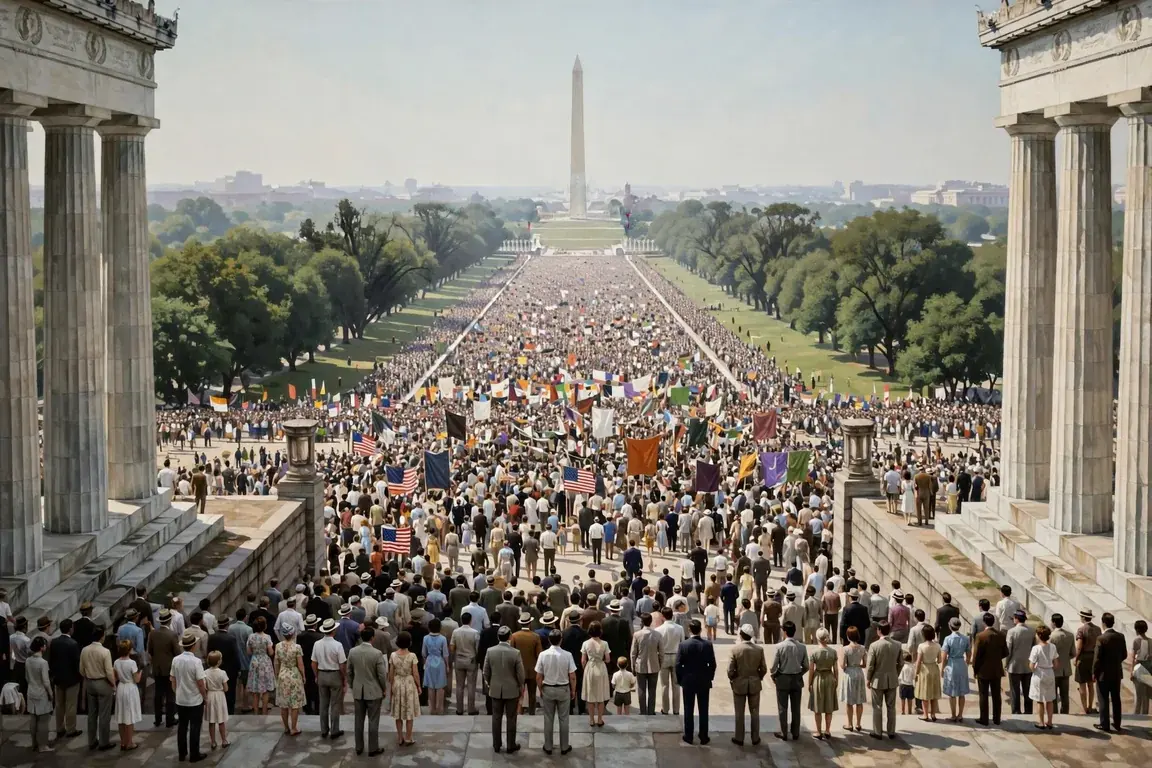
🖼️ THE MARCH ON WASHINGTON FROM THE LINCOLN MEMORIAL STEPS, AUGUST 28, 1963 · On August 28, 1963, a quarter-million people filled the National Mall shore to shore along the Reflecting Pool for the March on Washington, seen from high on the Lincoln Memorial steps in summer haze, with banners and dignity.
My fellow Americans:
Three days from now, after half a century in the service of our country, I shall lay down the responsibilities of office as, in traditional and solemn ceremony, the authority of the Presidency is vested in my successor.
This evening I come to you with a message of leave-taking and farewell, and to share a few final thoughts with you, my countrymen.
Like every other citizen, I wish the new President, and all who will labor with him, Godspeed. I pray that the coming years will be blessed with peace and prosperity for all.
Our people expect their President and the Congress to find essential agreement on issues of great moment, the wise resolution of which will better shape the future of the Nation.
My own relations with the Congress, which began on a remote and tenuous basis when, long ago, a member of the Senate appointed me to West Point, have since ranged to the intimate during the war and immediate post-war period, and, finally, to the mutually interdependent during these past eight years.
In this final relationship, the Congress and the Administration have, on most vital issues, cooperated well, to serve the national good rather than mere partisanship, and so have assured that the business of the Nation should go forward. So, my official relationship with the Congress ends in a feeling, on my part, of gratitude that we have been able to do so much together.
******
We now stand ten years past the midpoint of a century that has witnessed four major wars among great nations. Three of these involved our own country. Despite these holocausts America is today the strongest, the most influential and most productive nation in the world. Understandably proud of this pre-eminence, we yet realize that America's leadership and prestige depend, not merely upon our unmatched material progress, riches and military strength, but on how we use our power in the interests of world peace and human betterment.
******
Throughout America's adventure in free government, our basic purposes have been to keep the peace; to foster progress in human achievement, and to enhance liberty, dignity and integrity among people and among nations. To strive for less would be unworthy of a free and religious people. Any failure traceable to arrogance, or our lack of comprehension or readiness to sacrifice would inflict upon us grievous hurt both at home and abroad.
Progress toward these noble goals is persistently threatened by the conflict now engulfing the world. It commands our whole attention, absorbs our very beings. We face a hostile ideology-global in scope, atheistic in character, ruthless in purpose, and insidious in method. Unhappily the danger it poses promises to be of indefinite duration. To meet it successfully, there is called for, not so much the emotional and transitory sacrifices of crisis, but rather those which enable us to carry forward steadily, surely, and without complaint the burdens of a prolonged and complex struggle-with liberty at stake. Only thus shall we remain, despite every provocation, on our charted course toward permanent peace and human betterment.
Crises there will continue to be. In meeting them, whether foreign or domestic, great or small, there is a recurring temptation to feel that some spectacular and costly action could become the miraculous solution to all current difficulties. A huge increase in newer elements of our defense; development of unrealistic programs to cure every ill in agriculture; a dramatic expansion in basic and applied research-these and many other possibilities, each possibly promising in itself, may be suggested as the only way to the road we wish to travel.
But each proposal must be weighed in the light of a broader consideration: the need to maintain balance in and among national programs-balance between the private and the public economy, balance between cost and hoped for advantage-balance between the clearly necessary and the comfortably desirable; balance between our essential requirements as a nation and the duties imposed by the nation upon the individual; balance between action of the moment and the national welfare of the future. Good judgment seeks balance and progress; lack of it eventually finds imbalance and frustration.
The record of many decades stands as proof that our people and their government have, in the main, understood these truths and have responded to them well, in the face of stress and threat. But threats, new in kind or degree, constantly arise. I mention two only.
******
A vital element in keeping the peace is our military establishment. Our arms must be mighty, ready for instant action, so that no potential aggressor may be tempted to risk his own destruction.
Our military organization today bears little relation to that known by any of my predecessors in peace time, or indeed by the fighting men of World War II or Korea.
Until the latest of our world conflicts, the United States had no armaments industry. American makers of plowshares could, with time and as required, make swords as well. But now we can no longer risk emergency improvisation of national defense; we have been compelled to create a permanent armaments industry of vast proportions. Added to this, three and a half million men and women are directly engaged in the defense establishment. We annually spend on military security more than the net income of all United State corporations.
This conjunction of an immense military establishment and a large arms industry is new in the American experience. The total influence-economic, political, even spiritual-is felt in every city, every state house, every office of the Federal government. We recognize the imperative need for this development. Yet we must not fail to comprehend its grave implications. Our toil, resources and livelihood are all involved; so is the very structure of our society.
In the councils of government, we must guard against the acquisition of unwarranted influence, whether sought or unsought, by the military-industrial complex. The potential for the disastrous rise of misplaced power exists and will persist.
We must never let the weight of this combination endanger our liberties or democratic processes. We should take nothing for granted. Only an alert and knowledgeable citizenry can compel the proper meshing of the huge industrial and military machinery of defense with our peaceful methods and goals, so that security and liberty may prosper together.
Akin to, and largely responsible for the sweeping changes in our industrial-military posture, has been the technological revolution during recent decades.
In this revolution, research has become central; it also becomes more formalized, complex, and costly. A steadily increasing share is conducted for, by, or at the direction of, the Federal government.
Today, the solitary inventor, tinkering in his shop, has been over shadowed by task forces of scientists in laboratories and testing fields. In the same fashion, the free university, historically the fountainhead of free ideas and scientific discovery, has experienced a revolution in the conduct of research. Partly because of the huge costs involved, a government contract becomes virtually a substitute for intellectual curiosity. For every old blackboard there are now hundreds of new electronic computers.
The prospect of domination of the nation's scholars by Federal employment, project allocations, and the power of money is ever present and is gravely to be regarded.
Yet, in holding scientific research and discovery in respect, as we should, we must also be alert to the equal and opposite danger that public policy could itself become the captive of a scientific-technological elite.
It is the task of statesmanship to mold, to balance, and to integrate these and other forces, new and old, within the principles of our democratic system-ever aiming toward the supreme goals of our free society.
******
Another factor in maintaining balance involves the element of time. As we peer into society's future, we-you and I, and our government-must avoid the impulse to live only for today, plundering, for our own ease and convenience, the precious resources of tomorrow. We cannot mortgage the material assets of our grandchildren without risking the loss also of their political and spiritual heritage. We want democracy to survive for all generations to come, not to become the insolvent phantom of tomorrow.
******
Down the long lane of the history yet to be written America knows that this world of ours, ever growing smaller, must avoid becoming a community of dreadful fear and hate, and be, instead, a proud confederation of mutual trust and respect.
Such a confederation must be one of equals. The weakest must come to the conference table with the same confidence as do we, protected as we are by our moral, economic, and military strength. That table, though scarred by many past frustrations, cannot be abandoned for the certain agony of the battlefield.
Disarmament, with mutual honor and confidence, is a continuing imperative. Together we must learn how to compose difference, not with arms, but with intellect and decent purpose. Because this need is so sharp and apparent I confess that I lay down my official responsibilities in this field with a definite sense of disappointment. As one who has witnessed the horror and the lingering sadness of war-as one who knows that another war could utterly destroy this civilization which has been so slowly and painfully built over thousands of years-I wish I could say tonight that a lasting peace is in sight.
Happily, I can say that war has been avoided. Steady progress toward our ultimate goal has been made. But, so much remains to be done. As a private citizen, I shall never cease to do what little I can to help the world advance along that road.
******
So-in this my last good night to you as your President-I thank you for the many opportunities you have given me for public service in war and peace. I trust that in that service you find somethings worthy; as for the rest of it, I know you will find ways to improve performance in the future.
You and I-my fellow citizens-need to be strong in our faith that all nations, under God, will reach the goal of peace with justice. May we be ever unswerving in devotion to principle, confident but humble with power, diligent in pursuit of the Nation's great goals.
To all the peoples of the world, I once more give expression to America's prayerful and continuing inspiration:
We pray that peoples of all faiths, all races, all nations, may have their great human needs satisfied; that those now denied opportunity shall come to enjoy it to the full; that all who yearn for freedom may experience its spiritual blessings; that those who have freedom will understand, also, its heavy responsibilities; that all who are insensitive to the needs of others will learn charity; that the scourges of poverty, disease and ignorance will be made to disappear from the earth, and that, in the goodness of time, all peoples will come to live together in a peace guaranteed by the binding force of mutual respect and love.
FAREWELL ADDRESS (1961) by Dwight D. Eisenhower — a federal work, public domain. Transcript: U.S. National Archives.
© 2026 Eternity Gravestones LLC — this edition’s presentation only. All Rights Reserved.
Good evening my fellow citizens:
This afternoon, following a series of threats and defiant statements, the presence of Alabama National Guardsmen was required on the University of Alabama to carry out the final and unequivocal order of the United States District Court of the Northern District of Alabama. That order called for the admission of two clearly qualified young Alabama residents who happened to have been born Negro.
That they were admitted peacefully on the campus is due in good measure to the conduct of the students of the University of Alabama, who met their responsibilities in a constructive way.
I hope that every American, regardless of where he lives, will stop and examine his conscience about this and other related incidents. This Nation was founded by men of many nations and backgrounds. It was founded on the principle that all men are created equal, and that the rights of every man are diminished when the rights of one man are threatened.
Today we are committed to a worldwide struggle to promote and protect the rights of all who wish to be free. And when Americans are sent to Viet-Nam or West Berlin, we do not ask for whites only. It ought to be possible, therefore, for American students of any color to attend any public institution they select without having to be backed up by troops.
It ought to be possible for American consumers of any color to receive equal service in places of public accommodation, such as hotels and restaurants and theaters and retail stores, without being forced to resort to demonstrations in the street, and it ought to be possible for American citizens of any color to register to vote in a free election without interference or fear of reprisal.
It ought to be possible, in short, for every American to enjoy the privileges of being American without regard to his race or his color. In short, every American ought to have the right to be treated as he would wish to be treated, as one would wish his children to be treated. But this is not the case.
The Negro baby born in America today, regardless of the section of the Nation in which he is born, has about one-half as much chance of completing a high school as a white baby born in the same place on the same day, one-third as much chance of completing college, one-third as much chance of becoming a professional man, twice as much chance of becoming unemployed, about one-seventh as much chance of earning $10,000 a year, a life expectancy which is 7 years shorter, and the prospects of earning only half as much.
This is not a sectional issue. Difficulties over segregation and discrimination exist in every city, in every State of the Union, producing in many cities a rising tide of discontent that threatens the public safety. Nor is this a partisan issue. In a time of domestic crisis men of good will and generosity should be able to unite regardless of party or politics. This is not even a legal or legislative issue alone. It is better to settle these matters in the courts than on the streets, and new laws are needed at every level, but law alone cannot make men see right.
We are confronted primarily with a moral issue. It is as old as the scriptures and is as clear as the American Constitution.
The heart of the question is whether all Americans are to be afforded equal rights and equal opportunities, whether we are going to treat our fellow Americans as we want to be treated. If an American, because his skin is dark, cannot eat lunch in a restaurant open to the public, if he cannot send his children to the best public school available, if he cannot vote for the public officials who will represent him, if, in short, he cannot enjoy the full and free life which all of us want, then who among us would be content to have the color of his skin changed and stand in his place? Who among us would then be content with the counsels of patience and delay?
One hundred years of delay have passed since President Lincoln freed the slaves, yet their heirs, their grandsons, are not fully free. They are not yet freed from the bonds of injustice. They are not yet freed from social and economic oppression. And this Nation, for all its hopes and all its boasts, will not be fully free until all its citizens are free.
We preach freedom around the world, and we mean it, and we cherish our freedom here at home, but are we to say to the world, and much more importantly, to each other that this is the land of the free except for the Negroes; that we have no second-class citizens except Negroes; that we have no class or caste system, no ghettoes, no master race except with respect to Negroes?
Now the time has come for this Nation to fulfill its promise. The events in Birmingham and elsewhere have so increased the cries for equality that no city or State or legislative body can prudently choose to ignore them.
The fires of frustration and discord are burning in every city, North and South, where legal remedies are not at hand. Redress is sought in the streets, in demonstrations, parades, and protests which create tensions and threaten violence and threaten lives.
We face, therefore, a moral crisis as a country and as a people. It cannot be met by repressive police action. It cannot be left to increased demonstrations in the streets. It cannot be quieted by token moves or talk. It is time to act in the Congress, in your State and local legislative body and, above all, in all of our daily lives.
It is not enough to pin the blame on others, to say this is a problem of one section of the country or another, or deplore the fact that we face. A great change is at hand, and our task, our obligation, is to make that revolution, that change, peaceful and constructive for all.
Those who do nothing are inviting shame as well as violence. Those who act boldly are recognizing right as well as reality.
Next week I shall ask the Congress of the United States to act, to make a commitment it has not fully made in this century to the proposition that race has no place in American life or law. The Federal judiciary has upheld that proposition in the conduct of its affairs, including the employment of Federal personnel, the use of Federal facilities, and the sale of federally financed housing.
But there are other necessary measures which only the Congress can provide, and they must be provided at this session. The old code of equity law under which we live commands for every wrong a remedy, but in too many communities, in too many parts of the country, wrongs are inflicted on Negro citizens and there are no remedies at law. Unless the Congress acts, their only remedy is in the street.
I am, therefore, asking the Congress to enact legislation giving all Americans the right to be served in facilities which are open to the public--hotels, restaurants, theaters, retail stores, and similar establishments.
This seems to me to be an elementary right. Its denial is an arbitrary indignity that no American in 1963 should have to endure, but many do.
I have recently met with scores of business leaders urging them to take voluntary action to end this discrimination and I have been encouraged by their response, and in the last 2 weeks over 75 cities have seen progress made in desegregating these kinds of facilities. But many are unwilling to act alone, and for this reason, nationwide legislation is needed if we are to move this problem from the streets to the courts.
I am also asking the Congress to authorize the Federal Government to participate more fully in lawsuits designed to end segregation in public education. We have succeeded in persuading many districts to desegregate voluntarily. Dozens have admitted Negroes without violence. Today a Negro is attending a State-supported institution in every one of our 50 States, but the pace is very slow.
Too many Negro children entering segregated grade schools at the time of the Supreme Court's decision 9 years ago will enter segregated high schools this fall, having suffered a loss which can never be restored. The lack of an adequate education denies the Negro a chance to get a decent job.
The orderly implementation of the Supreme Court decision, therefore, cannot be left solely to those who may not have the economic resources to carry the legal action or who may be subject to harassment.
Other features will also be requested, including greater protection for the right to vote. But legislation, I repeat, cannot solve this problem alone. It must be solved in the homes of every American in every community across our country.
In this respect I want to pay tribute to those citizens North and South who have been working in their communities to make life better for all. They are acting not out of a sense of legal duty but out of a sense of human decency.
Like our soldiers and sailors in all parts of the world they are meeting freedom's challenge on the firing line, and I salute them for their honor and their courage.
My fellow Americans, this is a problem which faces us all--in every city of the North as well as the South. Today there are Negroes unemployed, two or three times as many compared to whites, inadequate in education, moving into the large cities, unable to find work, young people particularly out of work without hope, denied equal rights, denied the opportunity to eat at a restaurant or lunch counter or go to a movie theater, denied the right to a decent education, denied almost today the right to attend a State university even though qualified. It seems to me that these are matters which concern us all, not merely Presidents or Congressmen or Governors, but every citizen of the United States.
This is one country. It has become one country because all of us and all the people who came here had an equal chance to develop their talents.
We cannot say to 10 percent of the population that you can't have that right; that your children cannot have the chance to develop whatever talents they have; that the only way that they are going to get their rights is to go into the streets and demonstrate. I think we owe them and we owe ourselves a better country than that.
Therefore, I am asking for your help in making it easier for us to move ahead and to provide the kind of equality of treatment which we would want ourselves; to give a chance for every child to be educated to the limit of his talents.
As I have said before, not every child has an equal talent or an equal ability or an equal motivation, but they should have an equal right to develop their talent and their ability and their motivation, to make something of themselves.
We have a right to expect that the Negro community will be responsible, will uphold the law, but they have a right to expect that the law will be fair, that the Constitution will be color blind, as Justice Harlan said at the turn of the century.
This is what we are talking about and this is a matter which concerns this country and what it stands for, and in meeting it I ask the support of all our citizens.
Thank you very much.
CIVIL RIGHTS ADDRESS (1963) by John F. Kennedy — a federal work, public domain. Transcript: JFK Presidential Library.
© 2026 Eternity Gravestones LLC — this edition’s presentation only. All Rights Reserved.
The Civil Rights Act of 1964 has eleven titles. Titles I (voting rights), II (public accommodations), and VII (equal employment opportunity) are carried entire here, with the Act's preamble; the full enrolled act stands at the source — the National Archives transcript of Public Law 88-352 (78 Stat. 241), checked against the Statutes at Large text on govinfo.
An Act
To enforce the constitutional right to vote, to confer jurisdiction upon the district courts of the United States to provide injunctive relief against discrimination in public accommodations, to authorize the Attorney General to institute suits to protect constitutional rights in public facilities and public education, to extend the Commission on Civil Rights, to prevent discrimination in federally assisted programs, to establish a Commission on Equal Employment Opportunity, and for other purposes.
Be it enacted by the Senate and House of Representatives of the United States of America in Congress assembled, That this Act may be cited as the "Civil Rights Act of 1964".
SEC. 101. Section 2004 of the Revised Statutes (42 U.S.C. 1971), as amended by section 131 of the Civil Rights Act of 1957 (71 Stat. 637), and as further amended by section 601 of the Civil Rights Act of 1960 (74 Stat. 90), is further amended as follows:
(a) Insert "1" after "(a)" in subsection (a) and add at the end of subsection (a) the following new paragraphs:
"(2) No person acting under color of law shall--
"(A) in determining whether any individual is qualified under State law or laws to vote in any Federal election, apply any standard, practice, or procedure different from the standards, practices, or procedures applied under such law or laws to other individuals within the same county, parish, or similar political subdivision who have been found by State officials to be qualified to vote;
"(B) deny the right of any individual to vote in any Federal election because of an error or omission on any record or paper relating to any application, registration, or other act requisite to voting, if such error or omission is not material in determining whether such individual is qualified under State law to vote in such election; or
"(C) employ any literacy test as a qualification for voting in any Federal election unless (i) such test is administered to each individual and is conducted wholly in writing, and (ii) a certified copy of the test and of the answers given by the individual is furnished to him within twenty-five days of the submission of his request made within the period of time during which records and papers are required to be retained and preserved pursuant to title III of the Civil Rights Act of 1960 (42 U.S.C. 1974--74e; 74 Stat. 88): Provided, however, That the Attorney General may enter into agreements with appropriate State or local authorities that preparation, conduct, and maintenance of such tests in accordance with the provisions of applicable State or local law, including such special provisions as are necessary in the preparation, conduct, and maintenance of such tests for persons who are blind or otherwise physically handicapped, meet the purposes of this subparagraph and constitute compliance therewith.
"(3) For purposes of this subsection--
"(A) the term 'vote' shall have the same meaning as in subsection (e) of this section;
"(B) the phrase 'literacy test' includes any test of the ability to read, write, understand, or interpret any matter."
(b) Insert immediately following the period at the end of the first sentence of subsection (c) the following new sentence: "If in any such proceeding literacy is a relevant fact there shall be a rebuttable presumption that any person who has not been adjudged an incompetent and who has completed the sixth grade in a public school in, or a private school accredited by, any State or territory, the District of Columbia, or the Commonwealth of Puerto Rico where instruction is carried on predominantly in the English language, possesses sufficient literacy, comprehension, and intelligence to vote in any Federal election."
(c) Add the following subsection "(f)" and designate the present subsection "(f)" as subsection "(g)": "(f) When used in subsection (a) or (c) of this section, the words 'Federal election' shall mean any general, special, or primary election held solely or in part for the purpose of electing or selecting any candidate for the office of President, Vice President, presidential elector, Member of the Senate, or Member of the House of Representatives."
(d) Add the following subsection "(h)":
"(h) In any proceeding instituted by the United States in any district court of the United States under this section in which the Attorney General requests a finding of a pattern or practice of discrimination pursuant to subsection (e) of this section the Attorney General, at the time he files the complaint, or any defendant in the proceeding, within twenty days after service upon him of the complaint, may file with the clerk of such court a request that a court of three judges be convened to hear and determine the entire case. A copy of the request for a three-judge court shall be immediately furnished by such clerk to the chief judge of the circuit (or in his absence, the presiding circuit judge of the circuit) in which the case is pending. Upon receipt of the copy of such request it shall be the duty of the chief justice of the circuit or the presiding circuit judge, as the case may be, to designate immediately three judges in such circuit, of whom at least one shall be a circuit judge and another of whom shall be a district judge of the court in which the proceeding was instituted, to hear and determine such case, and it shall be the duty of the judges so designated to assign the case for hearing at the earliest practicable date, to participate in the hearing and determination thereof, and to cause the case to be in every way expedited.
An appeal from the final judgment of such court will lie to the Supreme Court.
"In any proceeding brought under subsection (c) of this section to enforce subsection (b) of this section, or in the event neither the Attorney General nor any defendant files a request for a three-judge court in any proceeding authorized by this subsection, it shall be the duty of the chief judge of the district (or in his absence, the acting chief judge) in which the case is pending immediately to designate a judge in such district to hear and determine the case. In the event that no judge in the district is available to hear and determine the case, the chief judge of the district, or the acting chief judge, as the case may be, shall certify this fact to the chief judge of the circuit (or, in his absence, the acting chief judge) who shall then designate a district or circuit judge of the circuit to hear and determine the case.
"It shall be the duty of the judge designated pursuant to this section to assign the case for hearing at the earliest practicable date and to cause the case to be in every way expedited."
SEC. 201. (a) All persons shall be entitled to the full and equal enjoyment of the goods, services, facilities, and privileges, advantages, and accommodations of any place of public accommodation, as defined in this section, without discrimination or segregation on the ground of race, color, religion, or national origin.
(b) Each of the following establishments which serves the public is a place of public accommodation within the meaning of this title if its operations affect commerce, or if discrimination or segregation by it is supported by State action:
(1) any inn, hotel, motel, or other establishment which provides lodging to transient guests, other than an establishment located within a building which contains not more than five rooms for rent or hire and which is actually occupied by the proprietor of such establishment as his residence;
(2) any restaurant, cafeteria, lunchroom, lunch counter, soda fountain, or other facility principally engaged in selling food for consumption on the premises, including, but not limited to, any such facility located on the
premises of any retail establishment; or any gasoline station;
(3) any motion picture house, theater, concert hall, sports arena, stadium or other place of exhibition or entertainment; and
(4) any establishment (A)(i) which is physically located within the premises of any establishment otherwise covered by this subsection, or (ii) within the premises of which is physically located any such covered establishment, and (B) which holds itself out as serving patrons of such covered establishment.
(c) The operations of an establishment affect commerce within the meaning of this title if (1) it is one of the establishments described in paragraph (1) of subsection (b); (2) in the case of an establishment described in paragraph (2) of subsection (b), it serves or offers to serve interstate travelers or a substantial portion of the food which it serves, or gasoline or other products which it sells, has moved in commerce; (3) in the case of an establishment described in paragraph (3) of subsection (b), it customarily presents films, performances, athletic teams, exhibitions, or other sources of entertainment which move in commerce; and (4) in the case of an establishment described in paragraph (4) of subsection (b), it is physically located within the premises of, or there is physically located within its premises, an establishment the operations of which affect commerce within the meaning of this subsection. For purposes of this section, "commerce" means travel, trade, traffic, commerce, transportation, or communication among the several States, or between the District of Columbia and any State, or between any foreign country or any territory or possession and any State or the District of Columbia, or between points in the same State but through any other State or the District of Columbia or a foreign country.
(d) Discrimination or segregation by an establishment is supported by State action within the meaning of this title if such discrimination or segregation (1) is carried on under color of any law, statute, ordinance, or regulation; or (2) is carried on under color of any custom or usage required or enforced by officials of the State or political subdivision thereof; or (3) is required by action of the State or political subdivision thereof.
(e) The provisions of this title shall not apply to a private club or other establishment not in fact open to the public, except to the extent that the facilities of such establishment are made available to the customers or patrons of an establishment within the scope of subsection (b).
SEC. 202. All persons shall be entitled to be free, at any establishment or place, from discrimination or segregation of any kind on the ground of race, color, religion, or national origin, if such discrimination or segregation is or purports to be required by any law, statute, ordinance, regulation, rule, or order of a State or any agency or political subdivision thereof.
SEC. 203. No person shall (a) withhold, deny, or attempt to withhold or deny, or deprive or attempt to deprive, any person of any right or privilege secured by section 201 or 202, or (b) intimidate, threaten, or coerce, or attempt to intimidate, threaten, or coerce any person with the purpose of interfering with any right or privilege secured by section 201 or 202, or (c) punish or attempt to punish any person for exercising or attempting to exercise any right or privilege secured by section 201 or 202.
SEC. 204. (a) Whenever any person has engaged or there are reasonable grounds to believe that any person is about to engage in any act or practice prohibited by section 203, a civil action for preventive relief, including an application for a permanent or temporary injunction, restraining order, or other order, may be instituted by the person aggrieved and, upon timely application, the court may, in its discretion, permit the Attorney General to intervene in such civil action if he certifies that the case is of general public importance. Upon application by the complainant and in such circumstances as the court may deem just, the court may appoint an attorney for such complainant and may authorize the commencement of the civil action without the payment of fees, costs, or security.
(b) In any action commenced pursuant to this title, the court, in its discretion, may allow the prevailing party, other than the United States, a reasonable attorney's fee as part of the costs, and the United States shall be liable for costs the same as a private person.
(c) In the case of an alleged act or practice prohibited by this title which occurs in a State, or political subdivision of a State, which has a State or local law prohibiting such act or practice and establishing or authorizing a State or local authority to grant or seek relief from such practice or to institute criminal proceedings with respect thereto upon receiving notice thereof, no civil action may be brought under subsection (a) before the expiration of thirty days after written notice of such alleged act or practice has been given to the appropriate State or local authority by registered mail or in person, provided that the court may stay proceedings in such civil action pending the termination of State or local enforcement proceedings.
(d) In the case of an alleged act or practice prohibited by this title which occurs in a State, or political subdivision of a State, which has no State or local law prohibiting such act or practice, a civil action may be brought under subsection (a): Provided, That the court may refer the matter to the Community Relations Service established by title X of this Act for as long as the court believes there is a reasonable possibility of obtaining voluntary compliance, but for not more than sixty days: Provided further, That upon expiration of such sixty-day period, the court may extend such period for an additional period, not to exceed a cumulative total of one hundred and twenty days, if it believes there then exists a reasonable possibility of securing voluntary compliance.
SEC. 205. The Service is authorized to make a full investigation of any complaint referred to it by the court under section 204(d) and may hold such hearings with respect thereto as may be necessary. The Service shall conduct any hearings with respect to any such complaint in executive session, and shall not release any testimony given therein except by agreement of all parties involved in the complaint with the permission of the court, and the Service shall endeavor to bring about a voluntary settlement between the parties.
SEC. 206. (a) Whenever the Attorney General has reasonable cause to believe that any person or group of persons is engaged in a pattern or practice of resistance to the full enjoyment of any of the rights secured by this title, and that the pattern or practice is of such a nature and is intended to deny the full exercise of the rights herein described, the Attorney General may bring a civil action in the appropriate district court of the United States by filing with it a complaint (1) signed by him (or in his absence the Acting Attorney General), (2) setting forth facts pertaining to such pattern or practice, and (3) requesting such preventive relief, including an application for a permanent or temporary injunction, restraining order or other order against the person or persons responsible for such pattern or practice, as he deems necessary to insure the full enjoyment of the rights herein described.
(b) In any such proceeding the Attorney General may file with the clerk of such court a request that a court of three judges be convened to hear and determine the case. Such request by the Attorney General shall be accompanied by a certificate that, in his opinion, the case is of general public importance. A copy of the certificate and request for a three-judge court shall be immediately furnished by such clerk to the chief judge of the circuit (or in his absence, the presiding circuit judge of the circuit) in which the case is pending. Upon receipt of the copy of such request it shall be the duty of the chief judge of the circuit or the presiding circuit judge, as the case may be, to designate immediately three judges in such circuit, of whom at least one shall be a circuit judge and another of whom shall be a district judge of the court in which the proceeding was instituted, to hear and determine such case, and it shall be the duty of the judges so designated to assign the case for hearing at the earliest practicable date, to participate in the hearing and determination thereof, and to cause the case to be in every way expedited. An appeal from the final judgment of such court will lie to the Supreme Court.
In the event the Attorney General fails to file such a request in any such proceeding, it shall be the duty of the chief judge of the district (or in his absence, the acting chief judge) in which the case is pending immediately to designate a judge in such district to hear and determine the case. In the event that no judge in the district is available to hear and determine the case, the chief judge of the district, or the acting chief judge, as the case may be, shall certify this fact to the chief judge of the circuit (or in his absence, the acting chief judge) who shall then designate a district or circuit judge of the circuit to hear and determine the case.
It shall be the duty of the judge designated pursuant to this section to assign the case for hearing at the earliest practicable date and to cause the case to be in every way expedited.
SEC. 207. (a) The district courts of the United States shall have jurisdiction of proceedings instituted pursuant to this title and shall exercise the same without regard to whether the aggrieved party shall have exhausted any administrative or other remedies that may be provided by law.
(b) The remedies provided in this title shall be the exclusive means of enforcing the rights based on this title, but nothing in this title shall preclude any individual or any State or local agency from asserting any right based on any other Federal or State law not inconsistent with this title, including any statute or ordinance requiring nondiscrimination in public establishments or accommodations, or from pursuing any remedy, civil or criminal, which may be available for the vindication or enforcement of such right.
DEFINITIONS SEC. 701. For the purposes of this title--
(a) The term "person" includes one or more individuals, labor unions, partnerships, associations, corporations, legal representatives, mutual companies, joint-stock companies, trusts, unincorporated organizations, trustees, trustees in bankruptcy, or receivers.
(b) The term "employer" means a person engaged in an industry affecting commerce who has twenty-five or more employees for each working day in each of twenty or more calendar weeks in the current or preceding calendar year, and any agent of such a person, but such term does not include (1) the United States, a corporation wholly owned by the Government of the United States, an Indian tribe, or a State or political subdivision thereof, (2) a bona fide private membership club (other than a labor organization) which is exempt from taxation under section 501(c) of the Internal Revenue Code of 1954: Provided, That during the first year after the effective date prescribed in subsection (a) of section 716, persons having fewer than one hundred employees (and their agents) shall not be considered employers, and, during the second year after such date, persons having fewer than seventy-five employees (and their agents) shall not be considered employers, and, during the third year after such date, persons having fewer than fifty employees (and their agents) shall not be considered employers: Provided further, That it shall be the policy of the United States to insure equal employment opportunities for Federal employees without discrimination because of race, color, religion, sex or national origin and the President shall utilize his existing authority to effectuate this policy.
(c) The term "employment agency" means any person regularly undertaking with or without compensation to procure employees for an employer or to procure for employees opportunities to work for an employer and includes an agent of such a person; but shall not include an agency of the United States, or an agency of a State or political subdivision of a State, except that such term shall include the United States Employment Service and the system of State and local employment services receiving Federal assistance.
(d) The term "labor organization" means a labor organization engaged in an industry affecting commerce, and any agent of such an organization, and includes any organization of any kind, any agency, or employee representation committee, group, association, or plan so engaged in which employees participate and which exists for the purpose, in whole or in part, of dealing with employers concerning grievances, labor disputes, wages, rates of pay, hours, or other terms or conditions of employment, and any conference, general committee, joint or system board, or joint council so engaged which is subordinate to a national or international labor organization.
(e) A labor organization shall be deemed to be engaged in an industry affecting commerce if (1) it maintains or operates a hiring hall or hiring office which procures employees for an employer or procures for employees opportunities to work for an employer, or (2) the number of its members (or, where it is a labor organization composed of other labor organizations or their representatives, if the aggregate number of the members of such other labor organization) is (A) one hundred or more during the first year after the effective date prescribed in subsection (a) of section 716, (B) seventy-five or more during the second year after such date or fifty or more during the third year, or (C) twenty-five or more thereafter, and such labor organization--
(1) is the certified representative of employees under the provisions of the National Labor Relations Act, as amended, or the Railway Labor Act, as amended;
(2) although not certified, is a national or international labor organization or a local labor organization recognized or acting as the representative of employees of an employer or employers engaged in an industry affecting commerce; or
(3) has chartered a local labor organization or subsidiary body which is representing or actively seeking to represent employees of employers within the meaning of paragraph (1) or (2); or
(4) has been chartered by a labor organization representing or actively seeking to represent employees within the meaning of paragraph (1) or (2) as the local or subordinate body through which such employees may enjoy membership or become affiliated with such labor organization; or
(5) is a conference, general committee, joint or system board, or joint council subordinate to a national or international labor organization, which includes a labor organization engaged in an industry affecting commerce within the meaning of any of the preceding paragraphs of this subsection.
(f) The term "employee" means an individual employed by an employer.
(g) The term "commerce" means trade, traffic, commerce, transportation, transmission, or communication among the several States; or between a State and any place outside thereof; or within the District of Columbia, or a possession of the United States; or between points in the same State but through a point outside thereof.
(h) The term "industry affecting commerce" means any activity, business, or industry in commerce or in which a labor dispute would hinder or obstruct commerce or the free flow of commerce and includes any activity or industry "affecting commerce" within the meaning of the Labor-Management Reporting and Disclosure Act of 1959.
(i) The term "State" includes a State of the United States, the District of Columbia, Puerto Rico, the Virgin Islands, American Samoa, Guam, Wake Island, The Canal Zone, and Outer Continental Shelf lands defined in the Outer Continental Shelf Lands Act.
EXEMPTION SEC. 702. This title shall not apply to an employer with respect to the employment of aliens outside any State, or to a religious corporation, association, or society with respect to the employment of individuals of a particular religion to perform work connected with the carrying on by such corporation, association, or society of its religious activities or to an educational institution with respect to the employment of individuals to perform work connected with the educational activities of such institution.
DISCRIMINATION BECAUSE OF RACE, COLOR, RELIGION, SEX, OR NATIONAL ORIGIN SEC. 703. (a) It shall be an unlawful employment practice for an employer--
(1) to fail or refuse to hire or to discharge any individual, or otherwise to discriminate against any individual with respect to his compensation, terms, conditions, or privileges of employment, because of such individual's race, color, religion, sex, or national origin; or
(2) to limit, segregate, or classify his employees in any way which would deprive or tend to deprive any individual of employment opportunities or otherwise adversely affect his status as an employee, because of such individual's race, color, religion, sex, or national origin.
(b) It shall be an unlawful employment practice for an employment agency to fail or refuse to refer for employment, or otherwise to discriminate against, any individual because of his race, color, religion, sex, or national origin, or to classify or refer for employment any individual on the basis of his race, color, religion, sex, or national origin.
(c) It shall be an unlawful employment practice for a labor organization--
(1) to exclude or to expel from its membership, or otherwise to discriminate against, any individual because of his race, color, religion, sex, or national origin;
(2) to limit, segregate, or classify its membership, or to classify or fail or refuse to refer for employment any individual, in any way which would deprive or tend to deprive any individual of employment opportunities, or would limit such employment opportunities or otherwise adversely affect his status as an employee or as an applicant for employment, because of such individual's race, color, religion, sex, or national origin; or
(3) to cause or attempt to cause an employer to discriminate against an individual in violation of this section.
(d) It shall be an unlawful employment practice for any employer, labor organization, or joint labor-management committee controlling apprenticeship or other training or retraining, including on-the-job training programs to discriminate against any individual because of his race, color, religion, sex, or national origin in admission to, or employment in, any program established to provide apprenticeship or other training.
(e) Notwithstanding any other provision of this title, (1) it shall not be an unlawful employment practice for an employer to hire and employ employees, for an employment agency to classify, or refer for employment any individual, for a labor organization to classify its membership or to classify or refer for employment any individual, or for an employer, labor organization, or joint labor-management committee controlling apprenticeship or other training or retraining programs to admit or employ any individual in any such program, on the basis of his religion, sex, or national origin in those certain instances where religion, sex, or national origin is a bona fide occupational qualification reasonably necessary to the normal operation of that particular business or enterprise, and (2) it shall not be an unlawful employment practice for a school, college, university, or other educational institution or institution of learning to hire and employ employees of a particular religion if such school, college, university, or other educational institution or institution of learning is, in whole or in substantial part, owned, supported, controlled, or managed by a particular religion or by a particular religious corporation, association, or society, or if the curriculum of such school, college, university, or other educational institution or institution of learning is directed toward the propagation of a particular religion.
(f) As used in this title, the phrase "unlawful employment practice" shall not be deemed to include any action or measure taken by an employer, labor organization, joint labor-management committee, or employment agency with respect to an individual who is a member of the Communist Party of the United States or of any other organization required to register as a Communist-action or Communist-front organization by final order of the Subversive Activities Control Board pursuant to the Subversive Activities Control Act of 1950.
(g) Notwithstanding any other provision of this title, it shall not be an unlawful employment practice for an employer to fail or refuse to hire and employ any individual for any position, for an employer to discharge any individual from any position, or for an employment agency to fail or refuse to refer any individual for employment in any position, or for a labor organization to fail or refuse to refer any individual for employment in any position, if--
(1) the occupancy of such position, or access to the premises in or upon which any part of the duties of such position is performed or is to be performed, is subject to any requirement imposed in the interest of the national security of the United States under any security program in effect pursuant to or administered under any statute of the United States or any Executive order of the President; and
(2) such individual has not fulfilled or has ceased to fulfill that requirement.
(h) Notwithstanding any other provision of this title, it shall not be an unlawful employment practice for an employer to apply different standards of compensation, or different terms, conditions, or privileges of employment pursuant to a bona fide seniority or merit system, or a system which measures earnings by quantity or quality of production or to employees who work in different locations, provided that such differences are not the result of an intention to discriminate because of race, color, religion, sex, or national origin, nor shall it be an unlawful employment practice for an employer to give and to act upon the results of any professionally developed ability test provided that such test, its administration or action upon the results is not designed, intended or used to discriminate because of race, color, religion, sex or national origin. It shall not be an unlawful employment practice under this title for any employer to differentiate upon the basis of sex in determining the amount of the wages or compensation paid or to be paid to employees of such employer if such differentiation is authorized by the provisions of section 6(d) of the Fair Labor Standards Act of 1938, as amended (29 U.S.C. 206(d)).
(i) Nothing contained in this title shall apply to any business or enterprise on or near an Indian reservation with respect to any publicly announced employment practice of such business or enterprise under which a preferential treatment is given to any individual because he is an Indian living on or near a reservation.
(j) Nothing contained in this title shall be interpreted to require any employer, employment agency, labor organization, or joint labor-management committee subject to this title to grant preferential treatment to any individual or to any group because of the race, color, religion, sex, or national origin of such individual or group on account of an imbalance which may exist with respect to the total number or percentage of persons of any race, color, religion, sex, or national origin employed by any employer, referred or classified for employment by any employment agency or labor organization, admitted to membership or classified by any labor organization, or admitted to, or employed in, any apprenticeship or other training program, in comparison with the total number or percentage of persons of such race, color, religion, sex, or national origin in any community, State, section, or other area, or in the available work force in any community, State, section, or other area.
OTHER UNLAWFUL EMPLOYMENT PRACTICES SEC. 704. (a) It shall be an unlawful employment practice for an employer to discriminate against any of his employees or applicants for employment, for an employment agency to discriminate against any individual, or for a labor organization to discriminate against any member thereof or applicant for membership, because he has opposed, any practice made an unlawful employment practice by this title, or because he has made a charge, testified, assisted, or participated in any manner in an investigation, proceeding, or hearing under this title.
(b) It shall be an unlawful employment practice for an employer, labor organization, or employment agency to print or publish or cause to be printed or published any notice or advertisement relating to employment by such an employer or membership in or any classification or referral for employment by such a labor organization, or relating to any classification or referral for employment by such an employment agency, indicating any preference, limitation, specification, or discrimination, based on race, color, religion, sex, or national origin, except that such a notice or advertisement may indicate a preference, limitation, specification, or discrimination based on religion, sex, or national origin when religion, sex, or national origin is a bona fide occupational qualification for employment.
EQUAL EMPLOYMENT OPPORTUNITY COMMISSION SEC. 705. (a) There is hereby created a Commission to be known as the Equal Employment Opportunity Commission, which shall be composed of five members, not more than three of whom shall be members of the same political party, who shall be appointed by the President by and with the advice and consent of the Senate. One of the original members shall be appointed for a term of one year, one for a term of two years, one for a term of three years, one for a term of four years, and one for a term of five years, beginning from the date of enactment of this title, but their successors shall be appointed for terms of five years each, except that any individual chosen to fill a vacancy shall be appointed only for the unexpired term of the member whom he shall succeed. The President shall designate one member to serve as Chairman of the Commission, and one member to serve as Vice Chairman. The Chairman shall be responsible on behalf of the Commission for the administrative operations of the Commission, and shall appoint, in accordance with the civil service laws, such officers, agents, attorneys, and employees as it deems necessary to assist it in the performance of its functions and to fix their compensation in accordance with the Classification Act of 1949, as amended. The Vice Chairman shall act as Chairman in the absence or disability of the Chairman or in the event of a vacancy in that office.
(b) A vacancy in the Commission shall not impair the right of the remaining members to exercise all the powers of the Commission and three members thereof shall constitute a quorum.
(c) The Commission shall have an official seal which shall be judicially noticed.
(d) The Commission shall at the close of each fiscal year report to the Congress and to the President concerning the action it has taken; the names, salaries, and duties of all individuals in its employ and the moneys it has disbursed; and shall make such further reports on the cause of and means of eliminating discrimination and such recommendations for further legislation as may appear desirable.
(e) The Federal Executive Pay Act of 1956, as amended (5 U.S.C. 2201-2209), is further amended--
(1) by adding to section 105 thereof (5 U.S.C. 2204) the following clause:
"(32) Chairman, Equal Employment Opportunity Commission"; and
(2) by adding to clause (45) of section 106(a) thereof (5 U.S.C. 2205(a)) the following: "Equal Employment Opportunity Commission (4)."
(f) The principal office of the Commission shall be in or near the District of Columbia, but it may meet or exercise any or all its powers at any other place. The Commission may establish such regional or State offices as it deems necessary to accomplish the purpose of this title.
(g) The Commission shall have power--
(1) to cooperate with and, with their consent, utilize regional, State, local, and other agencies, both public and private, and individuals;
(2) to pay to witnesses whose depositions are taken or who are summoned before the Commission or any of its agents the same witness and mileage fees as are paid to witnesses in the courts of the United States;
(3) to furnish to persons subject to this title such technical assistance as they may request to further their compliance with this title or an order issued thereunder;
(4) upon the request of (i) any employer, whose employees or some of them, or (ii) any labor organization, whose members or some of them, refuse or threaten to refuse to cooperate in effectuating the provisions of this title, to assist in such effectuation by conciliation or such other remedial action as is provided by this title;
(5) to make such technical studies as are appropriate to effectuate the purposes and policies of this title and to make the results of such studies available to the public;
(6) to refer matters to the Attorney General with recommendations for intervention in a civil action brought by an aggrieved party under section 706, or for the institution of a civil action by the Attorney General under section 707, and to advise, consult, and assist the Attorney General on such matters.
(h) Attorneys appointed under this section may, at the direction of the Commission, appear for and represent the Commission in any case in court.
(i) The Commission shall, in any of its educational or promotional activities, cooperate with other departments and agencies in the performance of such educational and promotional activities.
(j) All officers, agents, attorneys, and employees of the Commission shall be subject to the provisions of section 9 of the Act of August 2, 1939, as amended (the Hatch Act), notwithstanding any exemption contained in such section.
PREVENTION OF UNLAWFUL EMPLOYMENT PRACTICES SEC. 706. (a) Whenever it is charged in writing under oath by a person claiming to be aggrieved, or a written charge has been filed by a member of the Commission where he has reasonable cause to believe a violation of this title has occurred (and such charge sets forth the facts upon which it is based) that an employer, employment agency, or labor organization has engaged in an unlawful employment practice, the Commission shall furnish such employer, employment agency, or labor organization (hereinafter referred to as the "respondent") with a copy of such charge and shall make an investigation of such charge, provided that such charge shall not be made public by the Commission. If the Commission shall determine, after such investigation, that there is reasonable cause to believe that the charge is true, the Commission shall endeavor to eliminate any such alleged unlawful employment practice by informal methods of conference, conciliation, and persuasion. Nothing said or done during and as a part of such endeavors may be made public by the Commission without the written consent of the parties, or used as evidence in a subsequent proceeding. Any officer or employee of the Commission, who shall make public in any manner whatever any information in violation of this subsection shall be deemed guilty of a misdemeanor and upon conviction thereof shall be fined not more than $1,000 or imprisoned not more than one year.
(b) In the case of an alleged unlawful employment practice occurring in a State, or political subdivision of a State, which has a State or local law prohibiting the unlawful employment practice alleged and establishing or authorizing a State or local authority to grant or seek relief from such practice or to institute criminal proceedings with respect thereto upon receiving notice thereof, no charge may be filed under subsection (a) by the person aggrieved before the expiration of sixty days after proceedings have been commenced under the State or local law, unless such proceedings have been earlier terminated, provided that such sixty-day period shall be extended to one hundred and twenty days during the first year after the effective date of such State or local law. If any requirement for the commencement of such proceedings is imposed by a State or local authority other than a requirement of the filing of a written and signed statement of the facts upon which the proceeding is based, the proceeding shall be deemed to have been commenced for the purposes of this subsection at the time such statement is sent by registered mail to the appropriate State or local authority.
(c) In the case of any charge filed by a member of the Commission alleging an unlawful employment practice occurring in a State or political subdivision of a State, which has a State or local law prohibiting the practice alleged and establishing or authorizing a State or local authority to grant or seek relief from such practice or to institute criminal proceedings with respect thereto upon receiving notice thereof, the Commission shall, before taking any action with respect to such charge, notify the appropriate State or local officials and, upon request, afford them a reasonable time, but not less than sixty days (provided that such sixty-day period shall be extended to one hundred and twenty days during the first year after the effective day of such State or local law), unless a shorter period is requested, to act under such State or local law to remedy the practice alleged.
(d) A charge under subsection (a) shall be filed within ninety days after the alleged unlawful employment practice occurred, except that in the case of an unlawful employment practice with respect to which the person aggrieved has followed the procedure set out in subsection (b), such charge shall be filed by the person aggrieved within two hundred and ten days after the alleged unlawful employment practice occurred, or within thirty days after receiving notice that the State or local agency has terminated the proceedings under the State or local, law, whichever is earlier, and a copy of such charge shall be filed by the Commission with the State or local agency.
(e) If within thirty days after a charge is filed with the Commission or within thirty days after expiration of any period of reference under subsection (c) (except that in either case such period may be extended to not more than sixty days upon a determination by the Commission that further efforts to secure voluntary compliance are warranted), the Commission has been unable to obtain voluntary compliance with this title, the Commission shall so notify the person aggrieved and a civil action may, within thirty days thereafter, be brought against the respondent named in the charge (1) by the person claiming to be aggrieved, or (2) if such charge was filed by a member of the Commission, by any person whom the charge alleges was aggrieved by the alleged unlawful employment practice. Upon application by the complainant and in such circumstances as the court may deem just, the court may appoint an attorney for such complainant and may authorize the commencement of the action without the payment of fees, costs, or security. Upon timely application, the court may, in its discretion, permit the Attorney General to intervene in such civil action if he certifies that the case is of general public importance. Upon request, the court may, in its discretion, stay further proceedings for not more than sixty days pending the termination of State or local proceedings described in subsection (b) or the efforts of the Commission to obtain voluntary compliance.
(f) Each United States district court and each United States court of a place subject to the jurisdiction of the United States shall have jurisdiction of actions brought under this title. Such an action may be brought in any judicial district in the State in which the unlawful employment practice is alleged to have been committed, in the judicial district in which the employment records relevant to such practice are maintained and administered, or in the judicial district in which the plaintiff would have worked but for the alleged unlawful employment practice, but if the respondent is not found within any such district, such an action may be brought within the judicial district in which the respondent has his principal office. For purposes of sections 1404 and 1406 of title 28 of the United States Code, the judicial district in which the respondent has his principal office shall in all cases be considered a district in which the action might have been brought.
(g) If the court finds that the respondent has intentionally engaged in or is intentionally engaging in an unlawful employment practice charged in the complaint, the court may enjoin the respondent from engaging in such unlawful employment practice, and order such affirmative action as may be appropriate, which may include reinstatement or hiring of employees, with or without back pay (payable by the employer, employment agency, or labor organization, as the case may be, responsible for the unlawful employment practice). Interim earnings or amounts earnable with reasonable diligence by the person or persons discriminated against shall operate to reduce the back pay otherwise allowable. No order of the court shall require the admission or reinstatement of an individual as a member of a union or the hiring, reinstatement, or promotion of an individual as an employee, or the payment to him of any back pay, if such individual was refused admission, suspended, or expelled or was refused employment or advancement or was suspended or discharged for any reason other than discrimination on account of race, color, religion, sex or national origin or in violation of section 704(a).
(h) The provisions of the Act entitled "An Act to amend the Judicial Code and to define and limit the jurisdiction of courts sitting in equity, and for other purposes," approved March 23, 1932 (29 U.S.C. 101-115), shall not apply with respect to civil actions brought under this section.
(i) In any case in which an employer, employment agency, or labor organization fails to comply with an order of a court issued in a civil action brought under subsection (e), the Commission may commence proceedings to compel compliance with such order.
(j) Any civil action brought under subsection (e) and any proceedings brought under subsection (i) shall be subject to appeal as provided in sections 1291 and 1292, title 28, United States Code.
(k) In any action or proceeding under this title the court, in its discretion, may allow the prevailing party, other than the Commission or the United States, a reasonable attorney's fee as part of the costs, and the Commission and the United States shall be liable for costs the same as a private person.
SEC. 707. (a) Whenever the Attorney General has reasonable cause to believe that any person or group of persons is engaged in a pattern or practice of resistance to the full enjoyment of any of the rights secured by this title, and that the pattern or practice is of such a nature and is intended to deny the full exercise of the rights herein described, the Attorney General may bring a civil action in the appropriate district court of the United States by filing with it a complaint (1) signed by him (or in his absence the Acting Attorney General), (2) setting forth facts pertaining to such pattern or practice, and (3) requesting such relief, including an application for a permanent or temporary injunction, restraining order or other order against the person or persons responsible for such pattern or practice, as he deems necessary to insure the full enjoyment of the rights herein described.
(b) The district courts of the United States shall have and shall exercise jurisdiction of proceedings instituted pursuant to this section, and in any such proceeding the Attorney General may file with the clerk of such court a request that a court of three judges be convened to hear and determine the case. Such request by the Attorney General shall be accompanied by a certificate that, in his opinion, the case is of general public importance. A copy of the certificate and request for a three-judge court shall be immediately furnished by such clerk to the chief judge of the circuit (or in his absence, the presiding circuit judge of the circuit) in which the case is pending. Upon receipt of such request it shall be the duty of the chief judge of the circuit or the presiding circuit judge, as the case may be, to designate immediately three judges in such circuit, of whom at least one shall be a circuit judge and another of whom shall be a district judge of the court in which the proceeding was instituted, to hear and determine such case, and it shall be the duty of the judges so designated to assign the case for hearing at the earliest practicable date, to participate in the hearing and determination thereof, and to cause the case to be in every way expedited. An appeal from the final judgment of such court will lie to the Supreme Court.
In the event the Attorney General fails to file such a request in any such proceeding, it shall be the duty of the chief judge of the district (or in his absence, the acting chief judge) in which the case is pending immediately to designate a judge in such district to hear and determine the case. In the event that no judge in the district is available to hear and determine the case, the chief judge of the district, or the acting chief judge, as the case may be, shall certify this fact to the chief judge of the circuit (or in his absence, the acting chief judge) who shall then designate a district or circuit judge of the circuit to hear and determine the case.
It shall be the duty of the judge designated pursuant to this section to assign the case for hearing at the earliest practicable date and to cause the case to be in every way expedited.
EFFECT ON STATE LAWS SEC. 708. Nothing in this title shall be deemed to exempt or relieve any person from any liability, duty, penalty, or punishment provided by any present or future law of any State or political subdivision of a State, other than any such law which purports to require or permit the doing of any act which would be an unlawful employment practice under this title.
INVESTIGATIONS, INSPECTIONS, RECORDS, STATE AGENCIES SEC. 709. (a) In connection with any investigation of a charge filed under section 706, the Commission or its designated representative shall at all reasonable times have access to, for the purposes of examination, and the right to copy any evidence of any person being investigated or proceeded against that relates to unlawful employment practices covered by this title and is relevant to the charge under investigation.
(b) The Commission may cooperate with State and local agencies charged with the administration of State fair employment practices laws and, with the consent of such agencies, may for the purpose of carrying out its functions and duties under this title and within the limitation of funds appropriated specifically for such purpose, utilize the services of such agencies and their employees and, notwithstanding any other provision of law, may reimburse such agencies and their employees for services rendered to assist the Commission in carrying out this title. In furtherance of such cooperative efforts, the Commission may enter into written agreements with such State or local agencies and such agreements may include provisions under which the Commission shall refrain from processing a charge in any cases or class of cases specified in such agreements and under which no person may bring a civil action under section 706 in any cases or class of cases so specified, or under which the Commission shall relieve any person or class of persons in such State or locality from requirements imposed under this section. The Commission shall rescind any such agreement whenever it determines that the agreement no longer serves the interest of effective enforcement of this title.
(c) Except as provided in subsection (d), every employer, employment agency, and labor organization subject to this title shall (1) make and keep such records relevant to the determinations of whether unlawful employment practices have been or are being committed, (2) preserve such records for such periods, and (3) make such reports therefrom, as the Commission shall prescribe by regulation or order, after public hearing, as reasonable, necessary, or appropriate for the enforcement of this title or the regulations or orders thereunder. The Commission shall, by regulation, require each employer, labor organization, and joint labor-management committee subject to this title which controls an apprenticeship or other training program to maintain such records as are reasonably necessary to carry out the purpose of this title, including, but not limited to, a list of applicants who wish to participate in such program, including the chronological order in which such applications were received, and shall furnish to the Commission, upon request, a detailed description of the manner in which persons are selected to participate in the apprenticeship or other training program. Any employer, employment agency, labor organization, or joint labor-management committee which believes that the application to it of any regulation or order issued under this section would result in undue hardship may (1) apply to the Commission for an exemption from the application of such regulation or order, or (2) bring a civil action in the United States district court for the district where such records are kept. If the Commission or the court, as the case may be, finds that the application of the regulation or order to the employer, employment agency, or labor organization in question would impose an undue hardship, the Commission or the court, as the case may be, may grant appropriate relief.
(d) The provisions of subsection (c) shall not apply to any employer, employment agency, labor organization, or joint labor-management committee with respect to matters occurring in any State or political subdivision thereof which has a fair employment practice law during any period in which such employer, employment agency, labor organization, or joint labor-management committee is subject to such law, except that the Commission may require such notations on records which such employer, employment agency, labor organization, or joint labor-management committee keeps or is required to keep as are necessary because of differences in coverage or methods of enforcement between the State or local law and the provisions of this title. Where an employer is required by Executive Order 10925, issued March 6, 1961, or by any other Executive order prescribing fair employment practices for Government contractors and subcontractors, or by rules or regulations issued thereunder, to file reports relating to his employment practices with any Federal agency or committee, and he is substantially in compliance with such requirements, the Commission shall not require him to file additional reports pursuant to subsection (c) of this section.
(e) It shall be unlawful for any officer or employee of the Commission to make public in any manner whatever any information obtained by the Commission pursuant to its authority under this section prior to the institution of any proceeding under this title involving such information. Any officer or employee of the Commission who shall make public in any manner whatever any information in violation of this subsection shall be guilty of a misdemeanor and upon conviction thereof, shall be fined not more than $1,000, or imprisoned not more than one year.
INVESTIGATORY POWERS SEC. 710. (a) For the purposes of any investigation of a charge filed under the authority contained in section 706, the Commission shall have authority to examine witnesses under oath and to require the production of documentary evidence relevant or material to the charge under investigation.
(b) If the respondent named in a charge filed under section 706 fails or refuses to comply with a demand of the Commission for permission to examine or to copy evidence in conformity with the provisions of section 709(a), or if any person required to comply with the provisions of section 709 (c) or (d) fails or refuses to do so, or if any person fails or refuses to comply with a demand by the Commission to give testimony under oath, the United States district court for the district in which such person is found, resides, or transacts business, shall, upon application of the Commission, have jurisdiction to issue to such person an order requiring him to comply with the provisions of section 709 (c) or (d) or to comply with the demand of the Commission, but the attendance of a witness may not be required outside the State where he is found, resides, or transacts business and the production of evidence may not be required outside the State where such evidence is kept.
(c) Within twenty days after the service upon any person charged under section 706 of a demand by the Commission for the production of documentary evidence or for permission to examine or to copy evidence in conformity with the provisions of section 709(a), such person may file in the district court of the United States for the judicial district in which he resides, is found, or transacts business, and serve upon the Commission a petition for an order of such court modifying or setting aside such demand. The time allowed for compliance with the demand in whole or in part as deemed proper and ordered by the court shall not run during the pendency of such petition in the court. Such petition shall specify each ground upon which the petitioner relies in seeking such relief, and may be based upon any failure of such demand to comply with the provisions of this title or with the limitations generally applicable to compulsory process or upon any constitutional or other legal right or privilege of such person. No objection which is not raised by such a petition may be urged in the defense to a proceeding initiated by the Commission under subsection (b) for enforcement of such a demand unless such proceeding is commenced by the Commission prior to the expiration of the twenty-day period, or unless the court determines that the defendant could not reasonably have been aware of the availability of such ground of objection.
(d) In any proceeding brought by the Commission under subsection (b), except as provided in subsection (c) of this section, the defendant may petition the court for an order modifying or setting aside the demand of the Commission.
SEC. 711. (a) Every employer, employment agency, and labor organization, as the case may be, shall post and keep posted in conspicuous places upon its premises where notices to employees, applicants for employment, and members are customarily posted a notice to be prepared or approved by the Commission setting forth excerpts from or, summaries of, the pertinent provisions of this title and information pertinent to the filing of a complaint.
(b) A willful violation of this section shall be punishable by a fine of not more than $100 for each separate offense.
VETERANS' PREFERENCE SEC. 712. Nothing contained in this title shall be construed to repeal or modify any Federal, State, territorial, or local law creating special rights or preference for veterans.
RULES AND REGULATIONS SEC. 713. (a) The Commission shall have authority from time to time to issue, amend, or rescind suitable procedural regulations to carry out the provisions of this title. Regulations issued under this section shall be in conformity with the standards and limitations of the Administrative Procedure Act.
(b) In any action or proceeding based on any alleged unlawful employment practice, no person shall be subject to any liability or punishment for or on account of (1) the commission by such person of an unlawful employment practice if he pleads and proves that the act or omission complained of was in good faith, in conformity with, and in reliance on any written interpretation or opinion of the Commission, or (2) the failure of such person to publish and file any information required by any provision of this title if he pleads and proves that he failed to publish and file such information in good faith, in conformity with the instructions of the Commission issued under this title regarding the filing of such information. Such a defense, if established, shall be a bar to the action or proceeding, notwithstanding that (A) after such act or omission, such interpretation or opinion is modified or rescinded or is determined by judicial authority to be invalid or of no legal effect, or (B) after publishing or filing the description and annual reports, such publication or filing is determined by judicial authority not to be in conformity with the requirements of this title.
FORCIBLY RESISTING THE COMMISSION OR ITS REPRESENTATIVES SEC. 714. The provisions of section 111, title 18, United States Code, shall apply to officers, agents, and employees of the Commission in the performance of their official duties.
SPECIAL STUDY BY SECRETARY OF LABOR SEC. 715. The Secretary of Labor shall make a full and complete study of the factors which might tend to result in discrimination in employment because of age and of the consequences of such discrimination on the economy and individuals affected. The Secretary of Labor shall make a report to the Congress not later than June 30, 1965, containing the results of such study and shall include in such report such recommendations for legislation to prevent arbitrary discrimination in employment because of age as he determines advisable.
EFFECTIVE DATE SEC. 716. (a) This title shall become effective one year after the date of its enactment.
(b) Notwithstanding subsection (a), sections of this title other than sections 703, 704, 706, and 707 shall become effective immediately.
(c) The President shall, as soon as feasible after the enactment of this title, convene one or more conferences for the purpose of enabling the leaders of groups whose members will be affected by this title to become familiar with the rights afforded and obligations imposed by its provisions, and for the purpose of making plans which will result in the fair and effective administration of this title when all of its provisions become effective. The President shall invite the participation in such conference or conferences of (1) the members of the President's Committee on Equal Employment Opportunity, (2) the members of the Commission on Civil Rights, (3) representatives of State and local agencies engaged in furthering equal employment opportunity, (4) representatives of private agencies engaged in furthering equal employment opportunity, and (5) representatives of employers, labor organizations, and employment agencies who will be subject to this title.
CIVIL RIGHTS ACT OF 1964 — a federal work, public domain. Text: U.S. National Archives / Statutes at Large (78 Stat. 241).
© 2026 Eternity Gravestones LLC — this edition’s presentation only. All Rights Reserved.
President Pitzer, Mr. Vice President, Governor, Congressman Thomas, Senator Wiley, and Congressman Miller, Mr. Webb, Mr. Bell, scientists, distinguished guests, and ladies and gentlemen:
I appreciate your president having made me an honorary visiting professor, and I will assure you that my first lecture will be very brief.
I am delighted to be here and I'm particularly delighted to be here on this occasion.
We meet at a college noted for knowledge, in a city noted for progress, in a State noted for strength, and we stand in need of all three, for we meet in an hour of change and challenge, in a decade of hope and fear, in an age of both knowledge and ignorance. The greater our knowledge increases, the greater our ignorance unfolds.
Despite the striking fact that most of the scientists that the world has ever known are alive and working today, despite the fact that this Nation's own scientific manpower is doubling every 12 years in a rate of growth more than three times that of our population as a whole, despite that, the vast stretches of the unknown and the unanswered and the unfinished still far outstrip our collective comprehension.
No man can fully grasp how far and how fast we have come, but condense, if you will, the 50,000 years of man's recorded history in a time span of but a half a century. Stated in these terms, we know very little about the first 40 years, except at the end of them advanced man had learned to use the skins of animals to cover them. Then about 10 years ago, under this standard, man emerged from his caves to construct other kinds of shelter. Only five years ago man learned to write and use a cart with wheels. Christianity began less than two years ago. The printing press came this year, and then less than two months ago, during this whole 50-year span of human history, the steam engine provided a new source of power.
Newton explored the meaning of gravity. Last month electric lights and telephones and automobiles and airplanes became available. Only last week did we develop penicillin and television and nuclear power, and now if America's new spacecraft succeeds in reaching Venus, we will have literally reached the stars before midnight tonight.
This is a breathtaking pace, and such a pace cannot help but create new ills as it dispels old, new ignorance, new problems, new dangers. Surely the opening vistas of space promise high costs and hardships, as well as high reward.
So it is not surprising that some would have us stay where we are a little longer to rest, to wait. But this city of Houston, this State of Texas, this country of the United States was not built by those who waited and rested and wished to look behind them. This country was conquered by those who moved forward--and so will space.
William Bradford, speaking in 1630 of the founding of the Plymouth Bay Colony, said that all great and honorable actions are accompanied with great difficulties, and both must be enterprised and overcome with answerable courage.
If this capsule history of our progress teaches us anything, it is that man, in his quest for knowledge and progress, is determined and cannot be deterred. The exploration of space will go ahead, whether we join in it or not, and it is one of the great adventures of all time, and no nation which expects to be the leader of other nations can expect to stay behind in the race for space.
Those who came before us made certain that this country rode the first waves of the industrial revolutions, the first waves of modern invention, and the first wave of nuclear power, and this generation does not intend to founder in the backwash of the coming age of space. We mean to be a part of it--we mean to lead it. For the eyes of the world now look into space, to the moon and to the planets beyond, and we have vowed that we shall not see it governed by a hostile flag of conquest, but by a banner of freedom and peace. We have vowed that we shall not see space filled with weapons of mass destruction, but with instruments of knowledge and understanding.
Yet the vows of this Nation can only be fulfilled if we in this Nation are first, and, therefore, we intend to be first. In short, our leadership in science and in industry, our hopes for peace and security, our obligations to ourselves as well as others, all require us to make this effort, to solve these mysteries, to solve them for the good of all men, and to become the world's leading space-faring nation.
We set sail on this new sea because there is new knowledge to be gained, and new rights to be won, and they must be won and used for the progress of all people. For space science, like nuclear science and all technology, has no conscience of its own. Whether it will become a force for good or ill depends on man, and only if the United States occupies a position of pre-eminence can we help decide whether this new ocean will be a sea of peace or a new terrifying theater of war. I do not say the we should or will go unprotected against the hostile misuse of space any more than we go unprotected against the hostile use of land or sea, but I do say that space can be explored and mastered without feeding the fires of war, without repeating the mistakes that man has made in extending his writ around this globe of ours.
There is no strife, no prejudice, no national conflict in outer space as yet. Its hazards are hostile to us all. Its conquest deserves the best of all mankind, and its opportunity for peaceful cooperation may never come again. But why, some say, the moon? Why choose this as our goal? And they may well ask why climb the highest mountain? Why, 35 years ago, fly the Atlantic? Why does Rice play Texas?
We choose to go to the moon. We choose to go to the moon in this decade and do the other things, not because they are easy, but because they are hard, because that goal will serve to organize and measure the best of our energies and skills, because that challenge is one that we are willing to accept, one we are unwilling to postpone, and one which we intend to win, and the others, too.
It is for these reasons that I regard the decision last year to shift our efforts in space from low to high gear as among the most important decisions that will be made during my incumbency in the office of the Presidency.
In the last 24 hours we have seen facilities now being created for the greatest and most complex exploration in man's history. We have felt the ground shake and the air shattered by the testing of a Saturn C-1 booster rocket, many times as powerful as the Atlas which launched John Glenn, generating power equivalent to 10,000 automobiles with their accelerators on the floor. We have seen the site where five F-1 rocket engines, each one as powerful as all eight engines of the Saturn combined, will be clustered together to make the advanced Saturn missile, assembled in a new building to be built at Cape Canaveral as tall as a 48 story structure, as wide as a city block, and as long as two lengths of this field.
Within these last 19 months at least 45 satellites have circled the earth. Some 40 of them were "made in the United States of America" and they were far more sophisticated and supplied far more knowledge to the people of the world than those of the Soviet Union.
The Mariner spacecraft now on its way to Venus is the most intricate instrument in the history of space science. The accuracy of that shot is comparable to firing a missile from Cape Canaveral and dropping it in this stadium between the 40-yard lines.
Transit satellites are helping our ships at sea to steer a safer course. TIROS satellites have given us unprecedented warnings of hurricanes and storms, and will do the same for forest fires and icebergs.
We have had our failures, but so have others, even if they do not admit them. And they may be less public.
To be sure, we are behind, and will be behind for some time in manned flight. But we do not intend to stay behind, and in this decade, we shall make up and move ahead.
The growth of our science and education will be enriched by new knowledge of our universe and environment, by new techniques of learning and mapping and observation, by new tools and computers for industry, medicine, the home as well as the school. Technical institutions, such as Rice, will reap the harvest of these gains.
And finally, the space effort itself, while still in its infancy, has already created a great number of new companies, and tens of thousands of new jobs. Space and related industries are generating new demands in investment and skilled personnel, and this city and this State, and this region, will share greatly in this growth. What was once the furthest outpost on the old frontier of the West will be the furthest outpost on the new frontier of science and space. Houston, your City of Houston, with its Manned Spacecraft Center, will become the heart of a large scientific and engineering community. During the next 5 years the National Aeronautics and Space Administration expects to double the number of scientists and engineers in this area, to increase its outlays for salaries and expenses to $60 million a year; to invest some $200 million in plant and laboratory facilities; and to direct or contract for new space efforts over $1 billion from this Center in this City.
To be sure, all this costs us all a good deal of money. This year's space budget is three times what it was in January 1961, and it is greater than the space budget of the previous eight years combined. That budget now stands at $5,400 million a year--a staggering sum, though somewhat less than we pay for cigarettes and cigars every year. Space expenditures will soon rise some more, from 40 cents per person per week to more than 50 cents a week for every man, woman and child in the United Stated, for we have given this program a high national priority--even though I realize that this is in some measure an act of faith and vision, for we do not now know what benefits await us. But if I were to say, my fellow citizens, that we shall send to the moon, 240,000 miles away from the control station in Houston, a giant rocket more than 300 feet tall, the length of this football field, made of new metal alloys, some of which have not yet been invented, capable of standing heat and stresses several times more than have ever been experienced, fitted together with a precision better than the finest watch, carrying all the equipment needed for propulsion, guidance, control, communications, food and survival, on an untried mission, to an unknown celestial body, and then return it safely to earth, re-entering the atmosphere at speeds of over 25,000 miles per hour, causing heat about half that of the temperature of the sun--almost as hot as it is here today--and do all this, and do it right, and do it first before this decade is out--then we must be bold.
I'm the one who is doing all the work, so we just want you to stay cool for a minute. [laughter]
However, I think we're going to do it, and I think that we must pay what needs to be paid. I don't think we ought to waste any money, but I think we ought to do the job. And this will be done in the decade of the sixties. It may be done while some of you are still here at school at this college and university. It will be done during the term of office of some of the people who sit here on this platform. But it will be done. And it will be done before the end of this decade.
I am delighted that this university is playing a part in putting a man on the moon as part of a great national effort of the United States of America.
Many years ago the great British explorer George Mallory, who was to die on Mount Everest, was asked why did he want to climb it. He said, "Because it is there."
Well, space is there, and we're going to climb it, and the moon and the planets are there, and new hopes for knowledge and peace are there. And, therefore, as we set sail we ask God's blessing on the most hazardous and dangerous and greatest adventure on which man has ever embarked.
Thank you.
ADDRESS AT RICE UNIVERSITY (1962) by John F. Kennedy — a federal work, public domain. Transcript: JFK Presidential Library.
© 2026 Eternity Gravestones LLC — this edition’s presentation only. All Rights Reserved.
🎬 LIVING PLATE — A FAMILY WATCHES THE MOON LANDING, JULY 20, 1969 · On the night of July 20, 1969, an American family gathered around a small black-and-white television at their kitchen table as a man stepped onto the Moon, coffee cups forgotten and a child's face lit by the screen.

📷 THE PERIOD’S OWN WITNESS — THE MOON, JULY 20, 1969 · Astronaut Buzz Aldrin, lunar module pilot, stands on the surface of the Moon near the leg of the Lunar Module Eagle during the Apollo 11 moonwalk, July 20, 1969; photographed by Neil Armstrong (NASA Photo ID AS11-40-5903).
Work solely created by NASA (catalogued by NASA Headquarters under Photo ID AS11-40-5903); file page licensing: "This file is in the public domain in the United States because it was solely created by NASA. NASA copyright policy states that NASA material is not protected by copyright unless noted" — public domain
The primary objective of Apollo 11 was to complete a national goal set by President John F. Kennedy on May 25, 1961: perform a crewed lunar landing and return to Earth.
Additional flight objectives included scientific exploration by the lunar module, or LM, crew; deployment of a television camera to transmit signals to Earth; and deployment of a solar wind composition experiment, seismic experiment package and a Laser Ranging Retroreflector. During the exploration, the two astronauts were to gather samples of lunar-surface materials for return to Earth. They also were to extensively photograph the lunar terrain, the deployed scientific equipment, the LM spacecraft, and each other, both with still and motion picture cameras. This was to be the last Apollo mission to fly a “free-return” trajectory, which would enable a return to Earth with no engine firing, providing a ready abort of the mission at any time prior to lunar orbit insertion.
Apollo 11 launched from Cape Kennedy on July 16, 1969, carrying Commander Neil Armstrong, Command Module Pilot Michael Collins and Lunar Module Pilot Edwin “Buzz” Aldrin into an initial Earth-orbit of 114 by 116 miles. An estimated 650 million people watched Armstrong’s televised image and heard his voice describe the event as he took “…one small step for a man, one giant leap for mankind” on July 20, 1969.
Two hours, 44 minutes and one-and-a-half revolutions after launch, the S-IVB stage reignited for a second burn of five minutes, 48 seconds, placing Apollo 11 into a translunar orbit. The command and service module, or CSM, Columbia separated from the stage, which included the spacecraft-lunar module adapter, or SLA, containing the lunar module, or LM, Eagle. After transposition and jettisoning of the SLA panels on the S-IVB stage, the CSM docked with the LM. The S-IVB stage separated and injected into heliocentric orbit four hours, 40 minutes into the flight.
The first color TV transmission to Earth from Apollo 11 occurred during the translunar coast of the CSM/LM. Later, on July 17, a three-second burn of the SPS was made to perform the second of four scheduled midcourse corrections programmed for the flight. The launch had been so successful that the other three were not needed.
On July 18, Armstrong and Aldrin put on their spacesuits and climbed through the docking tunnel from Columbia to Eagle to check out the LM, and to make the second TV transmission.
On July 19, after Apollo 11 had flown behind the moon out of contact with Earth, came the first lunar orbit insertion maneuver. At about 75 hours, 50 minutes into the flight, a retrograde firing of the SPS for 357.5 seconds placed the spacecraft into an initial, elliptical-lunar orbit of 69 by 190 miles. Later, a second burn of the SPS for 17 seconds placed the docked vehicles into a lunar orbit of 62 by 70.5 miles, which was calculated to change the orbit of the CSM piloted by Collins. The change happened because of lunar-gravity perturbations to the nominal 69 miles required for subsequent LM rendezvous and docking after completion of the lunar landing. Before this second SPS firing, another TV transmission was made, this time from the surface of the moon.
On July 20, Armstrong and Aldrin entered the LM again, made a final check, and at 100 hours, 12 minutes into the flight, the Eagle undocked and separated from Columbia for visual inspection. At 101 hours, 36 minutes, when the LM was behind the moon on its 13th orbit, the LM descent engine fired for 30 seconds to provide retrograde thrust and commence descent orbit insertion, changing to an orbit of 9 by 67 miles, on a trajectory that was virtually identical to that flown by Apollo 10. At 102 hours, 33 minutes, after Columbia and Eagle had reappeared from behind the moon and when the LM was about 300 miles uprange, powered descent initiation was performed with the descent engine firing for 756.3 seconds. After eight minutes, the LM was at “high gate” about 26,000 feet above the surface and about five miles from the landing site.
The descent engine continued to provide braking thrust until about 102 hours, 45 minutes into the mission. Partially piloted manually by Armstrong, the Eagle landed in the Sea of Tranquility in Site 2 at 0 degrees, 41 minutes, 15 seconds north latitude and 23 degrees, 26 minutes east longitude. This was about four miles downrange from the predicted touchdown point and occurred almost one-and-a-half minutes earlier than scheduled. It included a powered descent that ran a mere nominal 40 seconds longer than preflight planning due to translation maneuvers to avoid a crater during the final phase of landing. Attached to the descent stage was a commemorative plaque signed by President Richard M. Nixon and the three astronauts.
The flight plan called for the first EVA to begin after a four-hour rest period, but it was advanced to begin as soon as possible. Nonetheless, it was almost four hours later that Armstrong emerged from the Eagle and deployed the TV camera for the transmission of the event to Earth. At about 109 hours, 42 minutes after launch, Armstrong stepped onto the moon. About 20 minutes later, Aldrin followed him. The camera was then positioned on a tripod about 30 feet from the LM. Half an hour later, President Nixon spoke by telephone link with the astronauts.
Commemorative medallions bearing the names of the three Apollo 1 astronauts who lost their lives in a launch pad fire, and two cosmonauts who also died in accidents, were left on the moon’s surface. A one-and-a-half inch silicon disk, containing micro miniaturized goodwill messages from 73 countries, and the names of congressional and NASA leaders, also stayed behind.
During the EVA, in which they both ranged up to 300 feet from the Eagle, Aldrin deployed the Early Apollo Scientific Experiments Package, or EASEP, experiments, and Armstrong and Aldrin gathered and verbally reported on the lunar surface samples. After Aldrin had spent one hour, 33 minutes on the surface, he re-entered the LM, followed 41 minutes later by Armstrong. The entire EVA phase lasted more than two-and-a-half hours, ending at 111 hours, 39 minutes into the mission.
Armstrong and Aldrin spent 21 hours, 36 minutes on the moon’s surface. After a rest period that included seven hours of sleep, the ascent stage engine fired at 124 hours, 22 minutes. It was shut down 435 seconds later when the Eagle reached an initial orbit of 11 by 55 miles above the moon, and when Columbia was on its 25th revolution. As the ascent stage reached apolune at 125 hours, 19 minutes, the reaction control system, or RCS, fired so as to nearly circularize the Eagle orbit at about 56 miles, some 13 miles below and slightly behind Columbia. Subsequent firings of the LM RCS changed the orbit to 57 by 72 miles. Docking with Columbia occurred on the CSM’s 27th revolution at 128 hours, three minutes into the mission. Armstrong and Aldrin returned to the CSM with Collins. Four hours later, the LM jettisoned and remained in lunar orbit.
Trans-Earth injection of the CSM began July 21 as the SPS fired for two-and-a-half minutes when Columbia was behind the moon in its 59th hour of lunar orbit. Following this, the astronauts slept for about 10 hours. An 11.2 second firing of the SPS accomplished the only midcourse correction required on the return flight. The correction was made July 22 at about 150 hours, 30 minutes into the mission. Two more television transmissions were made during the trans-Earth coast.
Re-entry procedures were initiated July 24, 44 hours after leaving lunar orbit. The SM separated from the CM, which was re-oriented to a heat-shield-forward position. Parachute deployment occurred at 195 hours, 13 minutes. After a flight of 195 hours, 18 minutes, 35 seconds – about 36 minutes longer than planned – Apollo 11 splashed down in the Pacific Ocean, 13 miles from the recovery ship USS Hornet. Because of bad weather in the target area, the landing point was changed by about 250 miles. Apollo 11 landed 13 degrees, 19 minutes north latitude and 169 degrees, nine minutes west longitude July 24, 1969.
102:42:08 Duke: Roger. Copy. (Pause) Eagle, Houston. You're Go for landing. Over.
102:42:13 Armstrong (onboard): Okay. 3000 at 70.
102:42:17 Aldrin: (Respoding to Charlie) Roger. Understand. Go for landing. (To Neil) 3000 feet.
102:42:19 Duke: Copy.
102:42:19 Aldrin: Program Alarm. (Pause) 1201
102:42:24 Armstrong: 1201. (Pause) (onboard) Okay, 2000 at 50.
102:42:25 Duke: Roger. 1201 alarm. (Pause) We're Go. Same type. We're Go.
102:42:31 Aldrin: 2000 feet. 2000 feet.
102:42:32 Armstrong: (onboard) Give me an LPD (angle). 102:42:?? Aldrin: Into the AGS. 47 degrees. 102:42:?? Armstrong: Give me an LPD. 102:42:?? Aldrin: (Repeating the LPD readout) 47 degrees.
102:42:35 Duke: Roger.
102:42:37 Armstrong (onboard): (Confirming Buzz's LPD readout) 47. That's not a bad looking area. (Garbled) Okay. (Pause) 1000 at 30 is good. What's LPD?
102:42:41 Duke: Eagle, looking great. You're Go. (Long Pause) Roger. 1202. We copy it.
102:43:01 Aldrin: 35 degrees. 35 degrees. 750. Coming down at 23 (feet per second).
102:43:07 Armstrong (onboard): Okay.
102:43:07 Aldrin: 700 feet, 21 (feet per second) down, 33 degrees.
102:43:10 Armstrong (onboard): Pretty rocky area.
102:43:11 Aldrin: 600 feet, down at 19.
102:43:15 Armstrong (onboard): I'm going to...
102:43:16 Aldrin: 540 feet, down at...(LPD angle is) 30. Down at 15. (Pause)
102:43:26 Aldrin: Okay, 400 feet, down at 9 (feet per second). 58 (feet per second) forward.
102:43:32 Armstrong (onboard): No problem.
102:43:33 Aldrin: 350 feet, down at 4.
102:43:35 Aldrin: 330, three and a half down. (Pause)
102:43:42 Aldrin: Okay, you're pegged on horizontal velocity.
102:43:46 Aldrin: 300 feet (altitude), down 3 1/2 (feet per second), 47 (feet per second) forward. Slow it up.
102:43:52 Aldrin: 1 1/2 down. Ease her down. 270.
102:43:58 Armstrong: Okay, how's the fuel?
102:44:00 Aldrin: Eight percent.
102:44:02 Armstrong (onboard): Okay. Here's a...Looks like a good area here.
102:44:04 Aldrin: I got the shadow out there.
102:44:07 Aldrin: 250 (feet altitude), down at 2 1/2, 19 forward. (Pause)
102:44:13 Aldrin: Altitude (and) velocity lights (on).
102:44:16 Aldrin: 3 1/2 down, 220 feet, 13 forward. (Pause)
102:44:23 Aldrin: 11 forward. Coming down nicely.
102:44:25 Armstrong (onboard): Gonna be right over that crater.
102:44:24 Aldrin: 200 feet, 4 1/2 down.
102:44:26 Aldrin: 5 1/2 down.
102:44:29 Armstrong (onboard): I got a good spot (garbled).
102:44:31 Aldrin: 160 feet, 6 1/2 down.
102:44:33 Aldrin: 5 1/2 down, 9 forward. You're looking good.
102:44:40 Aldrin: 120 feet.
102:44:45 Aldrin: 100 feet, 3 1/2 down, 9 forward. Five percent (fuel remaining). Quantity light.
102:44:54 Aldrin: Okay. 75 feet. And it's looking good. Down a half, 6 forward.
102:45:02 Duke: 60 seconds.
102:45:04 Aldrin: (Velocity) light's on.
102:45:08 Aldrin: 60 feet, down 2 1/2. (Pause) 2 forward. 2 forward. That's good.
102:45:17 Aldrin: 40 feet, down 2 1/2. Picking up some dust.
102:45:21 Aldrin: 30 feet, 2 1/2 down. (Garbled) shadow.
102:45:25 Aldrin: 4 forward. 4 forward. Drifting to the right a little. 20 feet, down a half.
102:45:31 Duke: 30 seconds (until the 'Bingo' call).
102:45:32 Aldrin: Drifting forward just a little bit; that's good. (Garbled) (Pause)
102:45:40 Aldrin: Contact Light.
102:45:43 Armstrong (onboard): Shutdown
102:45:44 Aldrin: Okay. Engine Stop.
102:45:45 Aldrin: ACA out of Detent.
102:45:46 Armstrong: Out of Detent. Auto.
102:45:47 Aldrin: Mode Control, both Auto. Descent Engine Command Override, Off. Engine Arm, Off. 413 is in.
102:45:57 Duke: We copy you down, Eagle.
102:45:58 Armstrong (onboard): Engine arm is off. (Pause) (Now on voice-activated comm) Houston, Tranquility Base here. The Eagle has landed.
102:46:06 Duke: Roger, Twan...(correcting himself) Tranquility. We copy you on the ground. You got a bunch of guys about to turn blue. We're breathing again. Thanks a lot.
102:46:16 Aldrin: Thank you.
102:46:18 Duke: You're looking good here.
102:46:23 Armstrong: Okay. (To Buzz) Let's get on with it. (To Houston) Okay. We're going to be busy for a minute.
102:46:25 Aldrin: Master Arm, On. Take care of the descent vent.
102:46:38 Aldrin: Very smooth touchdown. (Pause)
102:46:52 Aldrin: That looks...(Pause)
102:47:03 Aldrin: Okay. It looks like we're venting the oxidizer now.
102:47:06 Duke: Roger, Eagle. And you are Stay for...
102:47:08 Aldrin: (Garbled)
102:47:09 Duke:...T1. Over. Eagle, you are Stay for T1.
102:47:12 Armstrong: Roger. Understand, Stay for T1.
102:47:15 Duke: Roger. And we see you venting the Ox(idizer).
102:47:20 Armstrong: Roger. (Long Pause)
109:22:48 McCandless: Okay. Neil, we can see you (on the TV) coming down the ladder now. (Pause)
109:22:59 Armstrong: Okay. I just checked getting back up to that first step, Buzz. It's...The strut isn't collapsed too far, but it's adequate to get back up.
109:23:10 McCandless: Roger. We copy.
109:23:11 Armstrong: Takes a pretty good little jump. (Pause)
109:23:25 McCandless: Buzz, this is Houston. F/2 (and)...
109:23:28 Armstrong: Okay, I'm at the...(Listens)
109:23:29 McCandless:...1/160th second for shadow photography on the sequence camera.
109:23:35 Aldrin: Okay.
109:24:12 Armstrong: Okay. I'm going to step off the LM now. (Long Pause)
109:24:23 Armstrong: That's one small step for (a) man; one giant leap for mankind. (Long Pause)
APOLLO 11 RECORD (1969) — works of NASA, public domain.
© 2026 Eternity Gravestones LLC — this edition’s presentation only. All Rights Reserved.
🎬 LIVING PLATE — THE BERLIN WALL OPENS, NOVEMBER 9, 1989 · On the night of November 9, 1989, strangers stood atop the graffiti-covered Berlin Wall with hammers in hand, tears and laughter in the floodlights and cold breath, as the Wall opened.