
GODS ❤️ LOVE JOHN 3:16
ERA IV — RECONSTRUCTION & THE GILDED AGE
1865–1900 · AMERICA: 1776 TILL PRESENT™ — A Vision Book of the Republic
ETERNITY VISIONS™ · Following the Bible's lead in presentation — the texts exact, the scenes alive
The amendments are written into the Constitution — and then, in state after state, worked around. Railroads join the continent, light and telephones remake the night, a statue rises in the harbor; and in the same decades come Wounded Knee, exclusion laws, and Plessy’s long shelter for Jim Crow. Triumph and tragedy stand in this era at exactly the same height, because that is how they stood in the living of it.
🎬 LIVING PLATE — MAY 10, 1869, PROMONTORY SUMMIT, UTAH: TWO LOCOMOTIVES NOSE TO NOSE ON JOINED RAILS IN BRIGHT DESERT LIGHT, WORKERS AND OFFICIALS GATHERED, THE CONTINENT JOINED BY IRON · Promontory Summit, Utah, May 10, 1869 — Two locomotives meet nose to nose as the Golden Spike joins the continent by iron.
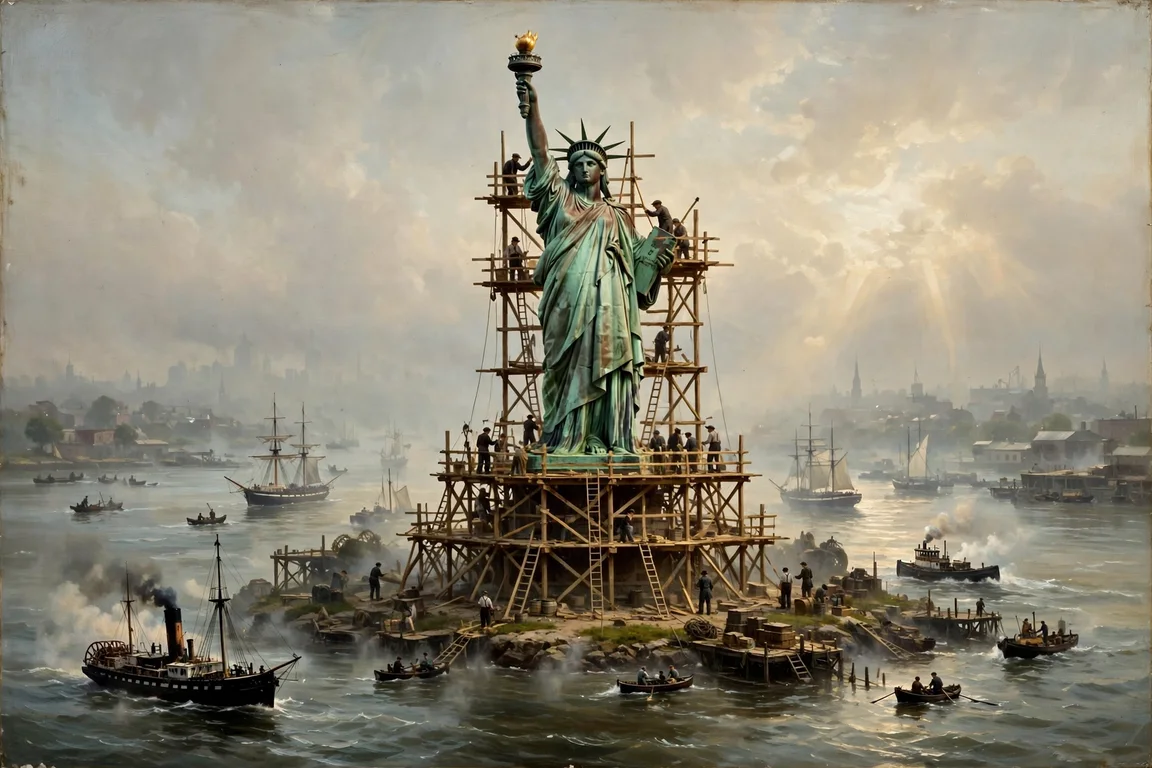
🖼️ 1886, NEW YORK HARBOR: THE STATUE OF LIBERTY STILL PARTLY IN SCAFFOLDING AS HER RAISED TORCH AND CROWN ARE COMPLETED, WORKMEN ON THE SCAFFOLD, SHIPS BELOW, MORNING HAZE · New York Harbor, 1886 — Liberty still in scaffolding, her torch and crown rising above the harbor in morning haze.
A Convention to discuss the SOCIAL, CIVIL, AND RELIGIOUS CONDITION OF WOMAN, was called by the Women of Seneca County, N.Y., and held at the village of Seneca Falls, in the Wesleyan Chapel, on the 19th and 20th of July, 1848.
The question was discussed throughout two entire days: the first day by women exclusively, the second day men participated in the deliberations. LUCRETIA MOTT, of Philadelphia, was the moving spirit of the occasion.
On the morning of the 19th, the Convention assembled at 11 o'clock. The meeting was organized by appointing MARY M'CLINTOCK Secretary. The object of the meeting was then stated by ELIZABETH C. STANTON; after which, remarks were made by LUCRETIA MOTT, urging the women present to throw aside the trammels of education, and not allow their new position to prevent them from joining in the debates of the meeting. The Declaration of Sentiments, offered for the acceptance of the Convention, was then read by E. C. STANTON. A proposition was made to have it re-read by paragraph, and after much consideration, some changes were suggested and adopted. The propriety of obtaining the signatures of men to the Declaration was discussed in an animated manner: a vote in favor was given; but concluding that the final decision would be the legitimate business of the next day, it was referred.
Adjourned to half-past two.
In the afternoon, the meeting assembled according to adjournment, and was opened by reading the minutes of the morning session. E. C. STANTON then addressed the meeting, and was followed by LUCRETIA MOTT. The reading of the Declaration was called for, an addition having been inserted since the morning session. A vote taken upon the amendment was carried, and papers circulated to obtain signatures. The following resolutions were then read:
Whereas, the great precept of nature is conceded to be; "that man shall pursue his own true and substantial happiness." Blackstone, in his Commentaries, remarks, that this law of Nature being coeval with mankind, and dictated by God himself, is of course superior in obligation to any other. It is binding over all the globe, in all countries, and at all times; no human laws are of any validity if contrary to this, and such of them as are valid, derive all their force, and all their validity, and all their authority, mediately and immediately, from this original; Therefore,
Resolved, That such laws as conflict, in any way, with the true and substantial happiness of woman, are contrary to the great precept of nature, and of no validity; for this is "superior in obligation to any other."
Resolved, That all laws which prevent woman from occupying such a station in society as her conscience shall dictate, or which place her in a position inferior to that of man, are contrary to the great precept of nature, and therefore of no force or authority.
Resolved, That woman is man's equal--was intended to be so by the Creator, and the highest good of the race demands that she should be recognized as such.
Resolved, That the women of this country ought to be enlightened in regard to the laws under which they live, that they may no longer publish their degradation, by declaring themselves satisfied with their present position, not their ignorance, by asserting that they have all the rights they want.
Resolved, That inasmuch as man, while claiming for himself intellectual superiority, does accord to woman moral superiority, it is pre-eminently his duty to encourage her to speak, and teach as she has an opportunity, in all religious assemblies.
Resolved, That the same amount of virtue, delicacy, and refinement of behavior, that is required of woman in the social state, should also be required of man, and the same transgressions should be visited with equal severity on both man and woman.
Resolved, That the objection of indelicacy and impropriety, which is so often brought against woman when she addresses a public audience, comes with a very ill grace from those who encourage, by their attendance, her appearance on the stage, in the concert, or in the feats of the circus.
Resolved, That woman has too long rested satisfied in the circumscribed limits which corrupt customs and a perverted application of the Scriptures have marked out for her, and that it is time she should move in the enlarged sphere which her great Creator has assigned her.
Resolved, That it is the duty of the women of this country to secure to themselves their sacred right to the elective franchise.
Resolved, That the equality of human rights results necessarily from the fact of the identity of the race in capabilities and responsibilities.
Resolved, Therefore, That, being invested by the Creator with the same capabilities, and the same consciousness of responsibility for their exercise, it is demonstrably the right and duty of woman, equally with man, to promote every righteous cause, by every righteous means; and especially in regard to the great subjects of morals and religion, it is self-evidently her right to participate with her brother in teaching them, both in private and in public, by writing and by speaking, by any instrumentalities proper to be used, and in any assemblies proper to be held; and this being a self-evident truth, growing out of the divinely implanted principles of human nature, any custom or authority adverse to it, whether modern or wearing the hoary sanction of antiquity, is to be regarded as self-evident falsehood, and at war with the interests of mankind.
LUCRETIA MOTT read a humorous article from a newspaper, written by MARTHA C. WRIGHT. After an address by E. W. M'CLINTOCK, the meeting adjourned to 10 o'clock the next morning.
In the evening, LUCRETIA MOTT spoke with her usual eloquence and power to a large and intelligent audience on the subject of Reforms in general.
The Convention assembled at the hour appointed, JAMES MOTT, of Philadelphia, in the Chair. The minutes of the previous day having been read, E. C. STANTON again read the Declaration of Sentiments, which was freely discussed by LUCRETIA MOTT, ANSEL BASCOM, S. E. WOODWORTH, THOMAS AND MARY ANN M'CLINTOCK, FREDERICK DOUGLASS, AMY POST, CATHARINE STEBBINS, AND ELIZABETH C. STANTON, and was unanimously adopted, as follows:
When, in the course of human events, it becomes necessary for one portion of the family of man to assume among the people of the earth a position different from that which they have hitherto occupied, but one to which the laws of nature and of nature's God entitle them, a decent respect to the opinions of mankind requires that they should declare the causes that impel them to such a course.
We hold these truths to be self-evident; that all men and women are created equal; that they are endowed by their Creator with certain inalienable rights; that among these are life, liberty, and the pursuit of happiness; that to secure these rights governments are instituted, deriving their just powers from the consent of the governed. Whenever any form of Government becomes destructive of these ends, it is the right of those who suffer from it to refuse allegiance to it, and to insist upon the institution of a new government, laying its foundation on such principles, and organizing its powers in such form as to them shall seem most likely to effect their safety and happiness. Prudence, indeed, will dictate that governments long established should not be changed for light and transient causes; and accordingly, all experience hath shown that mankind are more disposed to suffer, while evils are sufferable, than to right themselves, by abolishing the forms to which they are accustomed. But when a long train of abuses and usurpations, pursuing invariably the same object, evinces a design to reduce them under absolute despotism, it is their duty to throw off such government, and to provide new guards for their future security. Such has been the patient sufferance of the women under this government, and such is now the necessity which constrains them to demand the equal station to which they are entitled.
The history of mankind is a history of repeated injuries and usurpations on the part of man toward woman, having in direct object the establishment of an absolute tyranny over her. To prove this, let facts be submitted to a candid world.
He has never permitted her to exercise her inalienable right to the elective franchise.
He has compelled her to submit to laws, in the formation of which she had no voice.
He has withheld from her rights which are given to the most ignorant and degraded men - both natives and foreigners.
Having deprived her of this first right of a citizen, the elective franchise, thereby leaving her without representation in the halls of legislation, he has oppressed her on all sides.
He has made her, if married, in the eye of the law, civilly dead.
He has taken from her all right in property, even to the wages she earns.
He has made her, morally, an irresponsible being, as she can commit many crimes, with impunity, provided they be done in the presence of her husband. In the covenant of marriage, she is compelled to promise obedience to her husband, he becoming, to all intents and purposes, her master - the law giving him power to deprive her of her liberty, and to administer chastisement.
He has so framed the laws of divorce, as to what shall be the proper causes of divorce; in case of separation, to whom the guardianship of the children shall be given, as to be wholly regardless of the happiness of women - the law, in all cases, going upon the false supposition of the supremacy of man, and giving all power into his hands.
After depriving her of all rights as a married woman, if single and the owner of property, he has taxed her to support a government which recognizes her only when her property can be made profitable to it.
He has monopolized nearly all the profitable employments, and from those she is permitted to follow, she receives but a scanty remuneration.
He closes against her all the avenues to wealth and distinction, which he considers most honorable to himself. As a teacher of theology, medicine, or law, she is not known.
He has denied her the facilities for obtaining a thorough education - all colleges being closed against her.
He allows her in Church as well as State, but a subordinate position, claiming Apostolic authority for her exclusion from the ministry, and with some exceptions, from any public participation in the affairs of the Church.
He has created a false public sentiment, by giving to the world a different code of morals for men and women, by which moral delinquencies which exclude women from society, are not only tolerated but deemed of little account in man.
He has usurped the prerogative of Jehovah himself, claiming it as his right to assign for her a sphere of action, when that belongs to her conscience and her God.
He has endeavored, in every way that he could to destroy her confidence in her own powers, to lessen her self-respect, and to make her willing to lead a dependent and abject life.
Now, in view of this entire disfranchisement of one-half the people of this country, their social and religious degradation, - in view of the unjust laws above mentioned, and because women do feel themselves aggrieved, oppressed, and fraudulently deprived of their most sacred rights, we insist that they have immediate admission to all the rights and privileges which belong to them as citizens of these United States.
In entering upon the great work before us, we anticipate no small amount of misconception, misrepresentation, and ridicule; but we shall use every instrumentality within our power to effect our object. We shall employ agents, circulate tracts, petition the State and national Legislatures, and endeavor to enlist the pulpit and the press in our behalf. We hope this Convention will be followed by a series of Conventions, embracing every part of the country.
Firmly relying upon the final triumph of the Right and the True, we do this day affix our signatures to this declaration.
Lucretia Mott
Harriet Cady Eaton
Margaret Pryor
Elizabeth Cady Stanton
Eunice Newton Foote
Mary Ann M'Clintock
Margaret Schooley
Martha C. Wright
Jane C. Hunt
Amy Post
Catharine F. Stebbins
Mary Ann Frink
Lydia Mount
Delia Mathews
Catharine C. Paine
Elizabeth W. M'Clintock
Malvina Seymour
Phebe Mosher
Catharine Shaw
Deborah Scott
Sarah Hallowell
Mary M'Clintock
Mary Gilbert
Sophrone Taylor
Cynthia Davis
Hannah Plant
Lucy Jones
Sarah Whitney
Mary H. Hallowell
Elizabeth Conklin
Sally Pitcher
Mary Conklin
Susan Quinn
Mary S. Mirror
Phebe King
Julia Ann Drake
Charlotte Woodward
Martha Underhill
Dorothy Mathews
Eunice Barker
Sarah R. Woods
Lydia Gild
Sarah Hoffman
Elizabeth Leslie
Martha Ridley
Rachel D. Bonnel
Betsey Tewksbury
Rhoda Palmer
Margaret Jenkins
Cynthia Fuller
Mary Martin
P. A. Culvert
Susan R. Doty
Rebecca Race
Sarah A. Mosher
Mary E. Vail
Lucy Spalding
Lavinia Latham
Sarah Smith
Eliza Martin
Maria E. Wilbur
Elizabeth D. Smith
Caroline Barker
Ann Porter
Experience Gibbs
Antoinette E. Segur
Hannah J. Latham
Sarah Sisson
The following are the names of the gentlemen present in favor of the movement:
Richard P. Hunt
Samuel D. Tillman
Justin Williams
Elisha Foote
Frederick Douglass
Henry Seymour
Henry W. Seymour
David Spalding
William G. Barker
Elias J. Doty
John Jones
William S. Dell
James Mott
William Burroughs
Robert Smallbridge
Jacob Mathews
Charles L. Hoskins
Thomas M'Clintock
Saron Phillips
Jacob P. Chamberlain
Jonathan Metcalf
Nathan J. Milliken
S.E. Woodworth
Edward F. Underhill
George W. Pryor
Joel D. Bunker
Isaac Van Tassel
Thomas Dell
E. W. Capron
Stephen Shear
Henry Hatley
Azaliah Schooley
The meeting adjourned until two o'clock.
At the appointed hour the meeting convened. The minutes having been read, the resolutions of the day before were read and taken up separately. Some, from their self-evident truth, elicited but little remark; others, after some criticism, much debate, and some slight alterations, were finally passed by a large majority. The meeting closed with a forcible speech from LUCRETIA MOTT.
Adjourned to half-past seven o'clock.
The meeting opened by reading the minutes, E. C. STANTON volunteered an address in defence of the many severe accusations brought against the much-abused "Lords of Creation."
THOMAS M'CLINTOCK then read several extracts from Blackstone, in proof of woman's servitude to man; after which LUCRETIA MOTT offered and spoke to the following resolution: Resolved, That the speedy success of our cause depends upon the zealous and untiring efforts of both men and women, for the overthrow of the monopoly of the pulpit, and for the securing to woman an equal participation with men in the various trades, professions, and commerce.
The Resolution was adopted.
M. A. M'CLINTOCK, JR. delivered a short, but impressive address, calling upon woman to arouse from her lethargy and be true to herself and her God. When she had concluded, FREDERICK DOUGLASS arose, and in an excellent and appropriate speech, ably supported the cause of woman.
The meeting was closed by one of LUCRETIA MOTT'S most beautiful and spiritual appeals. She commanded the earnest attention of that large audience for nearly an hour.
M. A. M'CLINTOCK, E. N. FOOTE, AMY POST, E. W. M'CLINTOCK, AND E. C. STANTON, were appointed a Committee to prepare the proceedings of the Convention for publication.
DECLARATION OF SENTIMENTS AND RESOLUTIONS (1848) — public domain. Text via the National Park Service printing of the 1848 Report.
© 2026 Eternity Gravestones LLC — this edition’s presentation only. All Rights Reserved.
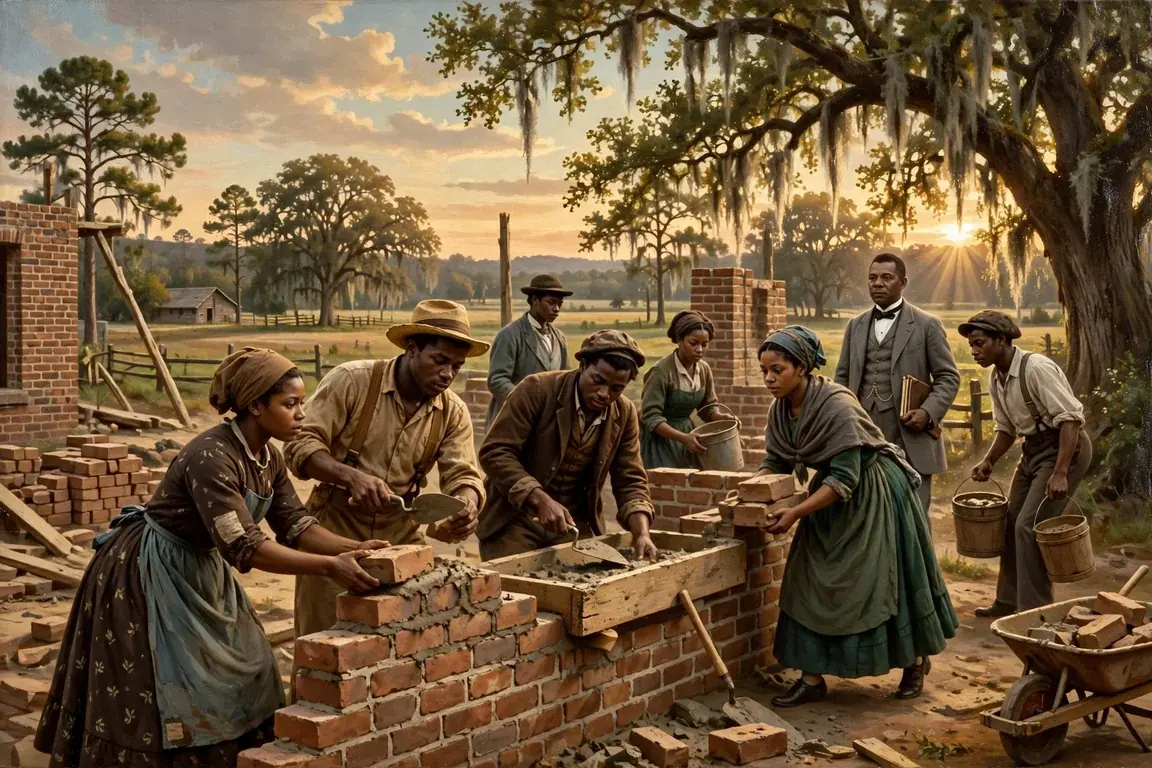
🖼️ 1880S ALABAMA: BLACK STUDENTS AT TUSKEGEE RAISING A BRICK SCHOOL BUILDING WITH THEIR OWN HANDS, BRICKS STACKED IN EVENING SUN, BOOKER T. WASHINGTON'S SCHOOL BUILT BY ITS STUDENTS · Tuskegee, Alabama, 1880s — Students raise their own brick schoolhouse by hand, brick by brick, in the evening sun.
I was born a slave on a plantation in Franklin County, Virginia. I am not quite sure of the exact place or exact date of my birth, but at any rate I suspect I must have been born somewhere and at some time. As nearly as I have been able to learn, I was born near a cross-roads post-office called Hale’s Ford, and the year was 1858 or 1859. I do not know the month or the day. The earliest impressions I can now recall are of the plantation and the slave quarters—the latter being the part of the plantation where the slaves had their cabins.
My life had its beginning in the midst of the most miserable, desolate, and discouraging surroundings. This was so, however, not because my owners were especially cruel, for they were not, as compared with many others. I was born in a typical log cabin, about fourteen by sixteen feet square. In this cabin I lived with my mother and a brother and sister till after the Civil War, when we were all declared free.
Of my ancestry I know almost nothing. In the slave quarters, and even later, I heard whispered conversations among the coloured people of the tortures which the slaves, including, no doubt, my ancestors on my mother’s side, suffered in the middle passage of the slave ship while being conveyed from Africa to America. I have been unsuccessful in securing any information that would throw any accurate light upon the history of my family beyond my mother. She, I remember, had a half-brother and a half-sister. In the days of slavery not very much attention was given to family history and family records—that is, black family records. My mother, I suppose, attracted the attention of a purchaser who was afterward my owner and hers. Her addition to the slave family attracted about as much attention as the purchase of a new horse or cow. Of my father I know even less than of my mother. I do not even know his name. I have heard reports to the effect that he was a white man who lived on one of the near-by plantations. Whoever he was, I never heard of his taking the least interest in me or providing in any way for my rearing. But I do not find especial fault with him. He was simply another unfortunate victim of the institution which the Nation unhappily had engrafted upon it at that time.
The cabin was not only our living-place, but was also used as the kitchen for the plantation. My mother was the plantation cook. The cabin was without glass windows; it had only openings in the side which let in the light, and also the cold, chilly air of winter. There was a door to the cabin—that is, something that was called a door—but the uncertain hinges by which it was hung, and the large cracks in it, to say nothing of the fact that it was too small, made the room a very uncomfortable one. In addition to these openings there was, in the lower right-hand corner of the room, the “cat-hole,”—a contrivance which almost every mansion or cabin in Virginia possessed during the ante-bellum period. The “cat-hole” was a square opening, about seven by eight inches, provided for the purpose of letting the cat pass in and out of the house at will during the night. In the case of our particular cabin I could never understand the necessity for this convenience, since there were at least a half-dozen other places in the cabin that would have accommodated the cats. There was no wooden floor in our cabin, the naked earth being used as a floor. In the centre of the earthen floor there was a large, deep opening covered with boards, which was used as a place in which to store sweet potatoes during the winter. An impression of this potato-hole is very distinctly engraved upon my memory, because I recall that during the process of putting the potatoes in or taking them out I would often come into possession of one or two, which I roasted and thoroughly enjoyed. There was no cooking-stove on our plantation, and all the cooking for the whites and slaves my mother had to do over an open fireplace, mostly in pots and “skillets.” While the poorly built cabin caused us to suffer with cold in the winter, the heat from the open fireplace in summer was equally trying.
The early years of my life, which were spent in the little cabin, were not very different from those of thousands of other slaves. My mother, of course, had little time in which to give attention to the training of her children during the day. She snatched a few moments for our care in the early morning before her work began, and at night after the day’s work was done. One of my earliest recollections is that of my mother cooking a chicken late at night, and awakening her children for the purpose of feeding them. How or where she got it I do not know. I presume, however, it was procured from our owner’s farm. Some people may call this theft. If such a thing were to happen now, I should condemn it as theft myself. But taking place at the time it did, and for the reason that it did, no one could ever make me believe that my mother was guilty of thieving. She was simply a victim of the system of slavery. I cannot remember having slept in a bed until after our family was declared free by the Emancipation Proclamation. Three children—John, my older brother, Amanda, my sister, and myself—had a pallet on the dirt floor, or, to be more correct, we slept in and on a bundle of filthy rags laid upon the dirt floor.
I was asked not long ago to tell something about the sports and pastimes that I engaged in during my youth. Until that question was asked it had never occurred to me that there was no period of my life that was devoted to play. From the time that I can remember anything, almost every day of my life had been occupied in some kind of labour; though I think I would now be a more useful man if I had had time for sports. During the period that I spent in slavery I was not large enough to be of much service, still I was occupied most of the time in cleaning the yards, carrying water to the men in the fields, or going to the mill to which I used to take the corn, once a week, to be ground. The mill was about three miles from the plantation. This work I always dreaded. The heavy bag of corn would be thrown across the back of the horse, and the corn divided about evenly on each side; but in some way, almost without exception, on these trips, the corn would so shift as to become unbalanced and would fall off the horse, and often I would fall with it. As I was not strong enough to reload the corn upon the horse, I would have to wait, sometimes for many hours, till a chance passer-by came along who would help me out of my trouble. The hours while waiting for some one were usually spent in crying. The time consumed in this way made me late in reaching the mill, and by the time I got my corn ground and reached home it would be far into the night. The road was a lonely one, and often led through dense forests. I was always frightened. The woods were said to be full of soldiers who had deserted from the army, and I had been told that the first thing a deserter did to a Negro boy when he found him alone was to cut off his ears. Besides, when I was late in getting home I knew I would always get a severe scolding or a flogging.
I had no schooling whatever while I was a slave, though I remember on several occasions I went as far as the schoolhouse door with one of my young mistresses to carry her books. The picture of several dozen boys and girls in a schoolroom engaged in study made a deep impression upon me, and I had the feeling that to get into a schoolhouse and study in this way would be about the same as getting into paradise.
So far as I can now recall, the first knowledge that I got of the fact that we were slaves, and that freedom of the slaves was being discussed, was early one morning before day, when I was awakened by my mother kneeling over her children and fervently praying that Lincoln and his armies might be successful, and that one day she and her children might be free. In this connection I have never been able to understand how the slaves throughout the South, completely ignorant as were the masses so far as books or newspapers were concerned, were able to keep themselves so accurately and completely informed about the great National questions that were agitating the country. From the time that Garrison, Lovejoy, and others began to agitate for freedom, the slaves throughout the South kept in close touch with the progress of the movement. Though I was a mere child during the preparation for the Civil War and during the war itself, I now recall the many late-at-night whispered discussions that I heard my mother and the other slaves on the plantation indulge in. These discussions showed that they understood the situation, and that they kept themselves informed of events by what was termed the “grape-vine” telegraph.
During the campaign when Lincoln was first a candidate for the Presidency, the slaves on our far-off plantation, miles from any railroad or large city or daily newspaper, knew what the issues involved were. When war was begun between the North and the South, every slave on our plantation felt and knew that, though other issues were discussed, the primal one was that of slavery. Even the most ignorant members of my race on the remote plantations felt in their hearts, with a certainty that admitted of no doubt, that the freedom of the slaves would be the one great result of the war, if the Northern armies conquered. Every success of the Federal armies and every defeat of the Confederate forces was watched with the keenest and most intense interest. Often the slaves got knowledge of the results of great battles before the white people received it. This news was usually gotten from the coloured man who was sent to the post-office for the mail. In our case the post-office was about three miles from the plantation, and the mail came once or twice a week. The man who was sent to the office would linger about the place long enough to get the drift of the conversation from the group of white people who naturally congregated there, after receiving their mail, to discuss the latest news. The mail-carrier on his way back to our master’s house would as naturally retail the news that he had secured among the slaves, and in this way they often heard of important events before the white people at the “big house,” as the master’s house was called.
I cannot remember a single instance during my childhood or early boyhood when our entire family sat down to the table together, and God’s blessing was asked, and the family ate a meal in a civilized manner. On the plantation in Virginia, and even later, meals were gotten by the children very much as dumb animals get theirs. It was a piece of bread here and a scrap of meat there. It was a cup of milk at one time and some potatoes at another. Sometimes a portion of our family would eat out of the skillet or pot, while some one else would eat from a tin plate held on the knees, and often using nothing but the hands with which to hold the food. When I had grown to sufficient size, I was required to go to the “big house” at meal-times to fan the flies from the table by means of a large set of paper fans operated by a pulley. Naturally much of the conversation of the white people turned upon the subject of freedom and the war, and I absorbed a good deal of it. I remember that at one time I saw two of my young mistresses and some lady visitors eating ginger-cakes, in the yard. At that time those cakes seemed to me to be absolutely the most tempting and desirable things that I had ever seen; and I then and there resolved that, if I ever got free, the height of my ambition would be reached if I could get to the point where I could secure and eat ginger-cakes in the way that I saw those ladies doing.
Of course as the war was prolonged the white people, in many cases, often found it difficult to secure food for themselves. I think the slaves felt the deprivation less than the whites, because the usual diet for slaves was corn bread and pork, and these could be raised on the plantation; but coffee, tea, sugar, and other articles which the whites had been accustomed to use could not be raised on the plantation, and the conditions brought about by the war frequently made it impossible to secure these things. The whites were often in great straits. Parched corn was used for coffee, and a kind of black molasses was used instead of sugar. Many times nothing was used to sweeten the so-called tea and coffee.
The first pair of shoes that I recall wearing were wooden ones. They had rough leather on the top, but the bottoms, which were about an inch thick, were of wood. When I walked they made a fearful noise, and besides this they were very inconvenient, since there was no yielding to the natural pressure of the foot. In wearing them one presented an exceedingly awkward appearance. The most trying ordeal that I was forced to endure as a slave boy, however, was the wearing of a flax shirt. In the portion of Virginia where I lived it was common to use flax as part of the clothing for the slaves. That part of the flax from which our clothing was made was largely the refuse, which of course was the cheapest and roughest part. I can scarcely imagine any torture, except, perhaps, the pulling of a tooth, that is equal to that caused by putting on a new flax shirt for the first time. It is almost equal to the feeling that one would experience if he had a dozen or more chestnut burrs, or a hundred small pin-points, in contact with his flesh. Even to this day I can recall accurately the tortures that I underwent when putting on one of these garments. The fact that my flesh was soft and tender added to the pain. But I had no choice. I had to wear the flax shirt or none; and had it been left to me to choose, I should have chosen to wear no covering. In connection with the flax shirt, my brother John, who is several years older than I am, performed one of the most generous acts that I ever heard of one slave relative doing for another. On several occasions when I was being forced to wear a new flax shirt, he generously agreed to put it on in my stead and wear it for several days, till it was “broken in.” Until I had grown to be quite a youth this single garment was all that I wore.
One may get the idea, from what I have said, that there was bitter feeling toward the white people on the part of my race, because of the fact that most of the white population was away fighting in a war which would result in keeping the Negro in slavery if the South was successful. In the case of the slaves on our place this was not true, and it was not true of any large portion of the slave population in the South where the Negro was treated with anything like decency. During the Civil War one of my young masters was killed, and two were severely wounded. I recall the feeling of sorrow which existed among the slaves when they heard of the death of “Mars’ Billy.” It was no sham sorrow, but real. Some of the slaves had nursed “Mars’ Billy”; others had played with him when he was a child. “Mars’ Billy” had begged for mercy in the case of others when the overseer or master was thrashing them. The sorrow in the slave quarter was only second to that in the “big house.” When the two young masters were brought home wounded, the sympathy of the slaves was shown in many ways. They were just as anxious to assist in the nursing as the family relatives of the wounded. Some of the slaves would even beg for the privilege of sitting up at night to nurse their wounded masters. This tenderness and sympathy on the part of those held in bondage was a result of their kindly and generous nature. In order to defend and protect the women and children who were left on the plantations when the white males went to war, the slaves would have laid down their lives. The slave who was selected to sleep in the “big house” during the absence of the males was considered to have the place of honour. Any one attempting to harm “young Mistress” or “old Mistress” during the night would have had to cross the dead body of the slave to do so. I do not know how many have noticed it, but I think that it will be found to be true that there are few instances, either in slavery or freedom, in which a member of my race has been known to betray a specific trust.
As a rule, not only did the members of my race entertain no feelings of bitterness against the whites before and during the war, but there are many instances of Negroes tenderly caring for their former masters and mistresses who for some reason have become poor and dependent since the war. I know of instances where the former masters of slaves have for years been supplied with money by their former slaves to keep them from suffering. I have known of still other cases in which the former slaves have assisted in the education of the descendants of their former owners. I know of a case on a large plantation in the South in which a young white man, the son of the former owner of the estate, has become so reduced in purse and self-control by reason of drink that he is a pitiable creature; and yet, notwithstanding the poverty of the coloured people themselves on this plantation, they have for years supplied this young white man with the necessities of life. One sends him a little coffee or sugar, another a little meat, and so on. Nothing that the coloured people possess is too good for the son of “old Mars’ Tom,” who will perhaps never be permitted to suffer while any remain on the place who knew directly or indirectly of “old Mars’ Tom.”
I have said that there are few instances of a member of my race betraying a specific trust. One of the best illustrations of this which I know of is in the case of an ex-slave from Virginia whom I met not long ago in a little town in the state of Ohio. I found that this man had made a contract with his master, two or three years previous to the Emancipation Proclamation, to the effect that the slave was to be permitted to buy himself, by paying so much per year for his body; and while he was paying for himself, he was to be permitted to labour where and for whom he pleased. Finding that he could secure better wages in Ohio, he went there. When freedom came, he was still in debt to his master some three hundred dollars. Notwithstanding that the Emancipation Proclamation freed him from any obligation to his master, this black man walked the greater portion of the distance back to where his old master lived in Virginia, and placed the last dollar, with interest, in his hands. In talking to me about this, the man told me that he knew that he did not have to pay the debt, but that he had given his word to the master, and his word he had never broken. He felt that he could not enjoy his freedom till he had fulfilled his promise.
From some things that I have said one may get the idea that some of the slaves did not want freedom. This is not true. I have never seen one who did not want to be free, or one who would return to slavery.
I pity from the bottom of my heart any nation or body of people that is so unfortunate as to get entangled in the net of slavery. I have long since ceased to cherish any spirit of bitterness against the Southern white people on account of the enslavement of my race. No one section of our country was wholly responsible for its introduction, and, besides, it was recognized and protected for years by the General Government. Having once got its tentacles fastened on to the economic and social life of the Republic, it was no easy matter for the country to relieve itself of the institution. Then, when we rid ourselves of prejudice, or racial feeling, and look facts in the face, we must acknowledge that, notwithstanding the cruelty and moral wrong of slavery, the ten million Negroes inhabiting this country, who themselves or whose ancestors went through the school of American slavery, are in a stronger and more hopeful condition, materially, intellectually, morally, and religiously, than is true of an equal number of black people in any other portion of the globe. This is so to such an extent that Negroes in this country, who themselves or whose forefathers went through the school of slavery, are constantly returning to Africa as missionaries to enlighten those who remained in the fatherland. This I say, not to justify slavery—on the other hand, I condemn it as an institution, as we all know that in America it was established for selfish and financial reasons, and not from a missionary motive—but to call attention to a fact, and to show how Providence so often uses men and institutions to accomplish a purpose. When persons ask me in these days how, in the midst of what sometimes seem hopelessly discouraging conditions, I can have such faith in the future of my race in this country, I remind them of the wilderness through which and out of which, a good Providence has already led us.
Ever since I have been old enough to think for myself, I have entertained the idea that, notwithstanding the cruel wrongs inflicted upon us, the black man got nearly as much out of slavery as the white man did. The hurtful influences of the institution were not by any means confined to the Negro. This was fully illustrated by the life upon our own plantation. The whole machinery of slavery was so constructed as to cause labour, as a rule, to be looked upon as a badge of degradation, of inferiority. Hence labour was something that both races on the slave plantation sought to escape. The slave system on our place, in a large measure, took the spirit of self-reliance and self-help out of the white people. My old master had many boys and girls, but not one, so far as I know, ever mastered a single trade or special line of productive industry. The girls were not taught to cook, sew, or to take care of the house. All of this was left to the slaves. The slaves, of course, had little personal interest in the life of the plantation, and their ignorance prevented them from learning how to do things in the most improved and thorough manner. As a result of the system, fences were out of repair, gates were hanging half off the hinges, doors creaked, window-panes were out, plastering had fallen but was not replaced, weeds grew in the yard. As a rule, there was food for whites and blacks, but inside the house, and on the dining-room table, there was wanting that delicacy and refinement of touch and finish which can make a home the most convenient, comfortable, and attractive place in the world. Withal there was a waste of food and other materials which was sad. When freedom came, the slaves were almost as well fitted to begin life anew as the master, except in the matter of book-learning and ownership of property. The slave owner and his sons had mastered no special industry. They unconsciously had imbibed the feeling that manual labour was not the proper thing for them. On the other hand, the slaves, in many cases, had mastered some handicraft, and none were ashamed, and few unwilling, to labour.
Finally the war closed, and the day of freedom came. It was a momentous and eventful day to all upon our plantation. We had been expecting it. Freedom was in the air, and had been for months. Deserting soldiers returning to their homes were to be seen every day. Others who had been discharged, or whose regiments had been paroled, were constantly passing near our place. The “grape-vine telegraph” was kept busy night and day. The news and mutterings of great events were swiftly carried from one plantation to another. In the fear of “Yankee” invasions, the silverware and other valuables were taken from the “big house,” buried in the woods, and guarded by trusted slaves. Woe be to any one who would have attempted to disturb the buried treasure. The slaves would give the Yankee soldiers food, drink, clothing—anything but that which had been specifically intrusted to their care and honour. As the great day drew nearer, there was more singing in the slave quarters than usual. It was bolder, had more ring, and lasted later into the night. Most of the verses of the plantation songs had some reference to freedom. True, they had sung those same verses before, but they had been careful to explain that the “freedom” in these songs referred to the next world, and had no connection with life in this world. Now they gradually threw off the mask, and were not afraid to let it be known that the “freedom” in their songs meant freedom of the body in this world. The night before the eventful day, word was sent to the slave quarters to the effect that something unusual was going to take place at the “big house” the next morning. There was little, if any, sleep that night. All as excitement and expectancy. Early the next morning word was sent to all the slaves, old and young, to gather at the house. In company with my mother, brother, and sister, and a large number of other slaves, I went to the master’s house. All of our master’s family were either standing or seated on the veranda of the house, where they could see what was to take place and hear what was said. There was a feeling of deep interest, or perhaps sadness, on their faces, but not bitterness. As I now recall the impression they made upon me, they did not at the moment seem to be sad because of the loss of property, but rather because of parting with those whom they had reared and who were in many ways very close to them. The most distinct thing that I now recall in connection with the scene was that some man who seemed to be a stranger (a United States officer, I presume) made a little speech and then read a rather long paper—the Emancipation Proclamation, I think. After the reading we were told that we were all free, and could go when and where we pleased. My mother, who was standing by my side, leaned over and kissed her children, while tears of joy ran down her cheeks. She explained to us what it all meant, that this was the day for which she had been so long praying, but fearing that she would never live to see.
For some minutes there was great rejoicing, and thanksgiving, and wild scenes of ecstasy. But there was no feeling of bitterness. In fact, there was pity among the slaves for our former owners. The wild rejoicing on the part of the emancipated coloured people lasted but for a brief period, for I noticed that by the time they returned to their cabins there was a change in their feelings. The great responsibility of being free, of having charge of themselves, of having to think and plan for themselves and their children, seemed to take possession of them. It was very much like suddenly turning a youth of ten or twelve years out into the world to provide for himself. In a few hours the great questions with which the Anglo-Saxon race had been grappling for centuries had been thrown upon these people to be solved. These were the questions of a home, a living, the rearing of children, education, citizenship, and the establishment and support of churches. Was it any wonder that within a few hours the wild rejoicing ceased and a feeling of deep gloom seemed to pervade the slave quarters? To some it seemed that, now that they were in actual possession of it, freedom was a more serious thing than they had expected to find it. Some of the slaves were seventy or eighty years old; their best days were gone. They had no strength with which to earn a living in a strange place and among strange people, even if they had been sure where to find a new place of abode. To this class the problem seemed especially hard. Besides, deep down in their hearts there was a strange and peculiar attachment to “old Marster” and “old Missus,” and to their children, which they found it hard to think of breaking off. With these they had spent in some cases nearly a half-century, and it was no light thing to think of parting. Gradually, one by one, stealthily at first, the older slaves began to wander from the slave quarters back to the “big house” to have a whispered conversation with their former owners as to the future.
One day, while at work in the coal-mine, I happened to overhear two miners talking about a great school for coloured people somewhere in Virginia. This was the first time that I had ever heard anything about any kind of school or college that was more pretentious than the little coloured school in our town.
In the darkness of the mine I noiselessly crept as close as I could to the two men who were talking. I heard one tell the other that not only was the school established for the members of any race, but the opportunities that it provided by which poor but worthy students could work out all or a part of the cost of a board, and at the same time be taught some trade or industry.
As they went on describing the school, it seemed to me that it must be the greatest place on earth, and not even Heaven presented more attractions for me at that time than did the Hampton Normal and Agricultural Institute in Virginia, about which these men were talking. I resolved at once to go to that school, although I had no idea where it was, or how many miles away, or how I was going to reach it; I remembered only that I was on fire constantly with one ambition, and that was to go to Hampton. This thought was with me day and night.
After hearing of the Hampton Institute, I continued to work for a few months longer in the coal-mine. While at work there, I heard of a vacant position in the household of General Lewis Ruffner, the owner of the salt-furnace and coal-mine. Mrs. Viola Ruffner, the wife of General Ruffner, was a “Yankee” woman from Vermont. Mrs. Ruffner had a reputation all through the vicinity for being very strict with her servants, and especially with the boys who tried to serve her. Few of them remained with her more than two or three weeks. They all left with the same excuse: she was too strict. I decided, however, that I would rather try Mrs. Ruffner’s house than remain in the coal-mine, and so my mother applied to her for the vacant position. I was hired at a salary of $5 per month.
I had heard so much about Mrs. Ruffner’s severity that I was almost afraid to see her, and trembled when I went into her presence. I had not lived with her many weeks, however, before I began to understand her. I soon began to learn that, first of all, she wanted everything kept clean about her, that she wanted things done promptly and systematically, and that at the bottom of everything she wanted absolute honesty and frankness. Nothing must be sloven or slipshod; every door, every fence, must be kept in repair.
I cannot now recall how long I lived with Mrs. Ruffner before going to Hampton, but I think it must have been a year and a half. At any rate, I here repeat what I have said more than once before, that the lessons that I learned in the home of Mrs. Ruffner were as valuable to me as any education I have ever gotten anywhere else. Even to this day I never see bits of paper scattered around a house or in the street that I do not want to pick them up at once. I never see a filthy yard that I do not want to clean it, a paling off of a fence that I do not want to put it on, an unpainted or unwhitewashed house that I do not want to paint or whitewash it, or a button off one’s clothes, or a grease-spot on them or on a floor, that I do not want to call attention to it.
From fearing Mrs. Ruffner I soon learned to look upon her as one of my best friends. When she found that she could trust me she did so implicitly. During the one or two winters that I was with her she gave me an opportunity to go to school for an hour in the day during a portion of the winter months, but most of my studying was done at night, sometimes alone, sometimes under some one whom I could hire to teach me. Mrs. Ruffner always encouraged and sympathized with me in all my efforts to get an education. It was while living with her that I began to get together my first library. I secured a dry-goods box, knocked out one side of it, put some shelves in it, and began putting into it every kind of book that I could get my hands upon, and called it my “library.”
Notwithstanding my success at Mrs. Ruffner’s I did not give up the idea of going to the Hampton Institute. In the fall of 1872 I determined to make an effort to get there, although, as I have stated, I had no definite idea of the direction in which Hampton was, or of what it would cost to go there. I do not think that any one thoroughly sympathized with me in my ambition to go to Hampton unless it was my mother, and she was troubled with a grave fear that I was starting out on a “wild-goose chase.” At any rate, I got only a half-hearted consent from her that I might start. The small amount of money that I had earned had been consumed by my stepfather and the remainder of the family, with the exception of a very few dollars, and so I had very little with which to buy clothes and pay my travelling expenses. My brother John helped me all that he could, but of course that was not a great deal, for his work was in the coal-mine, where he did not earn much, and most of what he did earn went in the direction of paying the household expenses.
Perhaps the thing that touched and pleased me most in connection with my starting for Hampton was the interest that many of the older coloured people took in the matter. They had spent the best days of their lives in slavery, and hardly expected to live to see the time when they would see a member of their race leave home to attend a boarding-school. Some of these older people would give me a nickel, others a quarter, or a handkerchief.
Finally the great day came, and I started for Hampton. I had only a small, cheap satchel that contained a few articles of clothing I could get. My mother at the time was rather weak and broken in health. I hardly expected to see her again, and thus our parting was all the more sad. She, however, was very brave through it all. At that time there were no through trains connecting that part of West Virginia with eastern Virginia. Trains ran only a portion of the way, and the remainder of the distance was travelled by stage-coaches.
The distance from Malden to Hampton is about five hundred miles. I had not been away from home many hours before it began to grow painfully evident that I did not have enough money to pay my fare to Hampton. One experience I shall long remember. I had been travelling over the mountains most of the afternoon in an old-fashion stage-coach, when, late in the evening, the coach stopped for the night at a common, unpainted house called a hotel. All the other passengers except myself were whites. In my ignorance I supposed that the little hotel existed for the purpose of accommodating the passengers who travelled on the stage-coach. The difference that the colour of one’s skin would make I had not thought anything about. After all the other passengers had been shown rooms and were getting ready for supper, I shyly presented myself before the man at the desk. It is true I had practically no money in my pocket with which to pay for bed or food, but I had hoped in some way to beg my way into the good graces of the landlord, for at that season in the mountains of Virginia the weather was cold, and I wanted to get indoors for the night. Without asking as to whether I had any money, the man at the desk firmly refused to even consider the matter of providing me with food or lodging. This was my first experience in finding out what the colour of my skin meant. In some way I managed to keep warm by walking about, and so got through the night. My whole soul was so bent upon reaching Hampton that I did not have time to cherish any bitterness toward the hotel-keeper.
By walking, begging rides both in wagons and in the cars, in some way, after a number of days, I reached the city of Richmond, Virginia, about eighty-two miles from Hampton. When I reached there, tired, hungry, and dirty, it was late in the night. I had never been in a large city, and this rather added to my misery. When I reached Richmond, I was completely out of money. I had not a single acquaintance in the place, and, being unused to city ways, I did not know where to go. I applied at several places for lodging, but they all wanted money, and that was what I did not have. Knowing nothing else better to do, I walked the streets. In doing this I passed by many food-stands where fried chicken and half-moon apple pies were piled high and made to present a most tempting appearance. At that time it seemed to me that I would have promised all that I expected to possess in the future to have gotten hold of one of those chicken legs or one of those pies. But I could not get either of these, nor anything else to eat.
I must have walked the streets till after midnight. At last I became so exhausted that I could walk no longer. I was tired, I was hungry, I was everything but discouraged. Just about the time when I reached extreme physical exhaustion, I came upon a portion of a street where the board sidewalk was considerably elevated. I waited for a few minutes, till I was sure that no passers-by could see me, and then crept under the sidewalk and lay for the night upon the ground, with my satchel of clothing for a pillow. Nearly all night I could hear the tramp of feet over my head. The next morning I found myself somewhat refreshed, but I was extremely hungry, because it had been a long time since I had had sufficient food. As soon as it became light enough for me to see my surroundings I noticed that I was near a large ship, and that this ship seemed to be unloading a cargo of pig iron. I went at once to the vessel and asked the captain to permit me to help unload the vessel in order to get money for food. The captain, a white man, who seemed to be kind-hearted, consented. I worked long enough to earn money for my breakfast, and it seems to me, as I remember it now, to have been about the best breakfast that I have ever eaten.
My work pleased the captain so well that he told me if I desired I could continue working for a small amount per day. This I was very glad to do. I continued working on this vessel for a number of days. After buying food with the small wages I received there was not much left to add on the amount I must get to pay my way to Hampton. In order to economize in every way possible, so as to be sure to reach Hampton in a reasonable time, I continued to sleep under the same sidewalk that gave me shelter the first night I was in Richmond. Many years after that the coloured citizens of Richmond very kindly tendered me a reception at which there must have been two thousand people present. This reception was held not far from the spot where I slept the first night I spent in the city, and I must confess that my mind was more upon the sidewalk that first gave me shelter than upon the recognition, agreeable and cordial as it was.
When I had saved what I considered enough money with which to reach Hampton, I thanked the captain of the vessel for his kindness, and started again. Without any unusual occurrence I reached Hampton, with a surplus of exactly fifty cents with which to begin my education. To me it had been a long, eventful journey; but the first sight of the large, three-story, brick school building seemed to have rewarded me for all that I had undergone in order to reach the place. If the people who gave the money to provide that building could appreciate the influence the sight of it had upon me, as well as upon thousands of other youths, they would feel all the more encouraged to make such gifts. It seemed to me to be the largest and most beautiful building I had ever seen. The sight of it seemed to give me new life. I felt that a new kind of existence had now begun—that life would now have a new meaning. I felt that I had reached the promised land, and I resolved to let no obstacle prevent me from putting forth the highest effort to fit myself to accomplish the most good in the world.
As soon as possible after reaching the grounds of the Hampton Institute, I presented myself before the head teacher for an assignment to a class. Having been so long without proper food, a bath, and a change of clothing, I did not, of course, make a very favourable impression upon her, and I could see at once that there were doubts in her mind about the wisdom of admitting me as a student. I felt that I could hardly blame her if she got the idea that I was a worthless loafer or tramp. For some time she did not refuse to admit me, neither did she decide in my favour, and I continued to linger about her, and to impress her in all the ways I could with my worthiness. In the meantime I saw her admitting other students, and that added greatly to my discomfort, for I felt, deep down in my heart, that I could do as well as they, if I could only get a chance to show what was in me.
After some hours had passed, the head teacher said to me: “The adjoining recitation-room needs sweeping. Take the broom and sweep it.”
It occurred to me at once that here was my chance. Never did I receive an order with more delight. I knew that I could sweep, for Mrs. Ruffner had thoroughly taught me how to do that when I lived with her.
I swept the recitation-room three times. Then I got a dusting-cloth and dusted it four times. All the woodwork around the walls, every bench, table, and desk, I went over four times with my dusting-cloth. Besides, every piece of furniture had been moved and every closet and corner in the room had been thoroughly cleaned. I had the feeling that in a large measure my future depended upon the impression I made upon the teacher in the cleaning of that room. When I was through, I reported to the head teacher. She was a “Yankee” woman who knew just where to look for dirt. She went into the room and inspected the floor and closets; then she took her handkerchief and rubbed it on the woodwork about the walls, and over the table and benches. When she was unable to find one bit of dirt on the floor, or a particle of dust on any of the furniture, she quietly remarked, “I guess you will do to enter this institution.”
I was one of the happiest souls on Earth. The sweeping of that room was my college examination, and never did any youth pass an examination for entrance into Harvard or Yale that gave him more genuine satisfaction. I have passed several examinations since then, but I have always felt that this was the best one I ever passed.
I have spoken of my own experience in entering the Hampton Institute. Perhaps few, if any, had anything like the same experience that I had, but about the same period there were hundreds who found their way to Hampton and other institutions after experiencing something of the same difficulties that I went through. The young men and women were determined to secure an education at any cost.
The sweeping of the recitation-room in the manner that I did it seems to have paved the way for me to get through Hampton. Miss Mary F. Mackie, the head teacher, offered me a position as janitor. This, of course, I gladly accepted, because it was a place where I could work out nearly all the cost of my board. The work was hard and taxing but I stuck to it. I had a large number of rooms to care for, and had to work late into the night, while at the same time I had to rise by four o’clock in the morning, in order to build the fires and have a little time in which to prepare my lessons. In all my career at Hampton, and ever since I have been out in the world, Miss Mary F. Mackie, the head teacher to whom I have referred, proved one of my strongest and most helpful friends. Her advice and encouragement were always helpful in strengthening to me in the darkest hour.
I have spoken of the impression that was made upon me by the buildings and general appearance of the Hampton Institute, but I have not spoken of that which made the greatest and most lasting impression on me, and that was a great man—the noblest, rarest human being that it has ever been my privilege to meet. I refer to the late General Samuel C. Armstrong.
It has been my fortune to meet personally many of what are called great characters, both in Europe and America, but I do not hesitate to say that I never met any man who, in my estimation, was the equal of General Armstrong. Fresh from the degrading influences of the slave plantation and the coal-mines, it was a rare privilege for me to be permitted to come into direct contact with such a character as General Armstrong. I shall always remember that the first time I went into his presence he made the impression upon me of being a perfect man: I was made to feel that there was something about him that was superhuman. It was my privilege to know the General personally from the time I entered Hampton till he died, and the more I saw of him the greater he grew in my estimation. One might have removed from Hampton all the buildings, class-rooms, teachers, and industries, and given the men and women there the opportunity of coming into daily contact with General Armstrong, and that alone would have been a liberal education. The older I grow, the more I am convinced that there is no education which one can get from books and costly apparatus that is equal to that which can be gotten from contact with great men and women. Instead of studying books so constantly, how I wish that our schools and colleges might learn to study men and things!
General Armstrong spent two of the last six months of his life in my home at Tuskegee. At that time he was paralyzed to the extent that he had lost control of his body and voice in a very large degree. Notwithstanding his affliction, he worked almost constantly night and day for the cause to which he had given his life. I never saw a man who so completely lost sight of himself. I do not believe he ever had a selfish thought. He was just as happy in trying to assist some other institution in the South as he was when working for Hampton. Although he fought the Southern white man in the Civil War, I never heard him utter a bitter word against him afterward. On the other hand, he was constantly seeking to find ways by which he could be of service to the Southern whites.
It would be difficult to describe the hold that he had upon the students at Hampton, or the faith they had in him. In fact, he was worshipped by his students. It never occurred to me that General Armstrong could fail in anything that he undertook. There is almost no request that he could have made that would not have been complied with. When he was a guest at my home in Alabama, and was so badly paralyzed that he had to be wheeled about in an invalid’s chair, I recall that one of the General’s former students had occasion to push his chair up a long, steep hill that taxed his strength to the utmost. When the top of the hill was reached, the former pupil, with a glow of happiness on his face, exclaimed, “I am so glad that I have been permitted to do something that was real hard for the General before he dies!” While I was a student at Hampton, the dormitories became so crowded that it was impossible to find room for all who wanted to be admitted. In order to help remedy the difficulty, the General conceived the plan of putting up tents to be used as rooms. As soon as it became known that General Armstrong would be pleased if some of the older students would live in the tents during the winter, nearly every student in school volunteered to go.
I was one of the volunteers. The winter that we spent in those tents was an intensely cold one, and we suffered severely—how much I am sure General Armstrong never knew, because we made no complaints. It was enough for us to know that we were pleasing General Armstrong, and that we were making it possible for an additional number of students to secure an education. More than once, during a cold night, when a stiff gale would be blowing, our tent was lifted bodily, and we would find ourselves in the open air. The General would usually pay a visit to the tents early in the morning, and his earnest, cheerful, encouraging voice would dispel any feeling of despondency.
I have spoken of my admiration for General Armstrong, and yet he was but a type of that Christlike body of men and women who went into the Negro schools at the close of the war by the hundreds to assist in lifting up my race. The history of the world fails to show a higher, purer, and more unselfish class of men and women than those who found their way into those Negro schools.
Life at Hampton was a constant revelation to me; was constantly taking me into a new world. The matter of having meals at regular hours, of eating on a tablecloth, using a napkin, the use of the bath-tub and of the tooth-brush, as well as the use of sheets upon the bed, were all new to me.
I sometimes feel that almost the most valuable lesson I got at the Hampton Institute was in the use and value of the bath. I learned there for the first time some of its value, not only in keeping the body healthy, but in inspiring self-respect and promoting virtue. In all my travels in the South and elsewhere since leaving Hampton I have always in some way sought my daily bath. To get it sometimes when I have been the guest of my own people in a single-roomed cabin has not always been easy to do, except by slipping away to some stream in the woods. I have always tried to teach my people that some provision for bathing should be a part of every house.
For some time, while a student at Hampton, I possessed but a single pair of socks, but when I had worn these till they became soiled, I would wash them at night and hang them by the fire to dry, so that I might wear them again the next morning.
The charge for my board at Hampton was ten dollars per month. I was expected to pay a part of this in cash and to work out the remainder. To meet this cash payment, as I have stated, I had just fifty cents when I reached the institution. Aside from a very few dollars that my brother John was able to send me once in a while, I had no money with which to pay my board. I was determined from the first to make my work as janitor so valuable that my services would be indispensable. This I succeeded in doing to such an extent that I was soon informed that I would be allowed the full cost of my board in return for my work. The cost of tuition was seventy dollars a year. This, of course, was wholly beyond my ability to provide. If I had been compelled to pay the seventy dollars for tuition, in addition to providing for my board, I would have been compelled to leave the Hampton school. General Armstrong, however, very kindly got Mr. S. Griffitts Morgan, of New Bedford, Mass., to defray the cost of my tuition during the whole time that I was at Hampton. After I finished the course at Hampton and had entered upon my lifework at Tuskegee, I had the pleasure of visiting Mr. Morgan several times.
After having been for a while at Hampton, I found myself in difficulty because I did not have books and clothing. Usually, however, I got around the trouble about books by borrowing from those who were more fortunate than myself. As to clothes, when I reached Hampton I had practically nothing. Everything that I possessed was in a small hand satchel. My anxiety about clothing was increased because of the fact that General Armstrong made a personal inspection of the young men in ranks, to see that their clothes were clean. Shoes had to be polished, there must be no buttons off the clothing, and no grease-spots. To wear one suit of clothes continually, while at work and in the schoolroom, and at the same time keep it clean, was rather a hard problem for me to solve. In some way I managed to get on till the teachers learned that I was in earnest and meant to succeed, and then some of them were kind enough to see that I was partly supplied with second-hand clothing that had been sent in barrels from the North. These barrels proved a blessing to hundreds of poor but deserving students. Without them I question whether I should ever have gotten through Hampton.
When I first went to Hampton I do not recall that I had ever slept in a bed that had two sheets on it. In those days there were not many buildings there, and room was very precious. There were seven other boys in the same room with me; most of them, however, students who had been there for some time. The sheets were quite a puzzle to me. The first night I slept under both of them, and the second night I slept on top of them; but by watching the other boys I learned my lesson in this, and have been trying to follow it ever since and to teach it to others.
I was among the youngest of the students who were in Hampton at the time. Most of the students were men and women—some as old as forty years of age. As I now recall the scene of my first year, I do not believe that one often has the opportunity of coming into contact with three or four hundred men and women who were so tremendously in earnest as these men and women were. Every hour was occupied in study or work. Nearly all had had enough actual contact with the world to teach them the need of education. Many of the older ones were, of course, too old to master the text-books very thoroughly, and it was often sad to watch their struggles; but they made up in earnest much of what they lacked in books. Many of them were as poor as I was, and, besides having to wrestle with their books, they had to struggle with a poverty which prevented their having the necessities of life. Many of them had aged parents who were dependent upon them, and some of them were men who had wives whose support in some way they had to provide for.
The great and prevailing idea that seemed to take possession of every one was to prepare himself to lift up the people at his home. No one seemed to think of himself. And the officers and teachers, what a rare set of human beings they were! They worked for the students night and day, in seasons and out of season. They seemed happy only when they were helping the students in some manner. Whenever it is written—and I hope it will be—the part that the Yankee teachers played in the education of the Negroes immediately after the war will make one of the most thrilling parts of the history off this country. The time is not far distant when the whole South will appreciate this service in a way that it has not yet been able to do.
The Atlanta Exposition, at which I had been asked to make an address as a representative of the Negro race, as stated in the last chapter, was opened with a short address from Governor Bullock. After other interesting exercises, including an invocation from Bishop Nelson, of Georgia, a dedicatory ode by Albert Howell, Jr., and addresses by the President of the Exposition and Mrs. Joseph Thompson, the President of the Woman’s Board, Governor Bullock introduce me with the words, “We have with us to-day a representative of Negro enterprise and Negro civilization.”
When I arose to speak, there was considerable cheering, especially from the coloured people. As I remember it now, the thing that was uppermost in my mind was the desire to say something that would cement the friendship of the races and bring about hearty cooperation between them. So far as my outward surroundings were concerned, the only thing that I recall distinctly now is that when I got up, I saw thousands of eyes looking intently into my face. The following is the address which I delivered:—
Mr. President and Gentlemen of the Board of Directors and Citizens.
One-third of the population of the South is of the Negro race. No enterprise seeking the material, civil, or moral welfare of this section can disregard this element of our population and reach the highest success. I but convey to you, Mr. President and Directors, the sentiment of the masses of my race when I say that in no way have the value and manhood of the American Negro been more fittingly and generously recognized than by the managers of this magnificent Exposition at every stage of its progress. It is a recognition that will do more to cement the friendship of the two races than any occurrence since the dawn of our freedom.
Not only this, but the opportunity here afforded will awaken among us a new era of industrial progress. Ignorant and inexperienced, it is not strange that in the first years of our new life we began at the top instead of at the bottom; that a seat in Congress or the state legislature was more sought than real estate or industrial skill; that the political convention or stump speaking had more attractions than starting a dairy farm or truck garden.
A ship lost at sea for many days suddenly sighted a friendly vessel. From the mast of the unfortunate vessel was seen a signal, “Water, water; we die of thirst!” The answer from the friendly vessel at once came back, “Cast down your bucket where you are.” A second time the signal, “Water, water; send us water!” ran up from the distressed vessel, and was answered, “Cast down your bucket where you are.” And a third and fourth signal for water was answered, “Cast down your bucket where you are.” The captain of the distressed vessel, at last heeding the injunction, cast down his bucket, and it came up full of fresh, sparkling water from the mouth of the Amazon River. To those of my race who depend on bettering their condition in a foreign land or who underestimate the importance of cultivating friendly relations with the Southern white man, who is their next-door neighbour, I would say: “Cast down your bucket where you are”—cast it down in making friends in every manly way of the people of all races by whom we are surrounded.
Cast it down in agriculture, mechanics, in commerce, in domestic service, and in the professions. And in this connection it is well to bear in mind that whatever other sins the South may be called to bear, when it comes to business, pure and simple, it is in the South that the Negro is given a man’s chance in the commercial world, and in nothing is this Exposition more eloquent than in emphasizing this chance. Our greatest danger is that in the great leap from slavery to freedom we may overlook the fact that the masses of us are to live by the productions of our hands, and fail to keep in mind that we shall prosper in proportion as we learn to dignify and glorify common labour and put brains and skill into the common occupations of life; shall prosper in proportion as we learn to draw the line between the superficial and the substantial, the ornamental gewgaws of life and the useful. No race can prosper till it learns that there is as much dignity in tilling a field as in writing a poem. It is at the bottom of life we must begin, and not at the top. Nor should we permit our grievances to overshadow our opportunities.
To those of the white race who look to the incoming of those of foreign birth and strange tongue and habits of the prosperity of the South, were I permitted I would repeat what I say to my own race: “Cast down your bucket where you are.” Cast it down among the eight millions of Negroes whose habits you know, whose fidelity and love you have tested in days when to have proved treacherous meant the ruin of your firesides. Cast down your bucket among these people who have, without strikes and labour wars, tilled your fields, cleared your forests, builded your railroads and cities, and brought forth treasures from the bowels of the earth, and helped make possible this magnificent representation of the progress of the South. Casting down your bucket among my people, helping and encouraging them as you are doing on these grounds, and to education of head, hand, and heart, you will find that they will buy your surplus land, make blossom the waste places in your fields, and run your factories. While doing this, you can be sure in the future, as in the past, that you and your families will be surrounded by the most patient, faithful, law-abiding, and unresentful people that the world has seen. As we have proved our loyalty to you in the past, nursing your children, watching by the sick-bed of your mothers and fathers, and often following them with tear-dimmed eyes to their graves, so in the future, in our humble way, we shall stand by you with a devotion that no foreigner can approach, ready to lay down our lives, if need be, in defence of yours, interlacing our industrial, commercial, civil, and religious life with yours in a way that shall make the interests of both races one. In all things that are purely social we can be as separate as the fingers, yet one as the hand in all things essential to mutual progress.
There is no defence or security for any of us except in the highest intelligence and development of all. If anywhere there are efforts tending to curtail the fullest growth of the Negro, let these efforts be turned into stimulating, encouraging, and making him the most useful and intelligent citizen. Effort or means so invested will pay a thousand per cent interest. These efforts will be twice blessed—“blessing him that gives and him that takes.”
There is no escape through law of man or God from the inevitable:—
The laws of changeless justice bind Oppressor with oppressed; And close as sin and suffering joined We march to fate abreast.
Nearly sixteen millions of hands will aid you in pulling the load upward, or they will pull against you the load downward. We shall constitute one-third and more of the ignorance and crime of the South, or one-third its intelligence and progress; we shall contribute one-third to the business and industrial prosperity of the South, or we shall prove a veritable body of death, stagnating, depressing, retarding every effort to advance the body politic.
Gentlemen of the Exposition, as we present to you our humble effort at an exhibition of our progress, you must not expect overmuch. Starting thirty years ago with ownership here and there in a few quilts and pumpkins and chickens (gathered from miscellaneous sources), remember the path that has led from these to the inventions and production of agricultural implements, buggies, steam-engines, newspapers, books, statuary, carving, paintings, the management of drug-stores and banks, has not been trodden without contact with thorns and thistles. While we take pride in what we exhibit as a result of our independent efforts, we do not for a moment forget that our part in this exhibition would fall far short of your expectations but for the constant help that has come to our education life, not only from the Southern states, but especially from Northern philanthropists, who have made their gifts a constant stream of blessing and encouragement.
The wisest among my race understand that the agitation of questions of social equality is the extremest folly, and that progress in the enjoyment of all the privileges that will come to us must be the result of severe and constant struggle rather than of artificial forcing. No race that has anything to contribute to the markets of the world is long in any degree ostracized. It is important and right that all privileges of the law be ours, but it is vastly more important that we be prepared for the exercises of these privileges. The opportunity to earn a dollar in a factory just now is worth infinitely more than the opportunity to spend a dollar in an opera-house.
In conclusion, may I repeat that nothing in thirty years has given us more hope and encouragement, and drawn us so near to you of the white race, as this opportunity offered by the Exposition; and here bending, as it were, over the altar that represents the results of the struggles of your race and mine, both starting practically empty-handed three decades ago, I pledge that in your effort to work out the great and intricate problem which God has laid at the doors of the South, you shall have at all times the patient, sympathetic help of my race; only let this be constantly in mind, that, while from representations in these buildings of the product of field, of forest, of mine, of factory, letters, and art, much good will come, yet far above and beyond material benefits will be that higher good, that, let us pray God, will come, in a blotting out of sectional differences and racial animosities and suspicions, in a determination to administer absolute justice, in a willing obedience among all classes to the mandates of law. This, this, coupled with our material prosperity, will bring into our beloved South a new heaven and a new earth.
The first thing that I remember, after I had finished speaking, was that Governor Bullock rushed across the platform and took me by the hand, and that others did the same. I received so many and such hearty congratulations that I found it difficult to get out of the building. I did not appreciate to any degree, however, the impression which my address seemed to have made, until the next morning, when I went into the business part of the city. As soon as I was recognized, I was surprised to find myself pointed out and surrounded by a crowd of men who wished to shake hands with me. This was kept up on every street on to which I went, to an extent which embarrassed me so much that I went back to my boarding-place. The next morning I returned to Tuskegee. At the station in Atlanta, and at almost all of the stations at which the train stopped between that city and Tuskegee, I found a crowd of people anxious to shake hands with me.
The papers in all parts of the United States published the address in full, and for months afterward there were complimentary editorial references to it. Mr. Clark Howell, the editor of the Atlanta Constitution, telegraphed to a New York paper, among other words, the following, “I do not exaggerate when I say that Professor Booker T. Washington’s address yesterday was one of the most notable speeches, both as to character and as to the warmth of its reception, ever delivered to a Southern audience. The address was a revelation. The whole speech is a platform upon which blacks and whites can stand with full justice to each other.”
The Boston Transcript said editorially: “The speech of Booker T. Washington at the Atlanta Exposition, this week, seems to have dwarfed all the other proceedings and the Exposition itself. The sensation that it has caused in the press has never been equalled.”
I very soon began receiving all kinds of propositions from lecture bureaus, and editors of magazines and papers, to take the lecture platform, and to write articles. One lecture bureau offered me fifty thousand dollars, or two hundred dollars a night and expenses, if I would place my services at its disposal for a given period. To all these communications I replied that my life-work was at Tuskegee; and that whenever I spoke it must be in the interests of Tuskegee school and my race, and that I would enter into no arrangements that seemed to place a mere commercial value upon my services.
Some days after its delivery I sent a copy of my address to the President of the United States, the Hon. Grover Cleveland. I received from him the following autograph reply:—
Gray Gables, Buzzard’s Bay, Mass.,
October 6, 1895.
Booker T. Washington, Esq.:
My Dear Sir: I thank you for sending me a copy of your address delivered at the Atlanta Exposition.
I thank you with much enthusiasm for making the address. I have read it with intense interest, and I think the Exposition would be fully justified if it did not do more than furnish the opportunity for its delivery. Your words cannot fail to delight and encourage all who wish well for your race; and if our coloured fellow-citizens do not from your utterances gather new hope and form new determinations to gain every valuable advantage offered them by their citizenship, it will be strange indeed.
Yours very truly,
Grover Cleveland.
Later I met Mr. Cleveland, for the first time, when, as President, he visited the Atlanta Exposition. At the request of myself and others he consented to spend an hour in the Negro Building, for the purpose of inspecting the Negro exhibit and of giving the coloured people in attendance an opportunity to shake hands with him. As soon as I met Mr. Cleveland I became impressed with his simplicity, greatness, and rugged honesty. I have met him many times since then, both at public functions and at his private residence in Princeton, and the more I see of him the more I admire him. When he visited the Negro Building in Atlanta he seemed to give himself up wholly, for that hour, to the coloured people. He seemed to be as careful to shake hands with some old coloured “auntie” clad partially in rags, and to take as much pleasure in doing so, as if he were greeting some millionaire. Many of the coloured people took advantage of the occasion to get him to write his name in a book or on a slip of paper. He was as careful and patient in doing this as if he were putting his signature to some great state document.
Mr. Cleveland has not only shown his friendship for me in many personal ways, but has always consented to do anything I have asked of him for our school. This he has done, whether it was to make a personal donation or to use his influence in securing the donations of others. Judging from my personal acquaintance with Mr. Cleveland, I do not believe that he is conscious of possessing any colour prejudice. He is too great for that. In my contact with people I find that, as a rule, it is only the little, narrow people who live for themselves, who never read good books, who do not travel, who never open up their souls in a way to permit them to come into contact with other souls—with the great outside world. No man whose vision is bounded by colour can come into contact with what is highest and best in the world. In meeting men, in many places, I have found that the happiest people are those who do the most for others; the most miserable are those who do the least. I have also found that few things, if any, are capable of making one so blind and narrow as race prejudice. I often say to our students, in the course of my talks to them on Sunday evenings in the chapel, that the longer I live and the more experience I have of the world, the more I am convinced that, after all, the one thing that is most worth living for—and dying for, if need be—is the opportunity of making some one else more happy and more useful.
The coloured people and the coloured newspapers at first seemed to be greatly pleased with the character of my Atlanta address, as well as with its reception. But after the first burst of enthusiasm began to die away, and the coloured people began reading the speech in cold type, some of them seemed to feel that they had been hypnotized. They seemed to feel that I had been too liberal in my remarks toward the Southern whites, and that I had not spoken out strongly enough for what they termed the “rights” of my race. For a while there was a reaction, so far as a certain element of my own race was concerned, but later these reactionary ones seemed to have been won over to my way of believing and acting.
While speaking of changes in public sentiment, I recall that about ten years after the school at Tuskegee was established, I had an experience that I shall never forget. Dr. Lyman Abbott, then the pastor of Plymouth Church, and also editor of the Outlook (then the Christian Union), asked me to write a letter for his paper giving my opinion of the exact condition, mental and moral, of the coloured ministers in the South, as based upon my observations. I wrote the letter, giving the exact facts as I conceived them to be. The picture painted was a rather black one—or, since I am black, shall I say “white”? It could not be otherwise with a race but a few years out of slavery, a race which had not had time or opportunity to produce a competent ministry.
What I said soon reached every Negro minister in the country, I think, and the letters of condemnation which I received from them were not few. I think that for a year after the publication of this article every association and every conference or religious body of any kind, of my race, that met, did not fail before adjourning to pass a resolution condemning me, or calling upon me to retract or modify what I had said. Many of these organizations went so far in their resolutions as to advise parents to cease sending their children to Tuskegee. One association even appointed a “missionary” whose duty it was to warn the people against sending their children to Tuskegee. This missionary had a son in the school, and I noticed that, whatever the “missionary” might have said or done with regard to others, he was careful not to take his son away from the institution. Many of the coloured papers, especially those that were the organs of religious bodies, joined in the general chorus of condemnation or demands for retraction.
During the whole time of the excitement, and through all the criticism, I did not utter a word of explanation or retraction. I knew that I was right, and that time and the sober second thought of the people would vindicate me. It was not long before the bishops and other church leaders began to make careful investigation of the conditions of the ministry, and they found out that I was right. In fact, the oldest and most influential bishop in one branch of the Methodist Church said that my words were far too mild. Very soon public sentiment began making itself felt, in demanding a purifying of the ministry. While this is not yet complete by any means, I think I may say, without egotism, and I have been told by many of our most influential ministers, that my words had much to do with starting a demand for the placing of a higher type of men in the pulpit. I have had the satisfaction of having many who once condemned me thank me heartily for my frank words.
The change of the attitude of the Negro ministry, so far as regards myself, is so complete that at the present time I have no warmer friends among any class than I have among the clergymen. The improvement in the character and life of the Negro ministers is one of the most gratifying evidences of the progress of the race. My experience with them, as well as other events in my life, convince me that the thing to do, when one feels sure that he has said or done the right thing, and is condemned, is to stand still and keep quiet. If he is right, time will show it.
In the midst of the discussion which was going on concerning my Atlanta speech, I received the letter which I give below, from Dr. Gilman, the President of Johns Hopkins University, who had been made chairman of the judges of award in connection with the Atlanta Exposition:—
Johns Hopkins University, Baltimore,
President’s Office, September 30, 1895.
Dear Mr. Washington: Would it be agreeable to you to be one of the Judges of Award in the Department of Education at Atlanta? If so, I shall be glad to place your name upon the list. A line by telegraph will be welcomed.
Yours very truly,
D.C. Gilman
I think I was even more surprised to receive this invitation than I had been to receive the invitation to speak at the opening of the Exposition. It was to be a part of my duty, as one of the jurors, to pass not only upon the exhibits of the coloured schools, but also upon those of the white schools. I accepted the position, and spent a month in Atlanta in performance of the duties which it entailed. The board of jurors was a large one, containing in all of sixty members. It was about equally divided between Southern white people and Northern white people. Among them were college presidents, leading scientists and men of letters, and specialists in many subjects. When the group of jurors to which I was assigned met for organization, Mr. Thomas Nelson Page, who was one of the number, moved that I be made secretary of that division, and the motion was unanimously adopted. Nearly half of our division were Southern people. In performing my duties in the inspection of the exhibits of white schools I was in every case treated with respect, and at the close of our labours I parted from my associates with regret.
I am often asked to express myself more freely than I do upon the political condition and the political future of my race. These recollections of my experience in Atlanta give me the opportunity to do so briefly. My own belief is, although I have never before said so in so many words, that the time will come when the Negro in the South will be accorded all the political rights which his ability, character, and material possessions entitle him to. I think, though, that the opportunity to freely exercise such political rights will not come in any large degree through outside or artificial forcing, but will be accorded to the Negro by the Southern white people themselves, and that they will protect him in the exercise of those rights. Just as soon as the South gets over the old feeling that it is being forced by “foreigners,” or “aliens,” to do something which it does not want to do, I believe that the change in the direction that I have indicated is going to begin. In fact, there are indications that it is already beginning in a slight degree.
Let me illustrate my meaning. Suppose that some months before the opening of the Atlanta Exposition there had been a general demand from the press and public platform outside the South that a Negro be given a place on the opening programme, and that a Negro be placed upon the board of jurors of award. Would any such recognition of the race have taken place? I do not think so. The Atlanta officials went as far as they did because they felt it to be a pleasure, as well as a duty, to reward what they considered merit in the Negro race. Say what we will, there is something in human nature which we cannot blot out, which makes one man, in the end, recognize and reward merit in another, regardless of colour or race.
I believe it is the duty of the Negro—as the greater part of the race is already doing—to deport himself modestly in regard to political claims, depending upon the slow but sure influences that proceed from the possession of property, intelligence, and high character for the full recognition of his political rights. I think that the according of the full exercise of political rights is going to be a matter of natural, slow growth, not an over-night, gourd-vine affair. I do not believe that the Negro should cease voting, for a man cannot learn the exercise of self-government by ceasing to vote, any more than a boy can learn to swim by keeping out of the water, but I do believe that in his voting he should more and more be influenced by those of intelligence and character who are his next-door neighbours.
I know coloured men who, through the encouragement, help, and advice of Southern white people, have accumulated thousands of dollars’ worth of property, but who, at the same time, would never think of going to those same persons for advice concerning the casting of their ballots. This, it seems to me, is unwise and unreasonable, and should cease. In saying this I do not mean that the Negro should truckle, or not vote from principle, for the instant he ceases to vote from principle he loses the confidence and respect of the Southern white man even.
I do not believe that any state should make a law that permits an ignorant and poverty-stricken white man to vote, and prevents a black man in the same condition from voting. Such a law is not only unjust, but it will react, as all unjust laws do, in time; for the effect of such a law is to encourage the Negro to secure education and property, and at the same time it encourages the white man to remain in ignorance and poverty. I believe that in time, through the operation of intelligence and friendly race relations, all cheating at the ballot-box in the South will cease. It will become apparent that the white man who begins by cheating a Negro out of his ballot soon learns to cheat a white man out of his, and that the man who does this ends his career of dishonesty by the theft of property or by some equally serious crime. In my opinion, the time will come when the South will encourage all of its citizens to vote. It will see that it pays better, from every standpoint, to have healthy, vigorous life than to have that political stagnation which always results when one-half of the population has no share and no interest in the Government.
As a rule, I believe in universal, free suffrage, but I believe that in the South we are confronted with peculiar conditions that justify the protection of the ballot in many of the states, for a while at least, either by an education test, a property test, or by both combined; but whatever tests are required, they should be made to apply with equal and exact justice to both races.
UP FROM SLAVERY (1901) by Booker T. Washington — public domain. Text via Project Gutenberg eBook #2376 (selections as noted).
© 2026 Eternity Gravestones LLC — this edition’s presentation only. All Rights Reserved.